You can achieve a lot with a well-written professional bio that you might not be able to do with landing pages and marketing campaigns.
Why?
Because your bio has the human touch that most people want to see.
Obviously, that’s not the only reason why a professional bio is an effective way to reach and connect with your target audience.
The real challenge is how to write a professional bio that converts.
This guide is all about it.
What’s a Professional Bio?
A professional bio, or author bio, or biography is a summary of your professional background and experience that you can use on social platforms, blog, website, and pretty much everywhere online.
You can tweak information based on the platform or channel where your bio will be published. It’s highly relative and variable.
For instance, if you are writing a guest post for a B2B blog, you need to add awards and credentials to showcase your expertise and experience (leading to high trust).
Here’s an example of a professional bio:

A professional bio should answer all (or most) of the following questions:
- Who are you?
- What makes you stand out?
- What do you do and what are you an expert in?
- What can you do for the audience/readers?
It’s not a formula, but a proven way to write a professional bio so it addresses these questions precisely.
What to Include in a Professional Bio?
Your bio is the first impression and it should be a lasting one. Here’s what you should include in your bio to help your target audience better understand you:
- Name
- Employer name
- Current position
- Experience
- Education and qualification
- Expertise and major skills
- Major achievements and awards
- Recent achievements
- Personal background
- Professional background
- Links to your website and social media accounts
- Other contact info.
You don’t have to necessarily add all these details. Most channels and outlets allow a certain number of words for a bio and others have a defined template. So, it’s not always possible to add all the mandatory details in your professional bio.
You have to decide what information is most important for a certain outlet and what can be skipped easily.
The idea is to have a clear purpose and then craft your bio in a way to achieve it.
How to Write a Professional Bio
Writing a bio can be a challenging task. It can get pretty easy if you know the exact steps to write a professional bio as covered below:
- Define the purpose of the bio
- Identify your audience
- Set voice
- Name and job title
- Add an intro
- Mention your work history
- State your skills and expertise
- Discuss your values and philosophy
- Add personal interests and hobbies
- Add a CTA.
1. Define the Purpose
If there’s one thing you need to avoid in your professional bio – it’s consistency.
You read it right.
Your bios across different platforms shouldn’t be the same. Here’s why:
- Similar or even reworded bios on different platforms might not work due to a mismatch with the audience
- Your audience might not get to know anything new about you, and if they keep on seeing the same bio over and over again, they’ll stop reading it
- It’s practically very challenging to copy-paste the same bio on different platforms due to varying word limits, templates, and restrictions.
The best way to write a professional bio is to start with a well-defined purpose.
Ask yourself: What do you want to achieve with this bio?
Do you want readers to click a link, follow you on a social media platform, visit your website, download a lead magnet, accept you as a thought leader, search you or your business, or buy a product?
Purpose-driven bios aren’t just customized, but they help you connect with your audience and achieve business goals at the same time.

Let’s say your purpose for a bio is to generate sales by sending readers to your website. You’ll need to persuade readers to click the link in your bio. Here’s an example of such a bio:

The first step is to see if the host site allows adding links in the bio. If it does, you can craft a bio accordingly with a link to your website or a landing page.
You can use UTM to track the performance of the link or use advanced tracking for attribution.
In contrast, if your purpose is to build trust and awareness via your bio, you’d write it by referring to your achievements, expertise, and experience that make it easy for readers to trust you.
All the bios you write should have a purpose and that’s the best way to write a professional bio.
2. Identify Your Audience
You can’t write a professional bio persuasively without considering your target audience.
Once you have defined the purpose of your bio, the next step is identifying the primary audience. This helps you in writing and tuning it in a way your audience can understand it.
Check out this author bio, as an example. It’s targeting business owners and uses terms that might be alien to a lot of people such as ROI, tangible, copywriting, and content marketing:
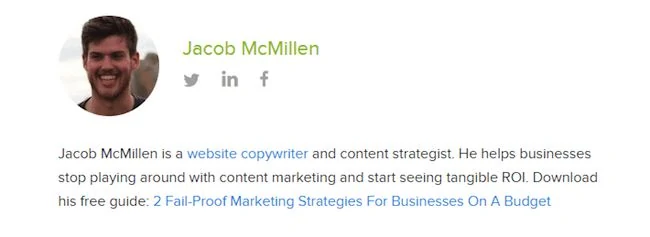
This is what happens when you know your audience and write your bio for them specifically.
In the example above, Jacob knew his audience very well and hesitated using an acronym and specific terms.
Crafting your professional bio for a specific audience has several benefits:
- You can connect with the right people easily
- Irrelevant clicks and traffic are filtered
- Your bio appears more authentic and relevant.
The idea is to write your bio for your target audience. This means you have to use a language and tone they can understand, you should know their challenges, you must know keywords and terms they use, and so on.
It requires a deep understanding of your audience so you can write a professional bio that they can relate to. It’s highly recommended to target a single buyer persona instead of reaching multiple personas via a single bio.
If you haven’t created buyer personas for your business, use this guide to create buyer personas and to get a better understanding of why you need them for your business.
3. Set Voice
Voice in writing a professional bio refers to your unique personality or style that makes you different. It’s your identity.
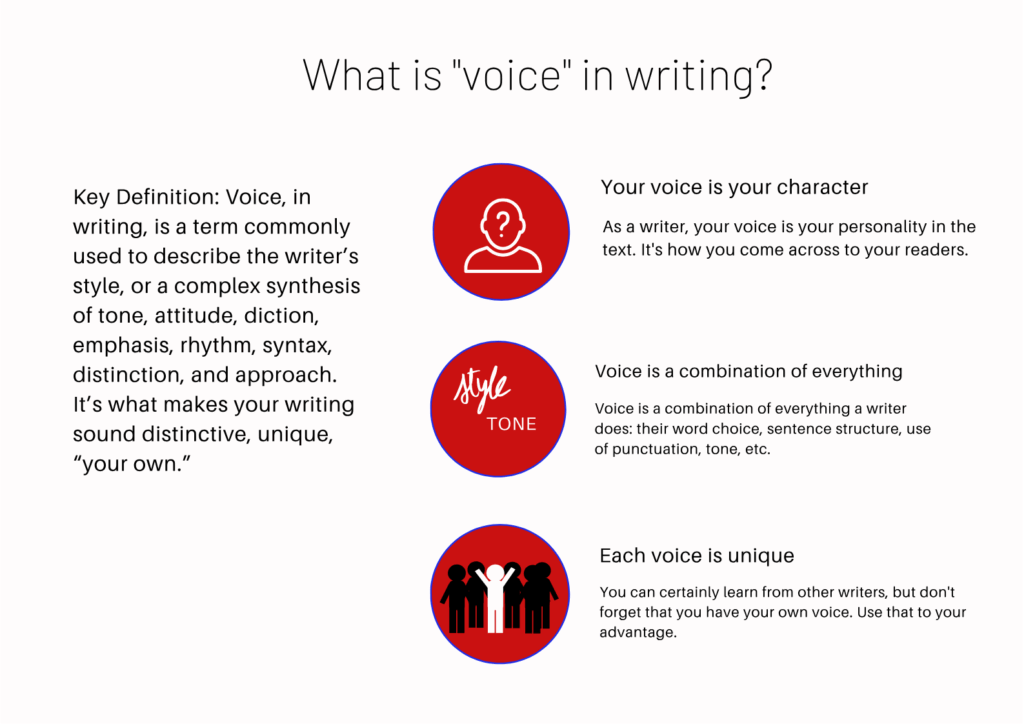
It is shaped using your writing style, tone, word selection, diction, point of view, rhythm, and punctuation. It’s much more than choosing first-person or third-person voice.
Your voice across all bios should be consistent. This is how you connect with your primary audience at a personal level. You need to make yourself and your business distinguishable, your unique voice helps you do it.
If you haven’t defined your voice yet, do it now. Here’s how to do it:
- Derive voice from the style guide, business philosophy, and vision. You can opt for a lively, professional, friendly, conversational, humorous, formal, or informal voice.
- Choose between first-person and third-person voice
- Identify diction, structure, and punctuation to convey your voice to the audience (or tone).
You can make minor tweaks to your voice as you move from one platform to another, but generally, it should remain the same.
For instance, if you have a friendly voice, you don’t have to switch to a professional voice in your bio just because the website has a professional tone.
Define your voice and stick with it – no matter what. This is what makes you stand out and makes you ‘YOU’.
4. Name and Job Title
Purpose, audience, and voice are preliminary mandatory steps to writing a professional bio. Once you are done with those three steps, you are set to craft your bio.
Ensure that you keep the purpose, audience, and voice in mind from this point forward.
Your name (and job title) is used as a title for the bio in most cases.
If it’s not part of the title, the bio should start with your name and job title. If the title isn’t added in the title, the first sentence of the bio should clearly mention your job title.
Why?
People reading your bio need to know who you are and what you do. It builds rapport.
In the professional bio example below, the author has done two things exceptionally well:
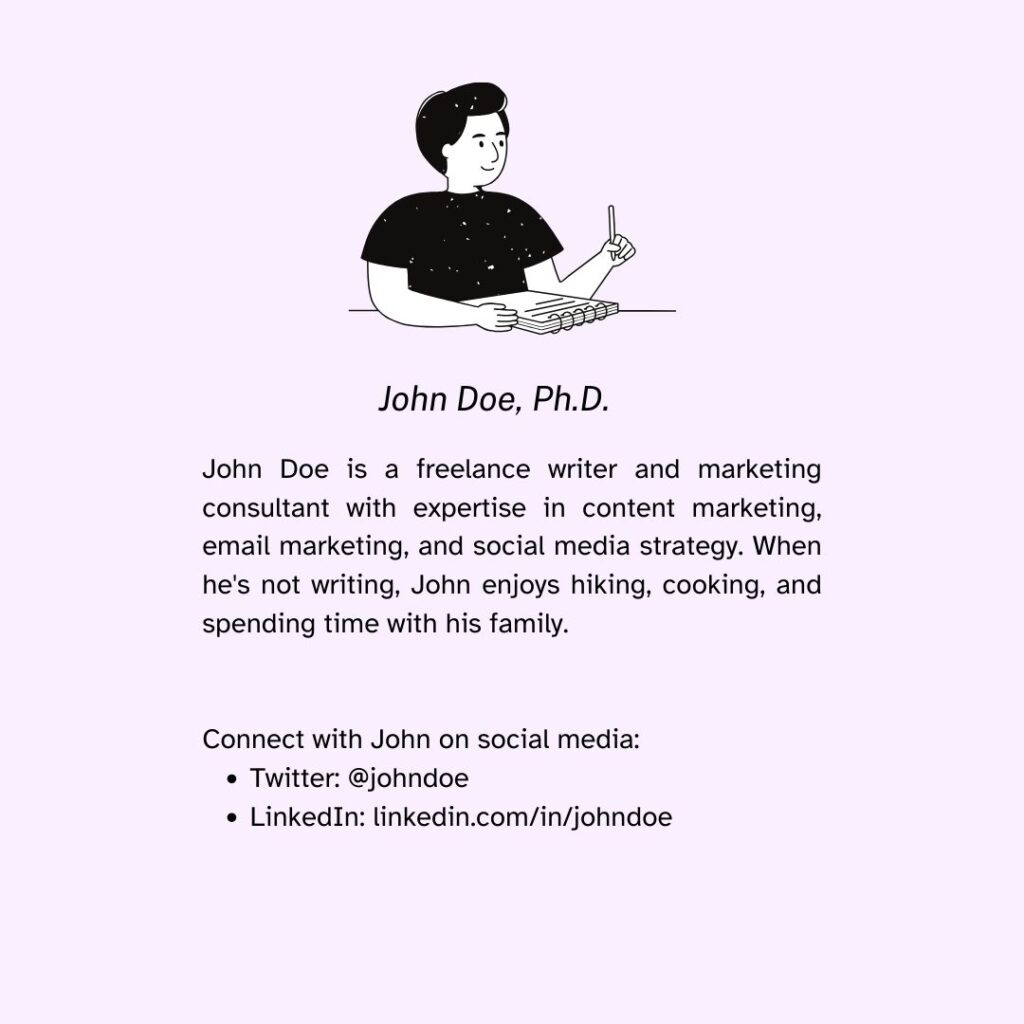
- Added a degree with the name to showcase his qualification
- Stating what he does right in the first sentence.
If you have a key highlight, you can mention it with your name in the title. Such as education, certification, experience, specific skill, award, or any other key aspect that makes you stand out in your niche.
Job title or what you do should follow immediately after your name. It should be stated in the first sentence to hook your audience. If you hold multiple job titles or offer multiple services, choose the most relevant one (not necessarily the best one).
Let’s say you are a founder of a company, work as a CEO of another company, and offer consulting services. If you are targeting founders, you should mention yourself as a founder and skip the other two. If you are publishing an article for executives, you should state yourself as a CEO.
The title should be relevant to the purpose and your target audience.
5. Add an Intro
The first sentence that has your name and what you do is part of the introduction. The 1-3 sentences consist of your introduction.
Now, this isn’t a rule.
Some publications allow long professional bios that can go as long as a couple of paragraphs, while others only allow a few sentences.
The highlighted part in the bio below is Henneke’s introduction:
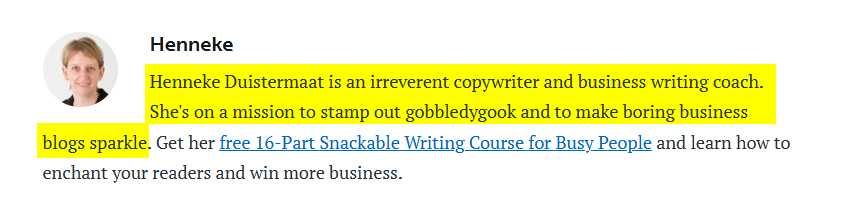
The introduction in this case is only 2 sentences, but it’s effective and attention-grabbing.
The introduction in the example below is quite detailed and explains a lot about the author:
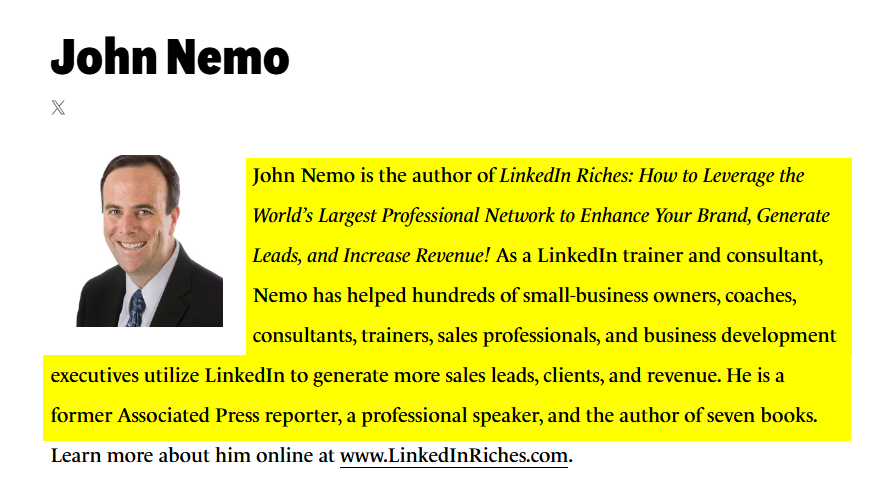
You have to adjust the introduction based on the space available.
The important question is what to add in the bio intro?
Here’s what you must add in a professional bio introduction:
- Add more relevant details that your audience is likely to remember
- Make the introduction relevant to the audience of the platform and adjust accordingly
- Add a hook. This can take any form. You can add a Fortune 500 company or add a couple of power words. It depends, but a hook is essential
- Keep it short, even if you are allowed a lot of space.
Here’s a template you can use to write a killer introduction for your bio:
[Name] + [current role] + [what makes you stand out (experience or skill)] + [current specialization].
Here’s an example of a well-written introduction using this template:
John is a freelance email marketer and copywriter. He has 21 years of hands-on experience in email marketing and has worked with top companies including XYZ Inc. He specializes in managing large-scale email campaigns for mid-sized and large businesses in the finance sector.
6. Mention Your Work History
After the introduction, you need to state your work history.
You don’t have to add all your work history, rather add the most relevant one (not necessarily the recent one).
Again, you need to make sure that the work history is consistent with the bio’s purpose and target audience.
You can explain it in a few lines or go into detail.
Here’s an example where Whitney Johnson has explained key roles in a single paragraph. It’s a nice way to state your work history by highlighting key achievements:
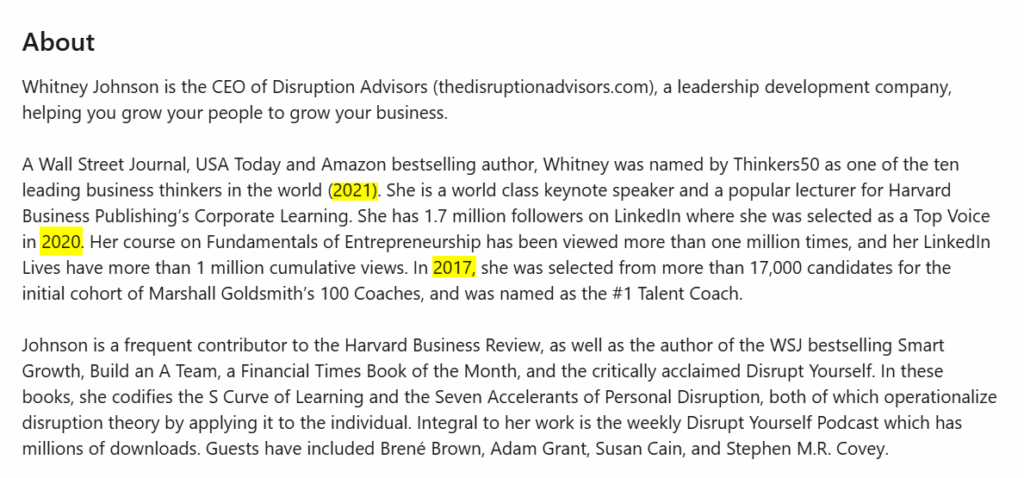
If you are writing an author bio for a publication, you might have limited space. In such cases, it’s best to refer to the most relevant work experience.
Experience is a key variable that makes you credible. If you have a rich experience of working with a few different organizations, it will create a positive image.
Follow these guidelines when writing work history for your professional bio:
- Add relevant work experience
- Keep your target audience in mind when choosing what type of experience to add
- Highlight your primary achievements in that role
- Describe what your primary duties were in that role
- If you don’t have relevant experience, skip it. It’s not necessary to add experience in a professional bio
- Keep it detailed for platforms like LinkedIn and add most of your work history.
7. State Your Skills and Expertise
Skills and expertise stem from your education, experience, or traits.
Most people mix skills with work experience and don’t mention them separately when they write a professional bio.
A skill is your ability to do something.
Expertise refers to a high level of skill or knowledge in a specific field that you have polished over time. An expertise is a refined, polished skill.
Here’s an example of a professional bio that focuses on expertise right after the introduction:
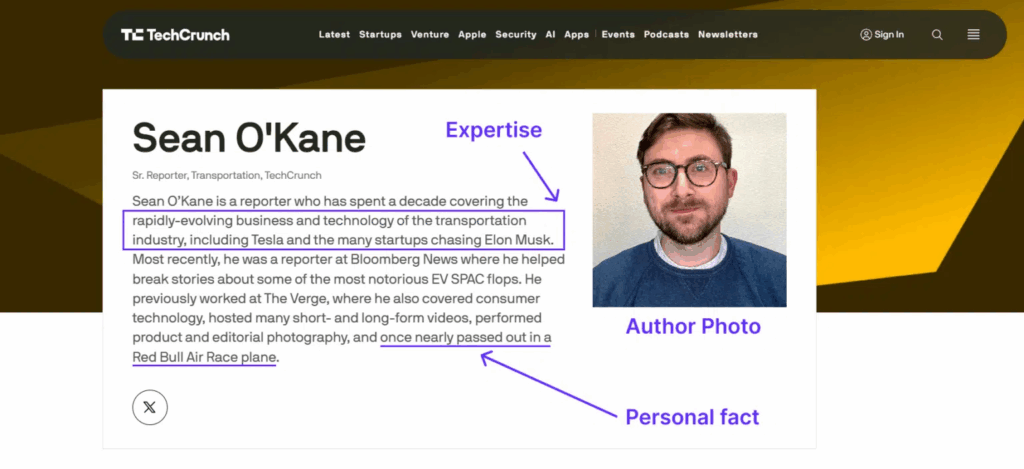
Social platforms like LinkedIn let you add skills separately to your professional bio which is a great way to showcase your expertise. But that’s not a standardized practice.
In most cases, you have to merge and add skills into your bio and it all goes collectively in a single paragraph (or maybe two). In this case, it’s crucial to state your core skills smartly in the bio so it flows naturally.
Ryan Reynolds, for instance, has explicitly stated his core skills on his LinkedIn about page and that too in a smart, humorous way that indicates what he is an expert at:
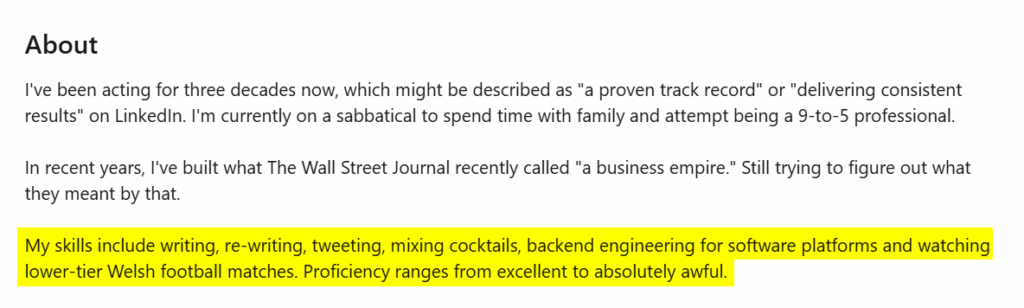
You need to figure out the best, natural way to incorporate your expertise in bio.
8. State Your Values and Philosophy
It’s more like hinting at your core values in the professional bio, as describing or even stating your business philosophy and values might make your bio bland.
Mentioning your values in your bio is essential for a few reasons:
- To connect with like-minded people and businesses
- To filter out unwanted leads and clients that won’t be a good fit
- Be distinct and authentic.
Here’s an example of how to subtly mention your core values and philosophy in the bio:
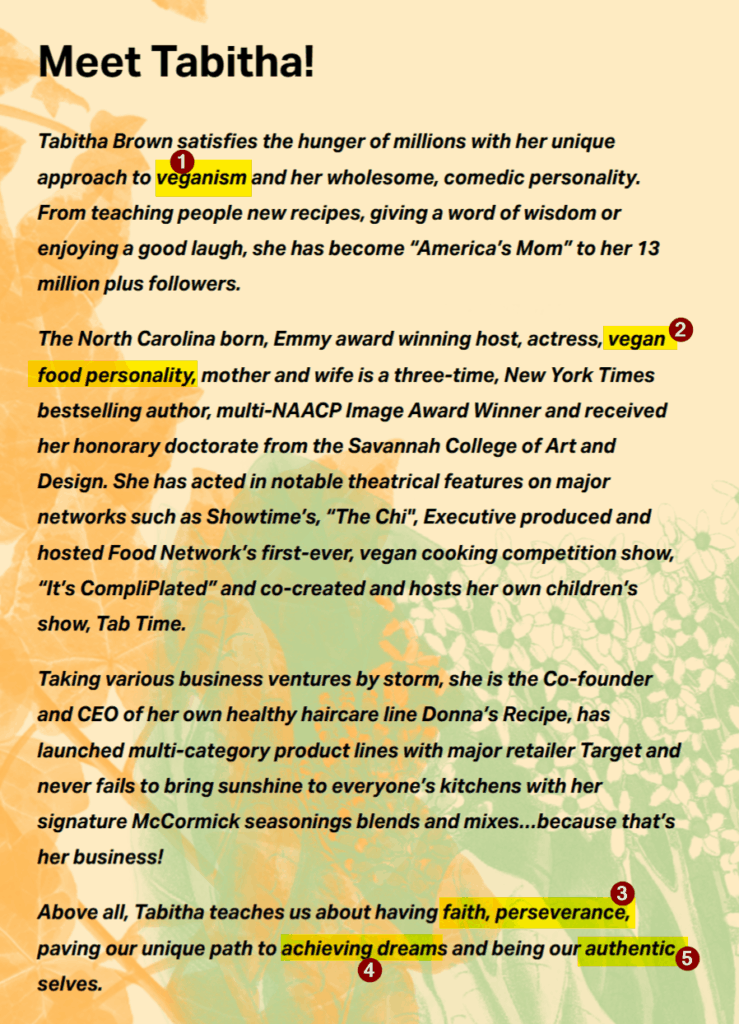
Tabitha has referred to her core values and philosophy at least 5x in her bio. She has done it without stating the words ‘values’ or ‘philosophy’, rather she wrote her professional bio in a way that it communicates what her values are.
And that’s the whole point.
You don’t have to explicitly mention your values in your bio. Add relevant words, themes, and phrases that you and your business stand for in the bio and it will do a decent job.
Is it necessary?
Not at all.
Adding your philosophy in a professional bio is optional. In most cases, you won’t have the space to add anything like this.
But if it’s part of your purpose, you should add it.
For instance, if you don’t work with businesses that contribute to carbon emissions, you should state this in the bio as it’s a core component of your philosophy.
When a certain value or principle, or a philosophy, becomes a part of your business, it needs to be added in the professional bio.
9. Add Personal Interests and Hobbies
Adding your interests, hobbies, and other personal details in a professional bio help your audience connect and relate with you. It humanizes your bio. It helps readers understand you better.
Here’s an example:
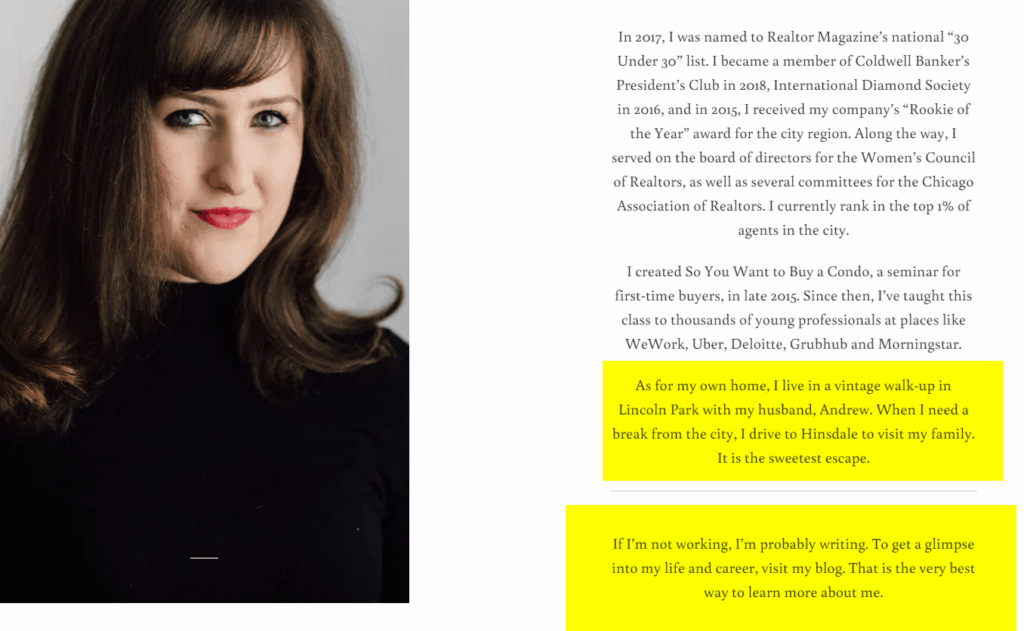
These types of personal details in a professional bio help you build your network outside of business contacts. For instance, if travelling by road is your hobby, you might connect with someone who is an avid road traveler and you can plan a tour together.
Besides connections, referring to your interests in bio is a way to humanize it. This shows potential clients you have a life outside work like normal humans. This is crucial for the success of your professional bio.
When you are reading about someone for the first time, you want to know their personality, hobbies, and traits besides work. This helps you understand people at a more personal level.
This is a reason why you should prefer adding 1-2 sentences about your personal life and interests that describe who you are as an individual.
10. Add a Call to Action
A professional bio is incomplete without a call to action (CTA).
When you write a professional bio with a well-defined purpose and objective, you’ll want readers to take action after reading it. That’s how you’ll accomplish your goal – or at least – measure your goal.
For instance, if your goal is to generate leads via your author bio, you need to explicitly tell readers to click the link and download a guide. That’s how you’ll be able to generate leads.
And that’s how you will be able to track the performance of your squeeze page (CTR vs. conversion rate).
People need clear instructions on what they are supposed to do once they have read your bio. You need to guide them on what to do once they have finished reading your bio.
Anyone who reads your full bio is interested in you or your work. Those who aren’t interested won’t read it to the end, right?
So, if someone has made it to the end of the bio, do you want that person to leave?
Probably not.
That’s a warm lead.
You need to send them to a lead page or your website, or a social profile so you can connect with interested people directly without any intermediary.
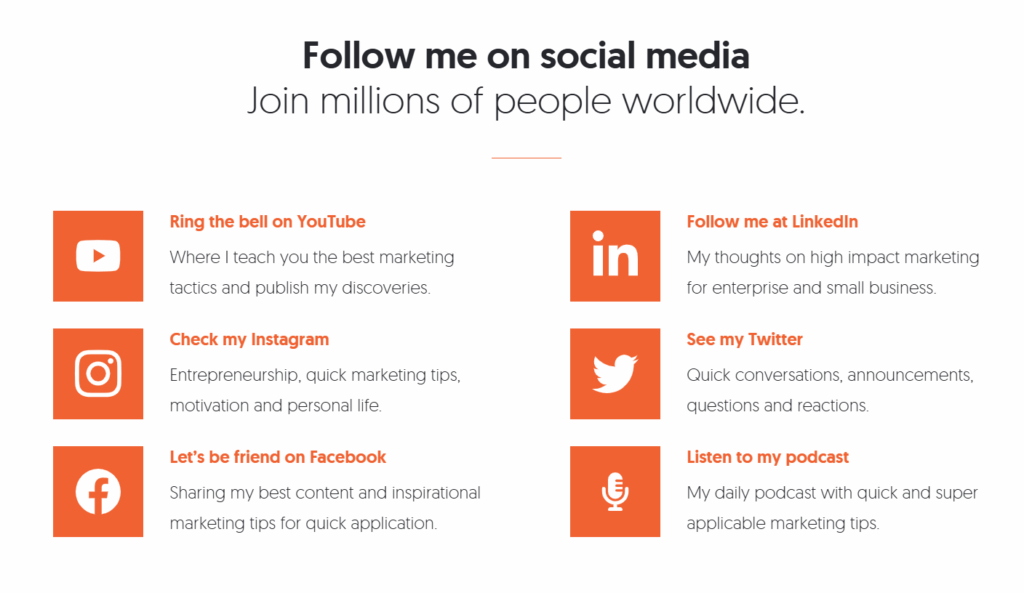
Here’s an example of how to incorporate CTA on your bio page:
The best way is to send traffic from your bio page to a landing page to collect email addresses for further communication. Here’s an example of how to do it by offering a high-quality lead magnet:
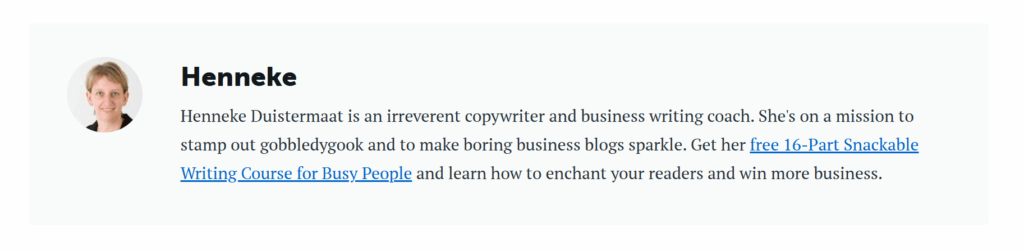
Henneke is sending traffic to a squeeze page that offers a top-notch lead magnet to her audience. That’s one of the best ways to convert readers into leads.
However, not all sites allow adding a link to a landing page in your bio.
You need to get approval for it.
You can still send visitors to your social media accounts or even your website.
Follow these guidelines to add a CTA in your bio:
- Keep your CTA short and persuasive
- Add it towards the end of the bio
- Keep both CTA and offer consistent with the platform and target audience
- Send visitors to a targeted squeeze page with a lead magnet to collect their email addresses
- Add links to your website and social platforms
- Keep links to a minimum. Ideally, 1-2 to minimize distraction.
Final Words
Your bio isn’t your resume.
It is neither a summary of everything you have achieved in your life and career.
It’s a purpose-driven summary of who you are and what you can do for your primary audience.
You should write a professional bio with a solid objective and for a specific target audience. Once it’s written, ask yourself: Does this fulfill its primary objective?
The steps covered in this guide will help you write professional bios for yourself and achieve your goals.
Start practicing and implementing.
Featured Image: Pexels