

The use of AI and AI tools is on the rise. AI engines and assistants are among the most used apps. Search engines like Google and Bing rely heavily on AI to make search results more user-friendly.
Google’s AI Overviews is one example that gets position 0 in SERPs.
As a business owner and marketer, it’s important to optimize your site and content for these generative engines so you don’t miss out on this emerging channel.
This article explores generative engine optimization in detail along with best practices that you can implement starting today.
Let’s get to the technical stuff…
What is Generative Engine Optimization?
Generative engine optimization (GEO) refers to the practice of optimizing your website and content for generative AI search engines like ChatGPT. All the leading AI search engines cite sources and that’s one way to drive traffic to your site.
For instance, Google’s AI Overviews appear at the top of the organic search results in SERPs. This provides a quick answer to the search query with links to the sources.
Here’s the example:
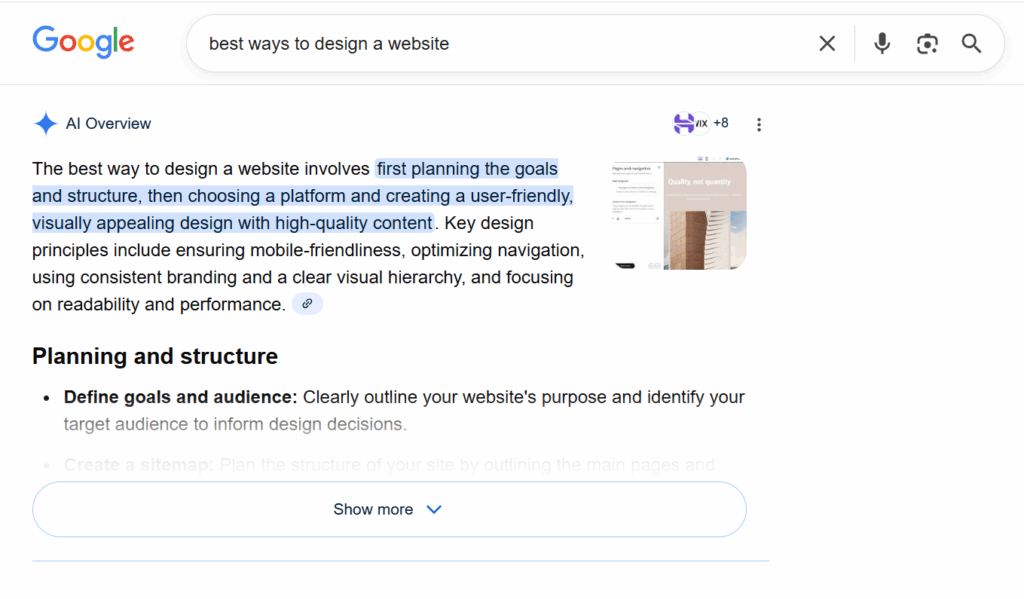
Most readers naturally skip scrolling down to search results if they get their answer from the AI. That’s how you miss clicks and traffic.
Optimizing your website for generative engines helps you make it to the AI search and your site gets views and traffic. It offers you tons of benefits in terms of search visibility.
How is GEO Different from SEO?
Both generative engine optimization and conventional search engine optimization share a lot of similarities, such as helping users find answers to their queries quickly.
However, these two types of optimization differ from a business perspective and in how you pursue each as a marketer.
Let’s explore the major differences between optimization for AI search and for traditional search:
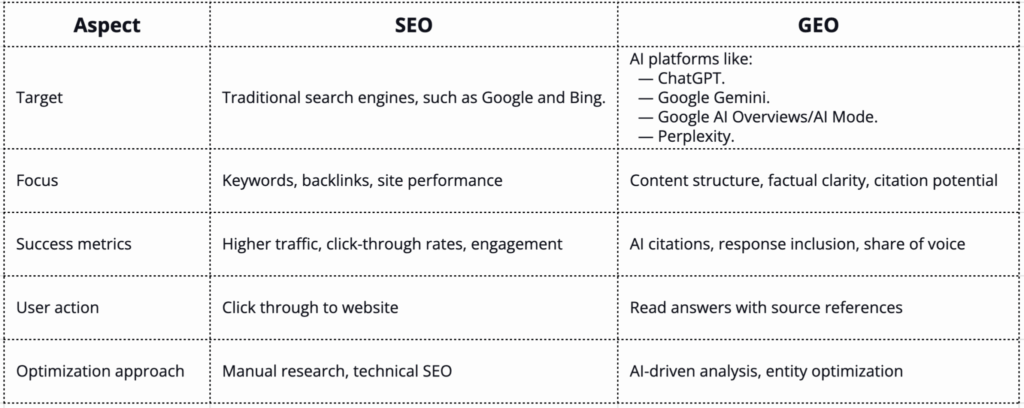
- GEO focuses on improving search visibility in AI-generated content, while SEO is focused on optimizing your site to improve its visibility and ranking in SERPs.
- Optimization for generative search is more about branding and citations in AI answers with minimal focus on referral traffic. SEO relies heavily on bringing visitors to your website and thus, CTR plays a massive role in this case.
- GEO relies on consistently publishing new content and being endorsed by trusted sources. The content needs to be well-written and factually correct so AI can understand and use it. AI tools don’t pick and choose content based on the authority of the domain or backlinks. SEO is entirely based on backlinks and domain authority.
- The queries and answers in GEO are conversational. Search queries are fairly long (much longer than average long-tail keywords) and the answer is detailed in conversational style. SEO queries are short and generally a mix of both long and short tail keywords and the results are presented in the form of clickable websites.
- You can track GEO success with metrics like citations, brand mentions, and referral traffic from AI search engines and chatbots. In the case of SEO, success is measured via rankings, organic CTR, and organic traffic.
- In the case of GEO, AI tools don’t rely on indexes, rather they use their existing database and access the internet in real-time to answer a query. SEO relies on crawling, indexing, and ranking which is a complex algorithmic process.
What Makes GEO Important?
Is SEO not just enough for your site?
Is it necessary to optimize your site for AI search?
Short answer: Yes, it’s essential.
Consider it as a new touchpoint to reach your target audience and connect with them. And you have to use it by ensuring your site’s presence in AI searches.
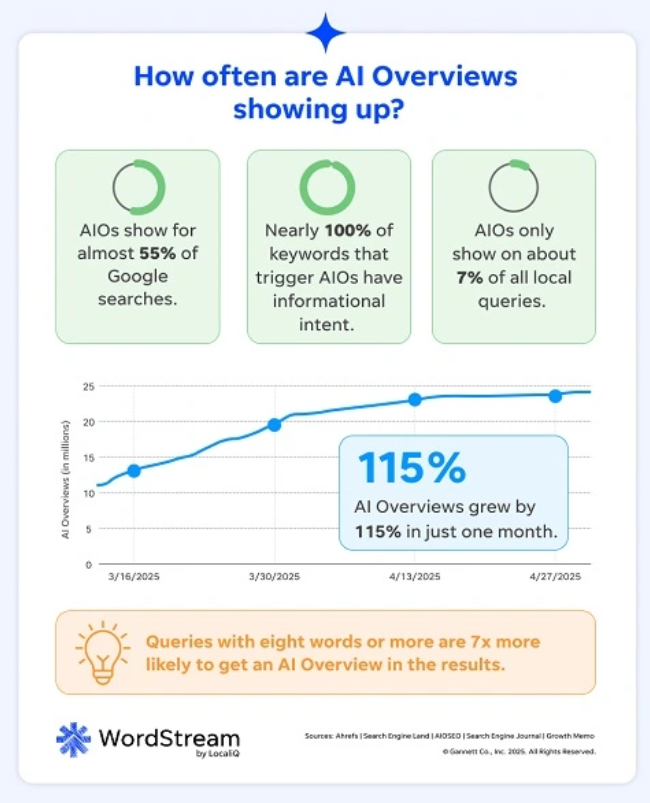
Research shows that as much as 55% of Google searches show AI Overviews and AIOs have increased by 115% since March 2025:
Keywords that have an AI Overview have a high percentage of zero-click searches. This indicates that when users see an AI Overview in Google that provides a quick answer to their query, they won’t click any search results. AI Overview reduces clicks by as much as 34.5%.
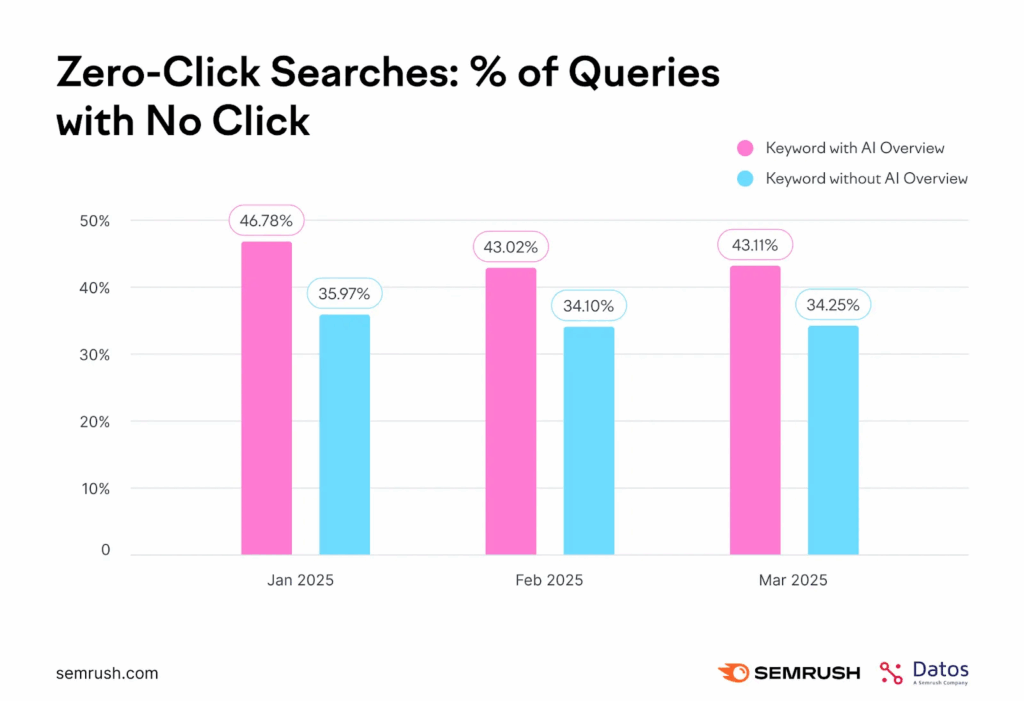
This is a reason you should focus on GEO along with SEO.
An increasing number of people don’t click any search results in Google (the leading global search engine with the highest market share). This means you are losing potential customers.
The only way to connect with missed potential customers is by ensuring your content is optimized for AI and your content is cited by Google’s AI and other leading AI tools.
GEO is essential as it doesn’t require a lot of additional work. If you are already doing SEO, optimizing for generative engines won’t be an issue (see below for more details).
Best Practices for Generative Engine Optimization
Let’s uncover the tactics and techniques to master GEO for your business.
Well-Formatted Content
The number one rule for generative engine optimization is to make it easy for AI tools to understand your content. You need to structure your content for AI apps.
The best part is: You don’t have to come up with something new. Structuring content for generative engines doesn’t mean you have to go an extra mile or, in some way, ruin UX.
No.
You just have to write and format content appropriately which makes it ideal for humans, web crawlers, and generative engines.
If I have to put it in one sentence, I’d say: Write with clarity, make content scannable, and format it.
The idea is to make it easy for AI engines to quickly understand your content and use it. If they can’t understand your content, they won’t be able to cite you.
Let’s break this down:
Proper Formatting
Have you ever seen the output from an AI engine?
It is properly formatted with clear headlines, bullets, and facts. Here’s an example:
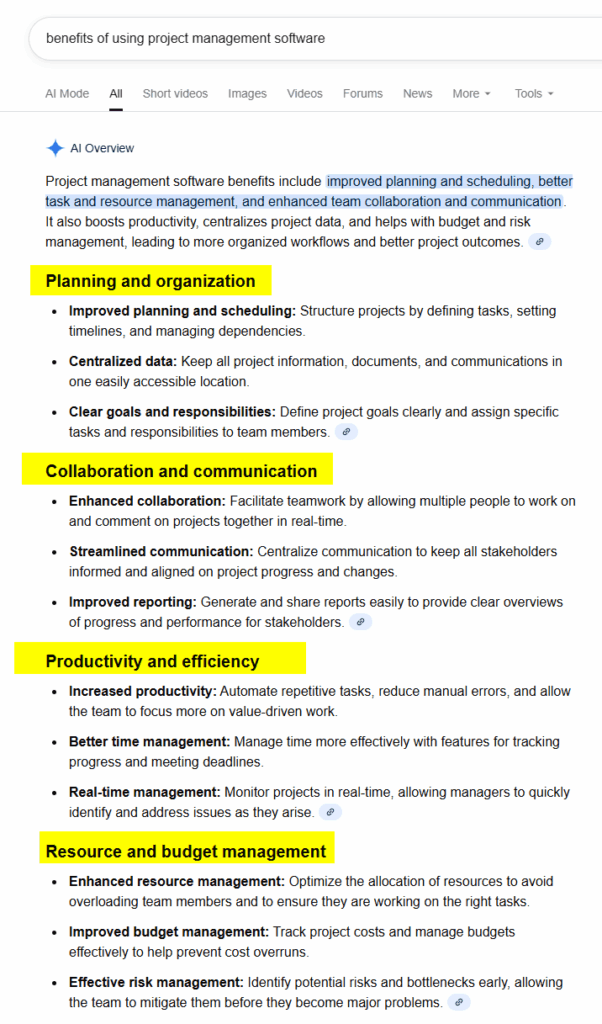
The output has an intro paragraph that answers the search query without any ambiguity. Then the benefits are listed under subheadings and each benefit is listed as a separate bullet.
This is exactly what you are supposed to do when writing content.
Your content should have:
- Clearly defined sections and subsections
- Use of proper heading tags for content distribution and hierarchy
- Use of bold text to highlight key points
- Bullets and lists for improved readership
- Short paragraphs.
This type of content formatting will not just help generative engines, but it will help humans understand content better. I mean, no one likes reading big blocks of text. It ruins UX and readership.
Write a Summary at the Start
Have you noticed that a lot of leading sites now add “Key Takeaways” or “Learning Outcomes” or similar summary of the blog post right after the introduction?
It’s because it works great for AI engines as they don’t have to scan the entire page. They can quickly get the answer without scrolling. It significantly increases the probability of your content being cited by generative engines.
Additionally, a quick overview of the key findings at the start helps readers and web crawlers to get a better idea of what the page is about.
Here’s an example:
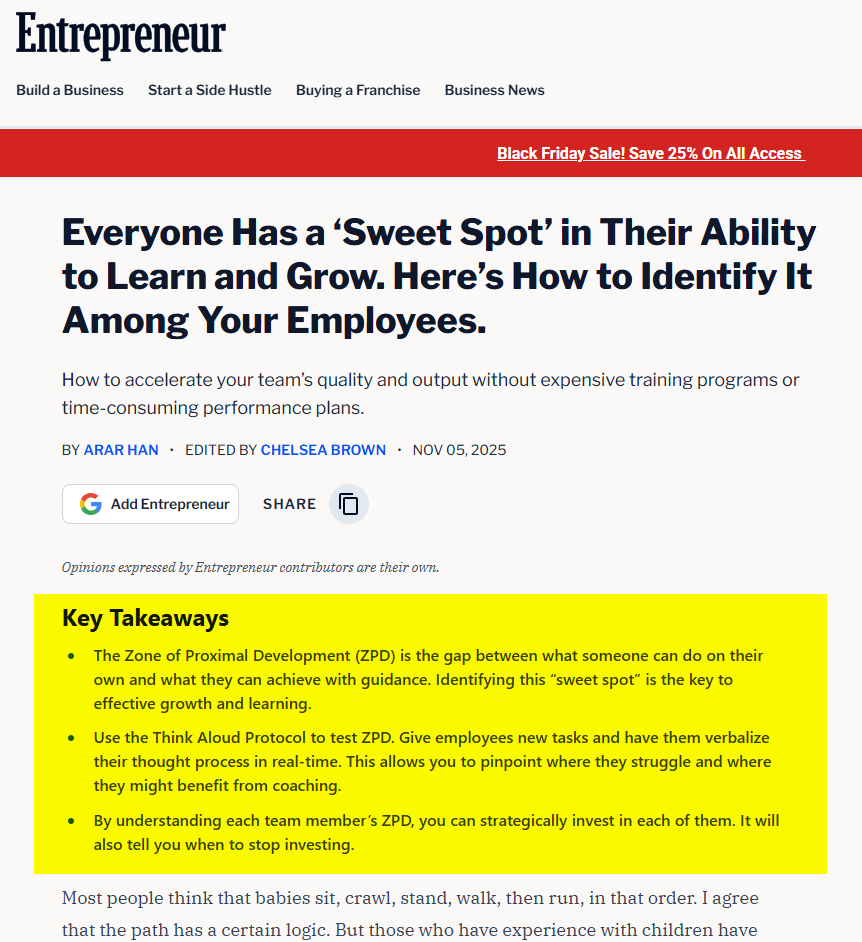
Entrepreneur starts articles from key takeaways. The introduction paragraph succeeds. This is a smart way to give a quick overview of the article to readers and AI engines.
Here’s another example:

Healthline also starts the article with a bulleted summary of the piece and it doesn’t use any heading for it.
A summary of your article with major outcomes should be added at the start of the article for AI engines.
One Idea Per Paragraph
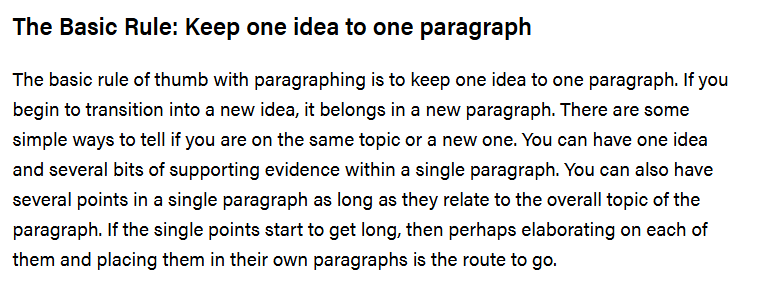
This is a basic writing rule. And it works for AI engines too.
Write one idea per paragraph. It makes the content reader-friendly.
Ideally, your paragraph must start with the most important information. The first sentence should be the most important sentence of the paragraph. Then the second most important sentence. And so on.
This helps AI engines understand the paragraph by reading the first sentence. They don’t have to go through the whole paragraph (which is time-consuming and, in the case of AI engines, time constraint is a big issue).
Sticking with this rule works best for human readers as well as they find it extremely easy to read, scan, and understand content.
Enforce Clarity
Generative engines like clarity. They aren’t smart enough yet, or they don’t want to waste their resources trying to make sense of ambiguous content.
Here are a few tips to improve content clarity:
- You need to ensure that you use simple language, write in a clear tone, and mention the obvious
- Everything should be stated explicitly in crystal clear language
- Use the most common words
- Avoid jargon and excessive use of technical terms
- Add facts, numbers, and concrete data
- Address common questions in plain, simple language.
Use Structured Data
Schema markup is the best way to generative engine optimization. This is how you structure content for AI engines and make it easy for them to understand it.
The FAQ schema tells AI tools that it’s an FAQ where they should look for answers to common questions.
The best structured data types to use for generative engine optimization include:
- Product information
- Article
- FAQs
- HowTo
- Review.
Make Content Scannable
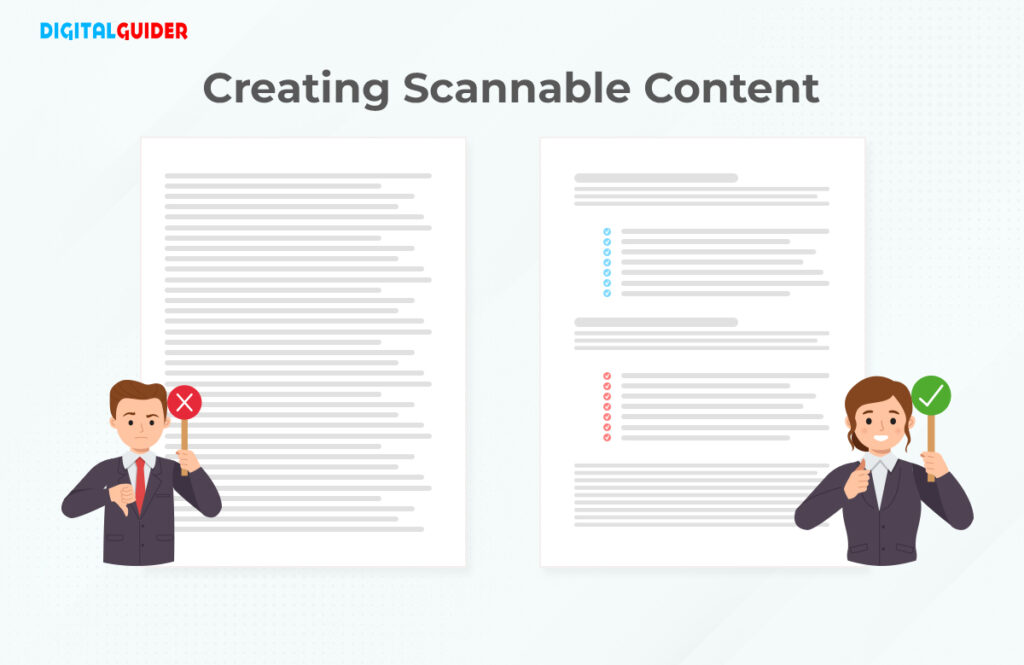
Go the extra mile to make your content skimmable. It’s ideal for humans as well as AI engines.
Scannable content is easier to read and understand. This is what AI engines like to see on your site.
Scannable content reduces their effort and resources to read and understand. If it requires time to understand a piece of content, most AI engines will bypass it.
Here’s how to make your content scannable for generative engines:
- Add lots of white space
- Use descriptive headings and subheadings
- Use bullets, lists, short paragraphs, and short sentences
- Properly structure content
- Add a table of contents
- Use visuals like images in a descriptive form.
Get Brand Mentions
Generative engines work differently from traditional search engines. They don’t look at the backlinks to gauge the popularity and authority of your site. Instead, they mostly rely on brand mentions.
These mentions include both clickable and non-clickable mentions of your brand or URL.
This doesn’t mean backlinks aren’t important. They still are.
In fact, more backlinks eventually mean a high number of brand mentions. So, it’s the same factor, from a different angle.
A brand mention or mention is any citation or reference, or a mention of your brand, company, product, or even URL on a site that you don’t own, either in clickable or non-clickable form. While backlinks only count links, mentions don’t have to be linked.
Common examples of mentions include people referring to your site on social media, Reddit mentions, and links from other sites and blogs.
Here’s an example of a brand mention:

I’m sure you must have seen such mentions across the web. These are pretty common.
AI engines use these mentions to figure out the popularity of a website or brand. More positive mentions mean a lot of people are citing it and referring to it.
You need to get lots of brand mentions for generative engine optimization. Since they don’t have to be linked, they are much easier to acquire than backlinks.
Mentions are mostly uncontrollable. You can’t control how, when, and where people mention your brand, and in what context they do it.
There are a few ways you can manage mentions:
- Monitor brand mentions using a tool
- Make sure your brand is mentioned in the appropriate context
- Try getting mentions as much as possible via outreach.
Co-Citation and Co-Occurrence
You can significantly improve your brand mentions and generate the right signals for AI engines by focusing on co-citations and co-occurrences.
When your site is mentioned with certain sites or brands surrounded by a certain type of words, it provides context to the AI engines.
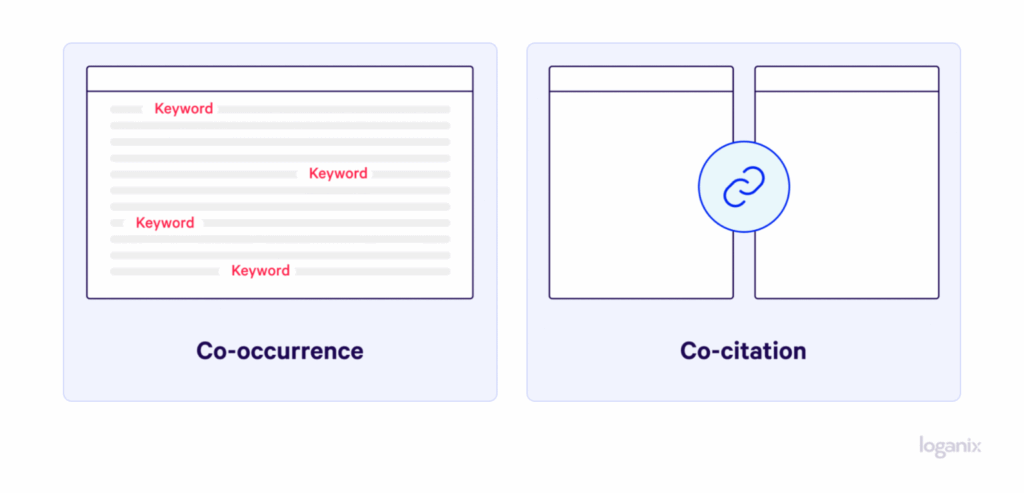
Here’s how co-citations work:
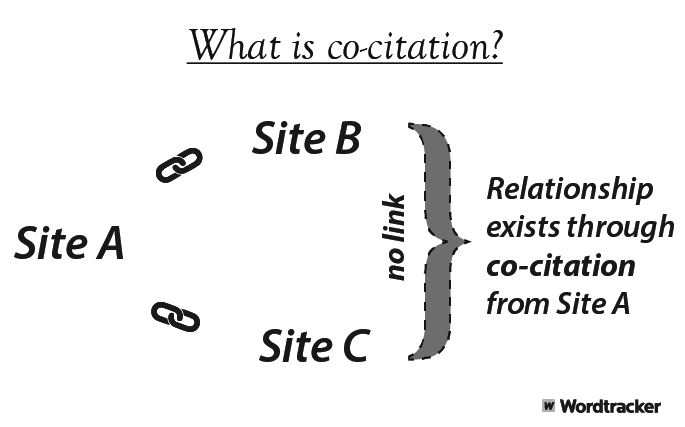
For instance, if you have a clothing brand, you’d like to mention your brand along with certain words related to clothing. At the same time, if your brand is co-cited with some top competitors or leading apparel brands, it will help AI engines better understand your brand and its purpose.
When your brand is mentioned alongside Zara, generative engines would start treating your brand in the same way.
This is where mentions play a massive role. They have the power to shape and define your brand, its position, and core values.
The big question: How to practically do it?
Here’s how to ensure you get the right co-citations and co-occurrences:
- Ensure that your brand is mentioned along with your competitors, especially the big names. If you don’t get mentioned, reach out to the publications and request them to mention your brand. Since you are not asking for a backlink, it’s much easier to get the desired outcome
- Establish a clear brand image with well-defined goals and objectives. Your audience and everyone else must know what your brand is about. This helps you get the right co-occurrences as people mention your brand with the right keywords every time
- Be part of networking events, surveys, reports, and business gatherings. This is where you get a chance to get mentioned with competitors and use their authority in your favor.
Publish on Multiple Platforms
One good thing about AI engines is that they scan a wide range of resources when looking for content. They don’t just stick with top ranked pages (like traditional search engines).
For instance, generative engines highly value and cite user-generated content from platforms like Reddit and Quora. Similarly, they cite comments from social media sites (which you rarely find in the case of search engines).
According to a study by Ahrefs, the top 10 most cited sites by AI assistants include UGC sites at the top including YouTube and Reddit at number two and third. Quora is in 6th place which isn’t a surprise:
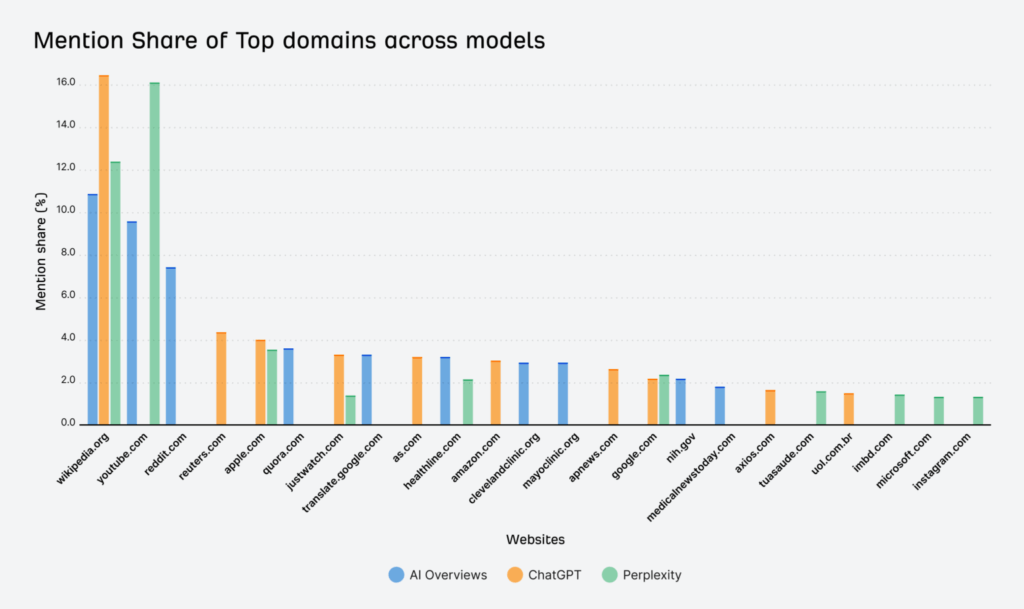
Here’s the thing: The more platforms you publish to, the better it is for generative engine optimization.
Each platform generates positive signals for AI tools and it helps them get to know your brand better. And once they see it across platforms, they are more likely to cite and refer to it.
Again, it’s not just where your site is mentioned. It’s how it is mentioned and in what context (refer above to co-citation and co-occurrences for details).
Follow these guidelines to be across different platforms:
- Create and execute a content distribution strategy. You can republish parts of the content on different platforms
- Repurpose blog content. Convert existing content into new formats for new platforms
- Manage your brand’s presence on UGC platforms with a focus on Reddit and Quora. Become an active member of leading platforms and forums and be part of the community
- Create a YouTube channel for your brand and publish videos regularly. It is the second most cited platform by AI tools, so make sure your brand is active on YouTube.
Publish the Right Content Type
There are certain content formats and types that AI engines prefer citing.
Research shows that words like best, top, guide, vs, and free are some of the most common words used in the URLs of the sites cited the most by AI engines (based on the study of 35K sites):
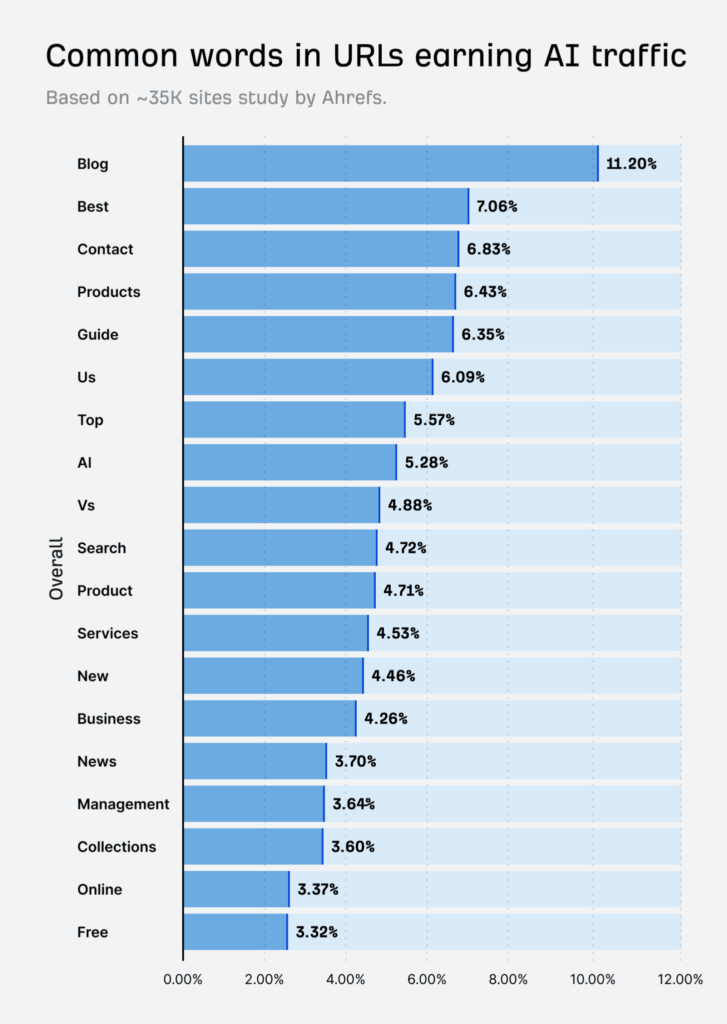
Analysis reveals that the following content types get the most cites and referral traffic from AI engines:
- Best content format
- Top lists and listicles
- Comparison articles
- Guides of all types including how-to guides
- Free resources and lists
- Product pages and product reviews that have product names mentioned in the title.
Informative content works best for AI assistants and tools.
On the flip side, unorthodox articles, opinion pieces, and new ideas aren’t the favorite citation sources of AI engines.
It doesn’t mean you should write just one type of content and not touch opinion articles and new content pieces. You should focus on a mix of both. Don’t push yourself to one extreme, rather maneuver between these two extremes and publish all types of content on a regular basis.
Follow these best practices to write the right content type for generative engine optimization:
- Publish lots of informative content, as it’s the best content type for AI engines
- Write long-form content including detailed, actionable guides
- Focus on listicles and how-to articles
- Publish multimedia and visual content.
Implement E-E-A-T
Well-written, informative, authoritative, and helpful content is still important for generative engine optimization. You can’t bypass it.
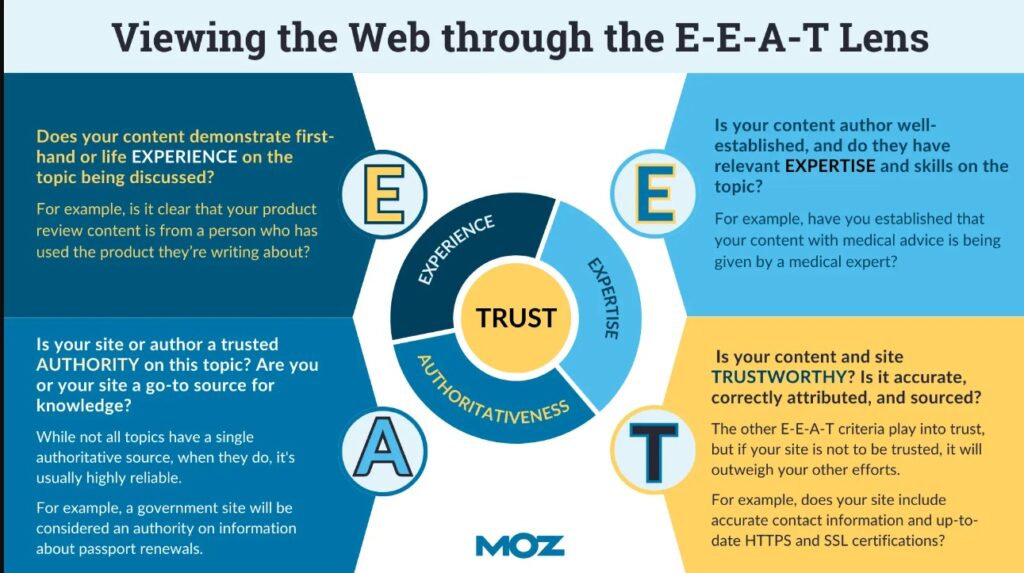
AI engines don’t follow Google’s E-E-A-T framework to evaluate content, but they prefer good quality content. You can’t just get citations from an AI tool with mediocre content.
When optimizing content for generative engines, one thing that must stand out is answering customer queries. Ask yourself the following question when writing an article: What problem or question does this piece address?
This is what AI engines like to see in the content.
They want to see short as well as detailed answers to the question.
You still have to demonstrate E-E-A-T by ensuring it showcases experience, expertise, authority, and trust. These factors improve the probability of getting citations from AI engines.
When you stick with E-E-A-T guidelines, your content will eventually have a purpose and it’ll solve a user’s query or problem. This is why it’s important to follow the basics of SEO when optimizing for AI engines.
Here are additional practical tips to write content using E-E-A-T that is fully optimized for generative engines:
- Have a clearly defined objective for every piece you write
- When unsure about how to fully capture the full scope of an article or keyword, don’t cover it
- Don’t run after keywords, instead, use topics and problems to address in the content
- Target question-based queries.
Measure Performance
Like traditional SEO, you have to track and measure GEO performance.
However, you need to use the right metrics.
Use the following metrics to track your performance:
- Mentions and citations
- Referral traffic from AI engines
- Sentiment
- Brand visibility.
Most of these metrics require a third-party tool for measurement. You can track referral traffic from your analytics tool easily. But all the other metrics require tools like Ahrefs or Semrush.
These tools provide detailed insights into AI optimization and cover a range of metrics like brand share, search demand, etc.
If you don’t have the resources, stick with Google Analytics to monitor referral traffic.
If you can afford it, use any paid tool to track generative engine visibility easily.
It’ll get easier to see if your strategy is working or if there’s something you need to change.
Final Words
Generative engine optimization, like SEO, needs time.
On average, it takes two years for newly published content to appear in any AI engine. That’s quite similar to SEO.
If you are expecting quick results or magical output, GEO isn’t for you.
Once you tweak your content marketing strategy, it will take time to see results. The best practices covered in this article will give you a jumpstart, but they won’t do wonders in a quick span.
Importantly, when implementing GEO, make sure you don’t end up ruining your site’s SEO.
Both GEO and SEO should work together. If you look closely, GEO doesn’t require anything additional or out of the box. It just needs minor adjustments to your content strategy.
You don’t have to go out of your way to optimize your site for AI engines, breaking all rules of SEO. It won’t work.
Make sure GEO and SEO complement each other and work together – not separately.
Maintain synergy.
Featured Image: Pexels


