

Artificial intelligence (AI), large language models (LLMs), generative search, and AI chatbots have completely transformed SEO. The impact of AI on SEO is unfathomable.
AI has changed user behavior, search habits, platforms they use, marketing channels and touchpoints, and how information is generated and consumed. This changed the SEO industry altogether. You have to now optimize content for LLMs and AI Overviews.
Of course, there are things that haven’t changed a bit.
Let’s understand the impact of AI on SEO and see what changed and what hasn’t changed so you can tweak your SEO strategy and grow your business by moving in the right direction.
AI and SEO
Artificial intelligence (AI) has changed SEO significantly in the past few years. Search engines like Google and Bing have implemented AI across their systems which resulted in a corresponding change in how marketers optimize their sites for search.
Google, for instance, introduced generative AI into search results in 2023 as experimentation. AI Overview was officially implemented in SERPs in 2024. A more advanced AI Mode was launched in 2025 that provides an interactive chat-based experience to users which uses Gemini models.
Bing offers a similar experience to its users by integrating Bing Chat powered by Copilot into search results pages.
These changes forced marketers to change their SEO strategies along with optimization for generative AI such as ChatGPT to reach a wider audience.
Optimizing content for AI Overview and Copilot Search requires a different technique. You can’t just write great content and expect it to be cited by a generative search engine.
Of course, the basics of SEO didn’t change. But a lot has changed, too.
Let’s explore what has changed, what is still the same, and how you can use AI for SEO in 2026 and beyond.
What AI Hasn’t Changed for SEO?
There’s a lot that hasn’t changed in SEO in the age of AI (and would probably not change in the coming years). These include:
- SEO fundamentals
- Content quality
- User intent
- EEAT.
1. SEO Fundamentals
Yes, SEO fundamentals haven’t changed a bit.
These basics include optimization techniques you use for on-page SEO.
For instance, web crawlers use the same technique to crawl and index webpages. This means they need metadata, structured content, tags, and meaningful content to understand and index it appropriately.
Here’s how a web crawler works:
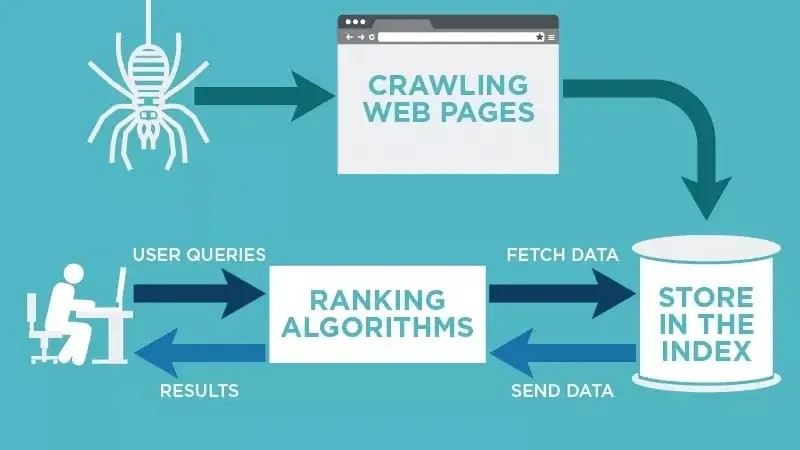
Database and ranking algorithms are still part of the process and that’s something which hasn’t changed. Search engines like Google have updated their algorithms to cater to AI content and queries, but the backend process is the same.
This means you still have to follow the same SEO rules, which include making your website accessible to web crawlers so they can easily crawl, understand, and index it.
Anything you do to help web crawlers do their job is part of the SEO basics such as:
- On-page SEO including HTML optimization and keyword research
- Website architecture, design, navigation, and internal linking
- Sitemap availability and optimization
- Robots.txt optimization
- Well-formatted content
- Off-page SEO such as backlink acquisition
- Page speed and responsiveness
- Crawl budget monitoring and optimization.
AI hasn’t changed how a search engine functions. It has no influence on search algorithms, its crawlers, indexing, ranking, and databases. Unless these processes are changed, SEO basics will remain the same.
2. Content Quality
This is something where a lot of businesses, content creators, and marketers get wrong.
The quality of content still determines where your site ranks in SERPs. AI has nothing to do with it.
You can use AI to create content. And you can generate heaps of AI content and publish it. You can’t rank it.
That’s because search engines still use the same factors to determine content quality and its user-friendliness.
A common misconception is that AI content is equally good with or without human editing. This is referenced back to Google, where it stated that it rewards high-quality content irrespective of how it is produced:
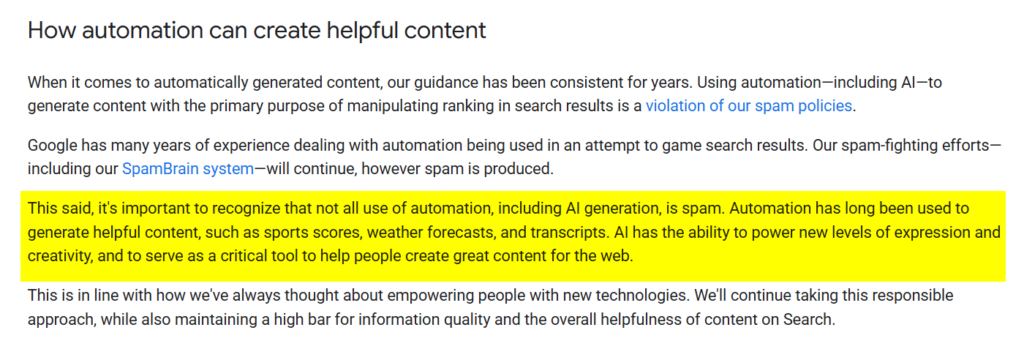
This is often misunderstood by marketers and they consider using AI content OK.
In fact, Google released multiple core algorithm updates in the past few years to tackle AI-generated content such as the August 2024 Core Update, the June 2024 Spam Update, and the Quality Rater Guidelines Update in 2025. These targeted low-quality AI content.
Quality, helpful content is still the top preference of both search engines and readers. There’s no way it is going anywhere, at least for now.
AI content can be spotted easily. It doesn’t provide enough value to the readers. When a user lands on a website that has low-quality AI content, the user will go back to search results and head to another page.
This creates a chain reaction and signals search engines that a page is low quality because it has a high bounce rate. It also signals search engines that this page is not fulfilling search intent and searchers’ needs.
Such pages are eventually demoted.
And there’s little you can do about it as a creator. Even if search engines push you to the top, humans won’t read poor content (whether it’s AI or not).
3. User Intent
User or search intent is the reason why someone runs a search query in a search engine. It’s the goal behind a search that a user wants to achieve.
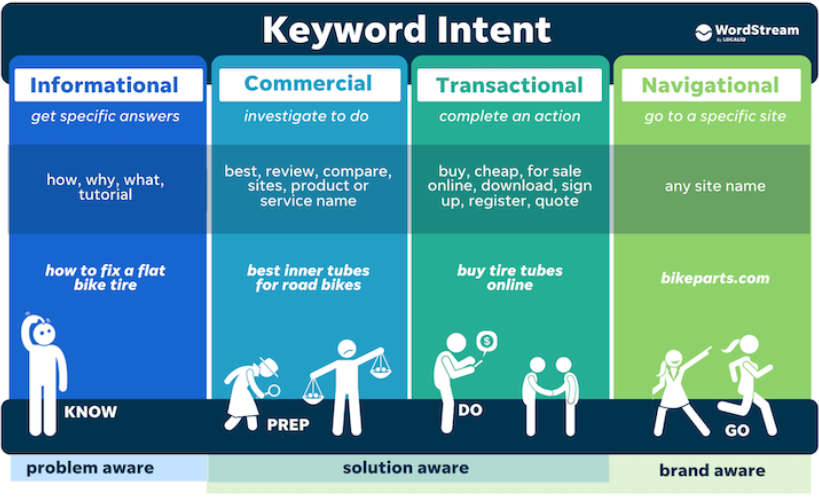
Search intent is derived from human needs and isn’t impacted by technology. For instance, someone interested in weight loss has little to do with AI. Informational and navigational intent can be influenced by AI because that’s where humans are least interested in how and where the information comes from.
Consider Google Maps. People use it for navigation with confidence, and it’s mostly AI.
AI has absolutely no role in impacting high transaction intents such as commercial or transactional. That’s where humans don’t like input from AI.
At a macro level, search intent is still a part of SEO.
As a marketer, you still need to find and target the right intent to rank for the right search terms. You can use AI to assist you in finding search intent, but it can’t be bypassed or replaced.
In fact, the importance of user intent has increased significantly recently because of the influx of irrelevant and AI-generated content. You need to precisely target the intent to stand out in SERPs.
4. E-E-A-T
Google’s E-E-A-T guidelines focus on creating people first content that demonstrates experience, expertise, authority, and trust. This framework is unchanged as it acts as a filter by Google to identify quality content that’s engaging and user-friendly:
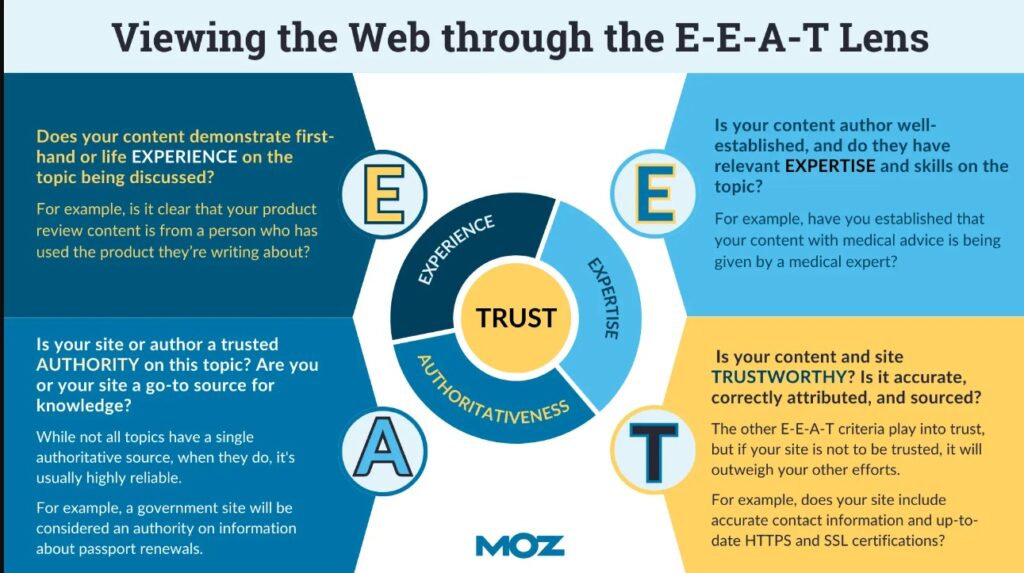
AI can create content at scale, but it lacks real-world experience. And it fails to meet other criteria of the E-E-A-T framework. This helps Google distinguish AI vs human-generated content.
Even the AI overview in Google and Google’s LLM Gemini rely heavily on E-E-A-T. Content that lacks experience, expertise, authority, or trust won’t appear in the AI Overview and won’t be cited by Gemini.
The importance of E-E-A-T has, in fact, increased for SEO more than ever before. It’s the only way to make your content stand out from the crowd and improve its visibility in SERPs. AI has failed to change this framework
How AI Has Changed SEO
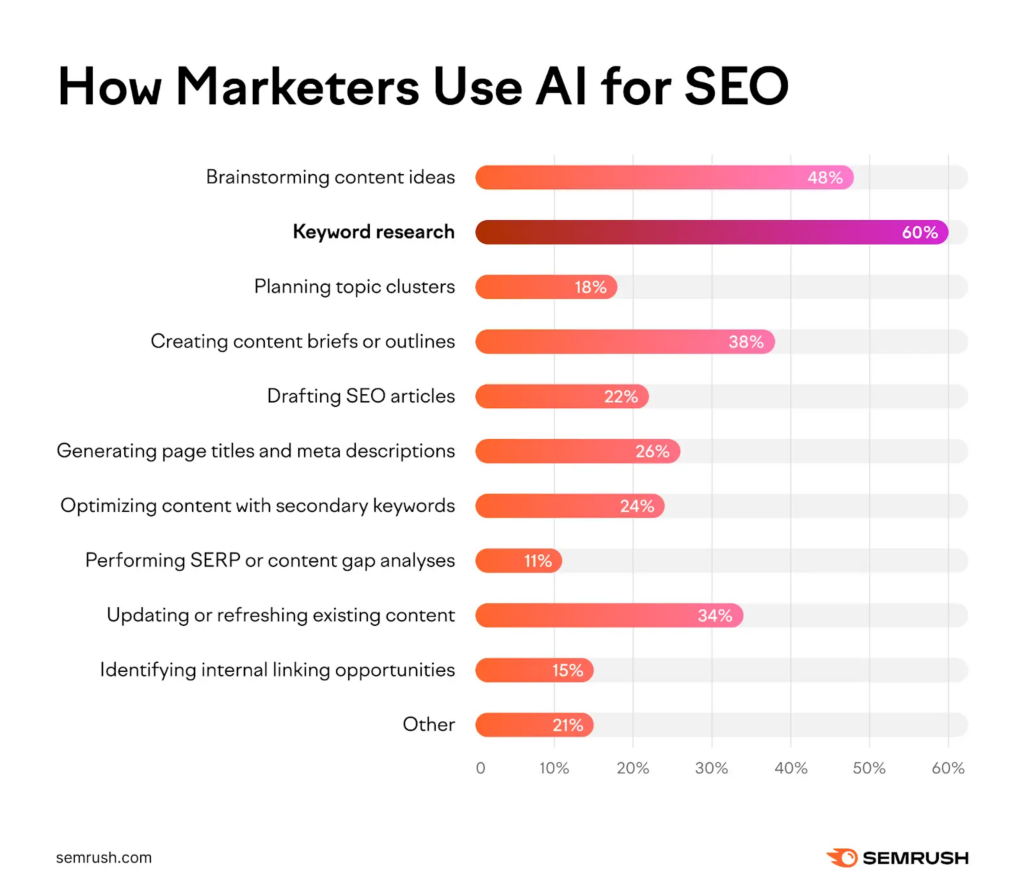
Artificial intelligence has changed search engine optimization for businesses in several ways. It has a direct impact on SEO with the majority of marketers using AI for SEO for tasks ranging from generating content ideas to drafting articles and more:
But the way you do SEO has also changed a lot in the AI era in the following major ways:
1. Conversational Keywords
One of the primary changes that SEO faced in the AI era is a shift towards conversational keywords. As more people now use LLMs like ChatGPT to find what they are looking for, there is a major shift towards conversational keywords.
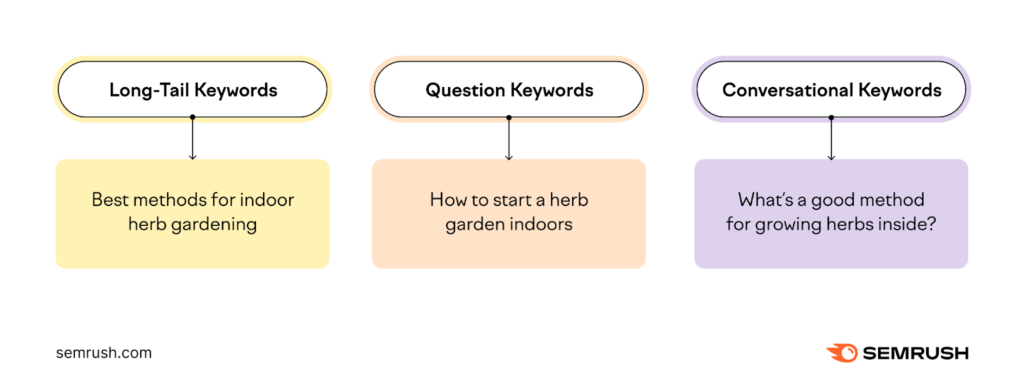
A conversational keyword is an extended form of a long-tail keyword that mimics natural language. It is a term or phrase that is exactly how people speak:
Research shows that more than 50% of mobile searches are generated via voice as globally 20.5% of people use voice search. Voice assistants are becoming common across devices. Think of smartphones, smart speakers, headphones, car devices, and other devices that support voice search. All of these devices are used by people to find stuff online.
And when they use voice search, they use complete sentences – not keywords.
A study reported that 54% of people say that they use more conversational phrases during searching and shopping and that’s due to AI:
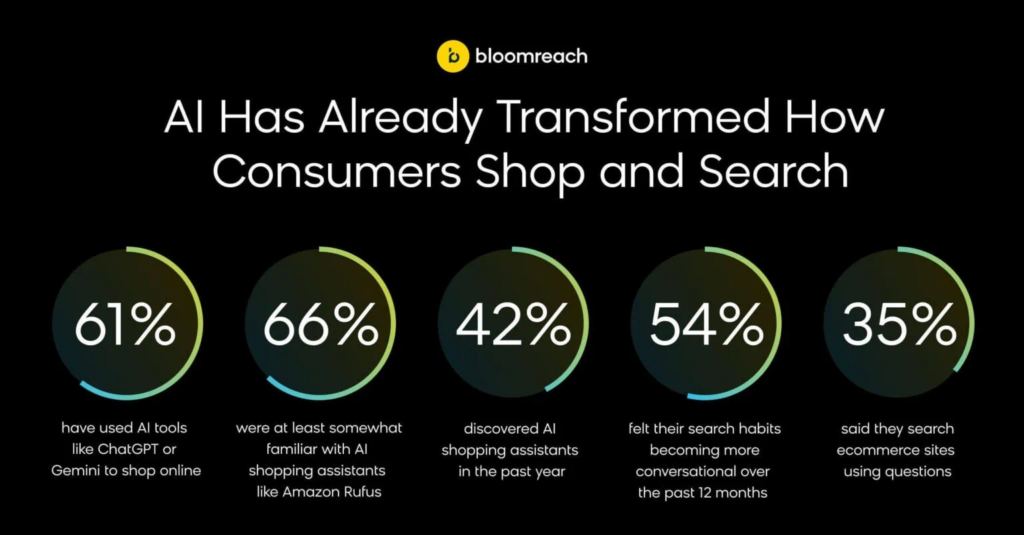
This change in consumer behavior has changed keyword research, targeting, and content creation. You can’t ignore traditional short-tail and long-tail keywords, but you have to emphasize conversational keywords and language to improve your content’s search visibility.
It is an evident impact of AI on SEO. You can see conversational keywords in leading keyword research tools like Ahrefs and Semrush. They might not explicitly use the same term, but you can now find questions and filter keywords based on word count.
This indicates an industry shift.
A move from conventional keywords to conversational phrases.
All because of AI and how people interact with AI.
2. Focus on GEO
Generative engine optimization (GEO) is becoming a new normal. If there’s one thing that can help you understand the impact of AI on SEO, it’s GEO.
It is the practice of optimizing your site for generative AI searches like ChatGPT including AI overviews that you see in Google, Bing, and a few other search engines.
This is because there’s a significant increase in two things:
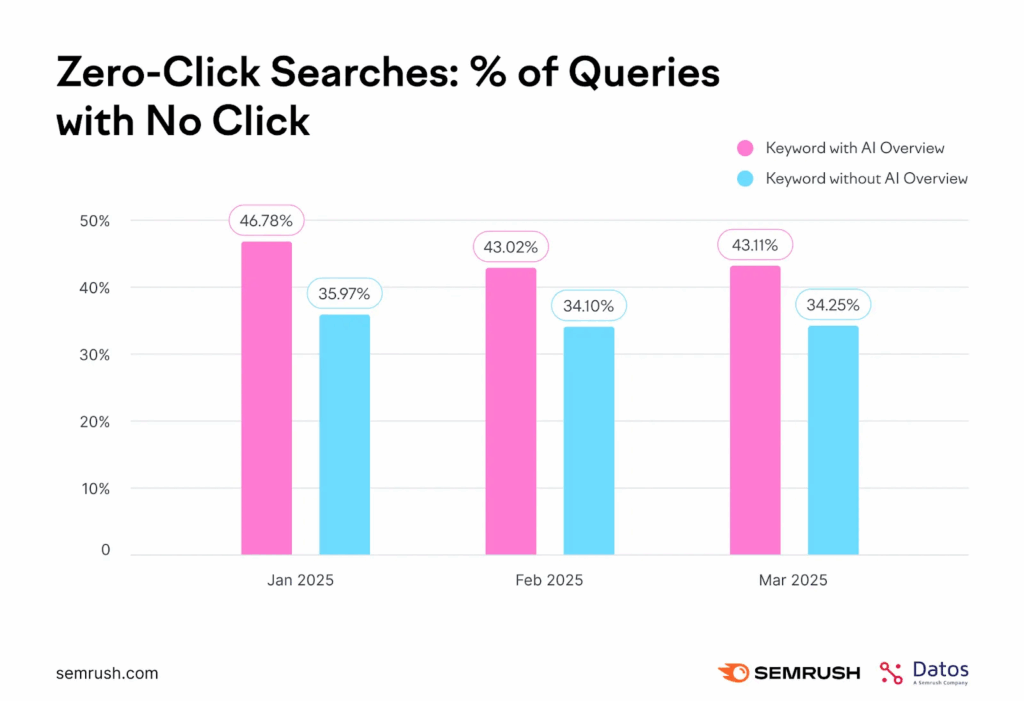
- Percentage of zero-click searches in search engines. Almost half the keywords (and therefore, search results) in Google have an AI Overview. And keywords with AI Overview usually don’t get any clicks. Almost 60% of searches in traditional search engines don’t result in a click (they are zero-click searches).
- Increased use of AI for searches like ChatGPT and Perplexity. A study reported that 44% of consumers prefer using AI-powered search. This includes LLMs and search engine-backed AI overviews.
The result?
Marketers now have to optimize their sites for LLMs and AI snippets. This is what’s called generative engine optimization. SEO isn’t enough to survive in these times. You have to focus on GEO as well.
Businesses are already doing it. As much as 56% of marketers are using generative AI as part of their SEO strategy, while 31% of marketers are doing it extensively.
You can either have a separate GEO strategy or you can align it with your SEO strategy. It works both ways. What’s important is that it’s one of the biggest impacts of AI on SEO.
3. Schema Markup
It is the structured data (in standardized format) added with existing content to improve search visibility, provide more context, and help crawlers better understand content.
Structured data is used to show reviews, product price, FAQs, local businesses, and others. Here’s an example of schema markup visible in SERPs:

Studies have shown that LLMs and search engine AI overviews work best and with higher accuracy when they have structured data (as opposed to unstructured data). A study found that LLMs (like ChatGPT) extract information accurately when they are presented with structured prompts.
The authors explained that LLMs work best when they have to deal with structured data. For instance, when the model has to extract data and fill it into predefined fields, they make fewer errors.
We know there are certain schema markup types that AI works very well with such as:
- HowTo
- FAQ
- Product and review
- Author.
For instance, LLMs use HowTo schema to find how-to articles and use the author schema to identify the author of the article. This data is also used by search engines extensively, but its importance has increased significantly due to AI.
When optimizing your site for generative engines, you need to use structured data for two main reasons:
- Make it easy for AI to understand content
- Reduce mistakes when citing your website.
Eventually, businesses will have to use more structured data across all types of content they produce when optimizing it for search and AI.
4. Content Velocity
The content velocity has increased significantly with AI.
Businesses use AI for content creation in several ways. Not all marketers use AI-generated content, but they use AI-assisted content. In both cases, new content can be produced and published fairly quickly.
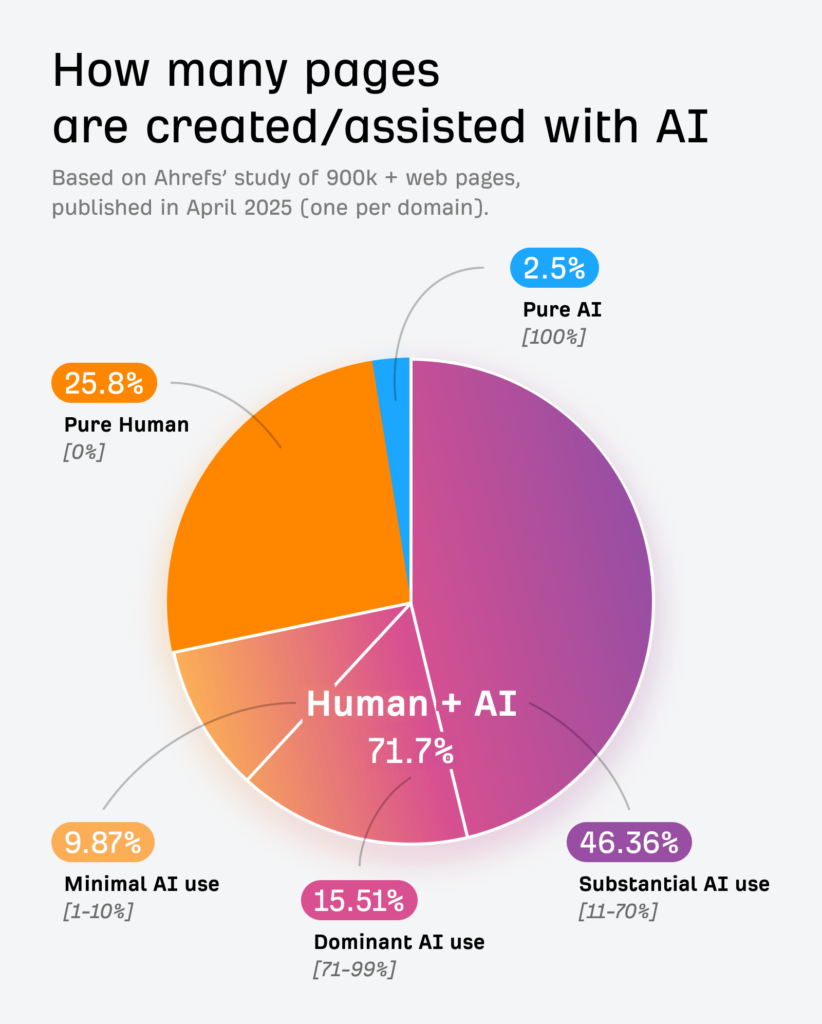
A study of 900K webpages reported that up to 74% of new webpages have some AI-generated content. That’s a lot. And it doesn’t include AI-assisted content which would be probably 100% because businesses use some sort of AI tools during content creation, so technically all content is AI-assisted.
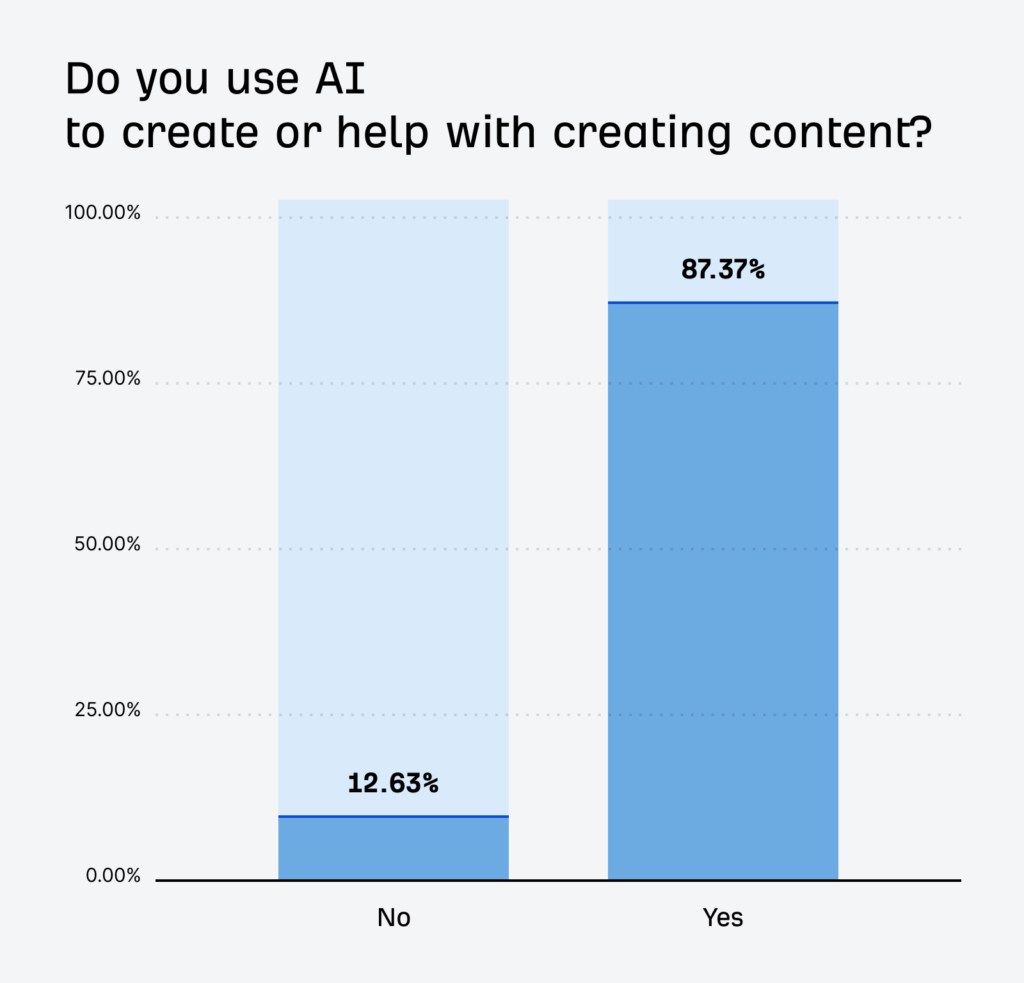
The same study reported that 87.4% of content creators say that they use AI to either create or help with content creation.
Since marketers now have the ability to create content at scale with AI, the content velocity across all channels has increased a lot. The impact of AI on SEO can be considered both good and bad.
- A high content velocity doesn’t always mean you are creating junk content. If you have developed an in-house AI-based system to generate content massively without excessive use of AI-generated content, you are in good hands. It has a positive impact on SERPs as more content means more keywords, impressions, and traffic.
- When content is created using AI without any human supervision, it has a negative impact on SEO. Google is cracking down on AI content that doesn’t offer E-E-A-T.
A high content velocity generally has a positive impact on SEO.
5. Reduced Organic Clicks and Traffic
This is a direct outcome of AI.
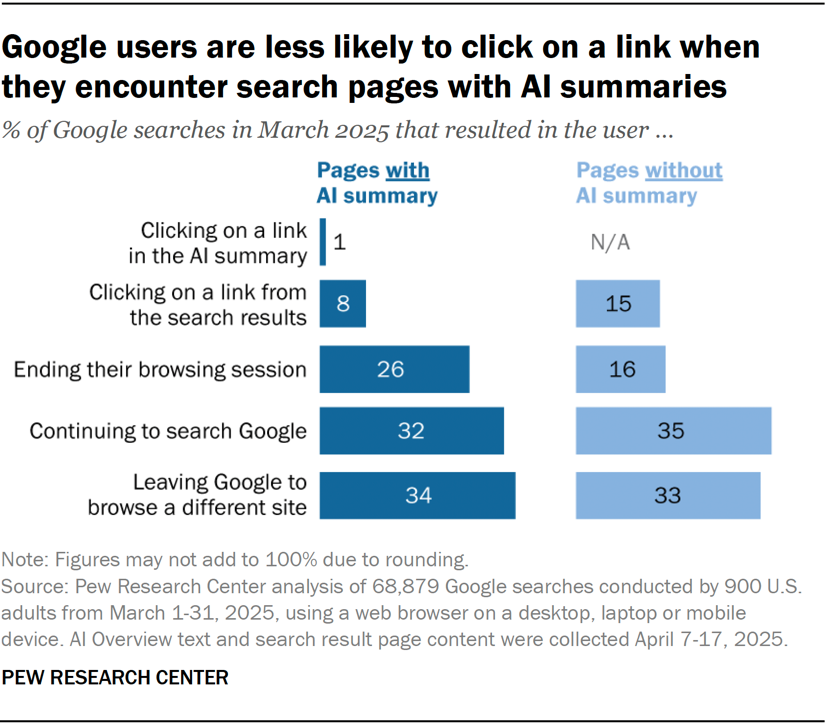
A Pew study found that up to 90% of people who see an AI Overview in Google search have zero clicks and 26% of them close their browsers without going to any other source:
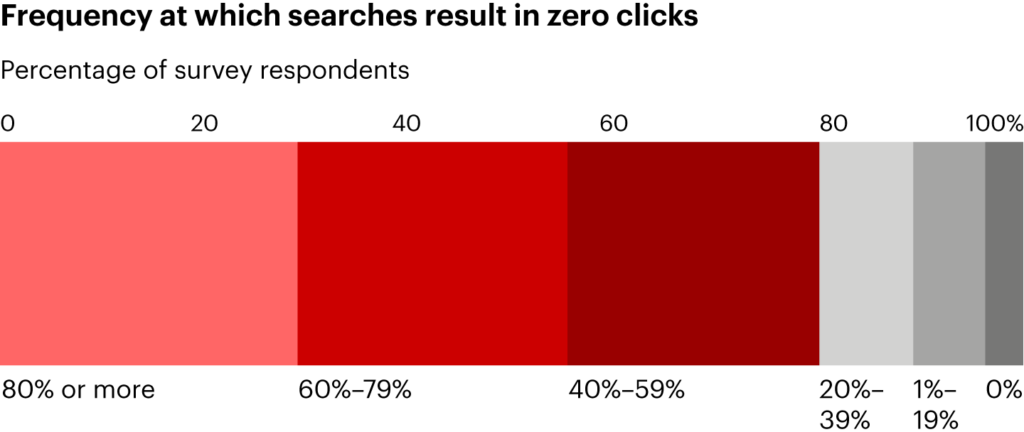
A study by Bain & Company found that 80% of users rely on AI summaries at least 40% of the time. This has resulted in a decrease in organic traffic by 25%:
An Ahrefs study of 300K keywords revealed that the average CTR of position #1 in Google has reduced by 34.5% due to AI summaries. We have moved to zero-click searches where users are interested in answers instead of websites, links, or anything else:
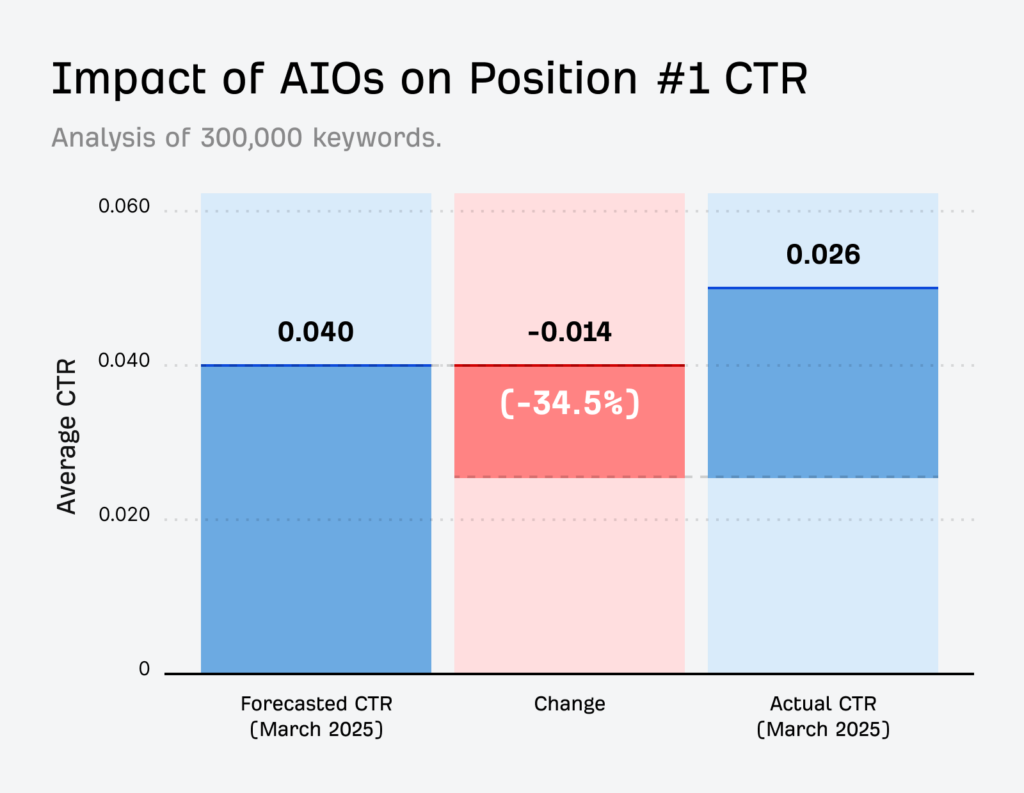
This means organic clicks and traffic both have declined due to AI. And it’s not just on paper, it’s a fact.
Zero-click searches are a hard reality.
This is a reason why businesses switched to GEO and AEO, along with SEO. But the fact remains, AI has negatively impacted organic traffic and clicks in general.
There’s a bright side, too, however.
A decline in organic clicks and traffic doesn’t necessarily mean a reduction in sales and revenue. You lose a certain percentage of organic visitors, but the ones you receive are highly likely to convert.
These visitors didn’t like AI summaries and wanted to get more details.
This translates into a high conversion rate and a more engaged audience.
AI Overview filters low-value traffic…
6. More Focus on LLMs
… There’s a huge difference between organic conversion rate and LLM traffic conversion rate. This is a reason why GEO is becoming a common practice. But it’s much more than that.
AI has done one thing that nothing could do in the past decade.
It showed marketers that Google search is replaceable.
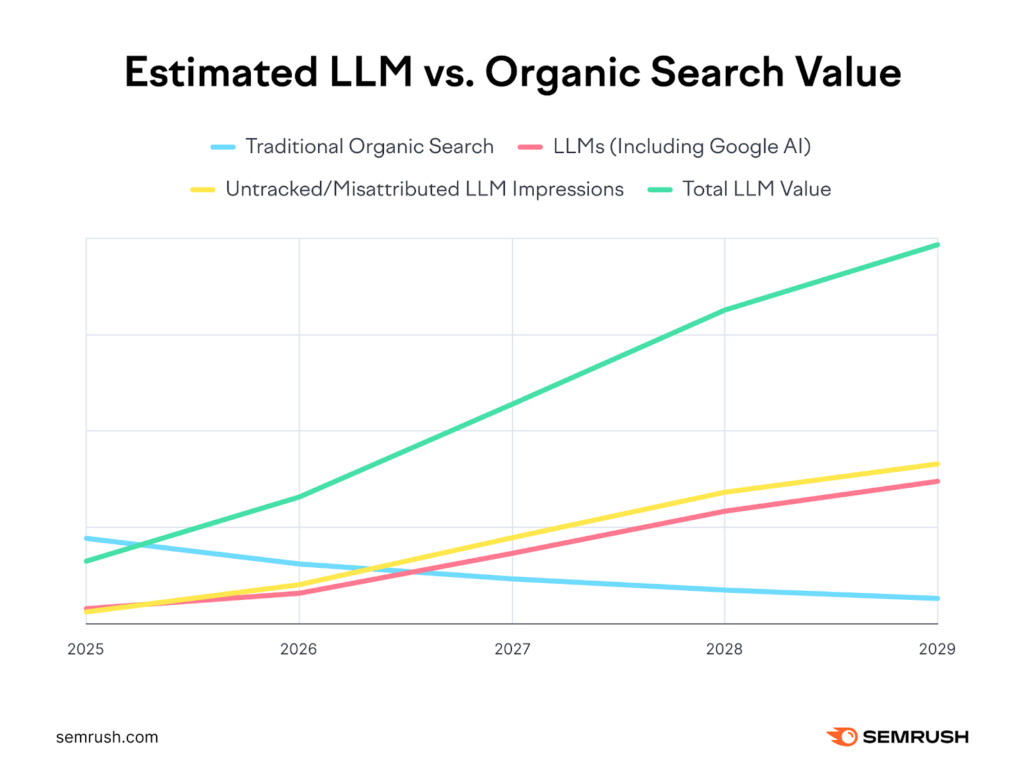
The focus is now on LLMs. Gen Z is already using AI chatbots as its primary search engine. Users who begin their journey from an LLM (such as ChatGPT) are 4.4x more valuable than traditional search visitors.
That is, a user who visits your website via an LLM is more likely to convert than an organic visitor.
This is because LLMs provide all the basic information to the users before they direct them to a source, or they click a cited source themselves. In both cases, the lead is already warmed up by LLM.
This is a reason the LLM value is estimated to surpass traditional search value by 2027:
Businesses already know the importance of AI citations.
A switch from Google to LLMs is all due to AI.
It has changed content formatting, writing styles, content depth, and a lot of other conventional SEO factors.
7. More SEO Metrics to Track
AI has added a good chunk of SEO metrics to the basket.
This means more work, more tracking, and more tweaks.
The common SEO metrics that are related to AI include:
- AI Overview inclusion rate
- AI citations
- Brand sentiment in AI
- Share of voice for AI
- Question coverage rate
- AI referral traffic
- Topical authority coverage
- AI traffic conversion rate.
These metrics are available with the leading SEO tools like Semrush and Ahrefs. You can track these easily with an app of your choice.
Eventually, this means more work for marketers and businesses.
It gets complicated and overwhelming at a certain stage because there’s too much to track and report. This comes with a high error rate.
When you have a few metrics to track, it’s easier. But when it increases, you need more resources and there’s a high chance of misreporting, duplication, or errors.
But it is essential.
For SEO and for survival.
Impact of AI on SEO: What Businesses Should Do
AI has changed SEO in numerous ways and it will continue to do so in the coming years.
Your strategy is what matters the most.
You need to prepare your business and SEO strategy accordingly. Develop an AI strategy for your business with clearly defined goals. Allocate a certain percentage of SEO budget to AI optimization (if you aren’t doing it already).
Align your AI strategy with your SEO strategy and make sure they work together. AI should be used to strengthen your brand’s visibility across search and LLMs.
Adapt.
That’s the only way to move forward.
Featured Image: Pexels


