

Influencer marketing is a highly effective and growth-focused marketing technique. Up to 92% of marketers say that it is the best marketing approach they have used. It works as long as you identify and bypass fake influencers.
Almost all types of influencers, from nano to mega, have some percentage of fake followers and engagement. No, it’s not common.
Some influencers drive all their engagement and followers via bots and AI.
And that’s where it hurts.
If you are running influencer marketing campaigns and don’t have an actionable plan to spot fake influencers, you are in deep trouble.
Let’s explore all about fake influencers, red flags, and how to avoid them to get the most out of your marketing budget.
What is a Fake Influencer?
A fake influencer is an influencer who manipulates popularity in the form of the number of followers, engagement, or other ways. The statistics aren’t real which has a negative impact on your brand when you collaborate with such fake influencers.
For instance, you run an influencer marketing campaign and expect a certain outcome in the form of referral traffic and leads. If you end up hiring a fake influencer, it will result in a poor ROI.
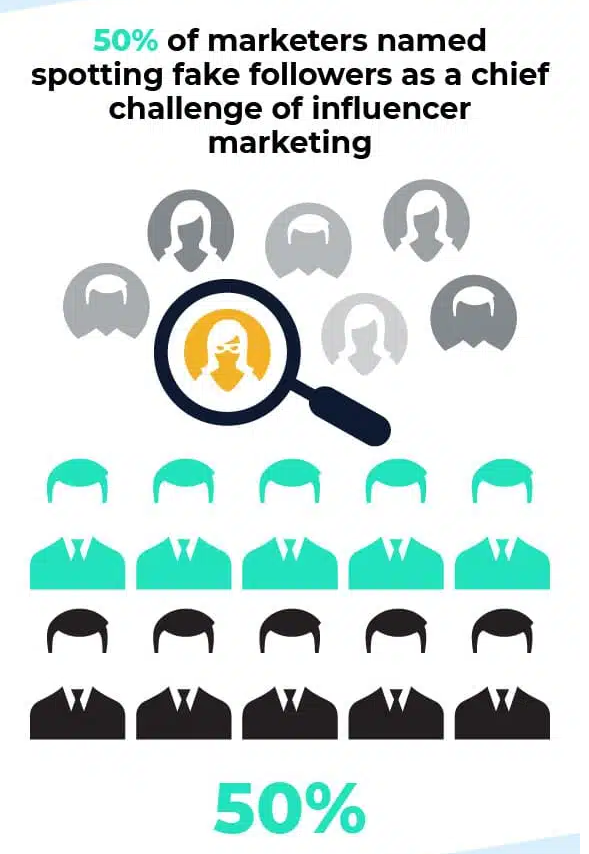
Research shows that up to 63% of brands reported that they experienced influencer fraud in at least one campaign. Consequently, 50% of marketers say that finding fake influencers is the biggest influencer marketing challenge.
It’s not easy for brands to spot a fake influencer.
An experiment conducted back in 2017 found that brands choose fake influencers for campaigns. They created two fake Instagram influencers. Posted random photos and purchased fake followers and engagement. They then acquired 4 brand collab campaigns for these two totally fake accounts.
It’s very common to have fake influencers. Even the real influencers use paid followers and engagement to inflate numbers to grab better deals.
Types of Fake Influencers
Fake influencers come in different forms and types:
- AI influencer: An AI or virtual influencer is the most dangerous type of fake influencer who isn’t real. The character is AI-generated, and it mimics human behavior. You will see engagement and all types of activity from such virtual influencers. They are easy to identify and, in most cases, they share full disclosure. But there are instances when they present themselves as real humans.
- Bot based influencer: Bot influencers use bot networks to inflate their metrics. Most of their followers are derived from bots and they don’t disclose it. They use it to collaborate with brands by showing numbers.
- Engagement fraud: A lot of influencers join private groups and communities where they engage in engagement activities in a highly coordinated manner. They comment, like, and share other people’s content and get the same in exchange. It gives the impression that an influencer has high engagement, but in reality, it’s not real.
- Follower fraud: This one is pretty common. Influencers purchase followers in bulk which includes both bot followers and human followers. Almost all the followers are inactive as they don’t perform any other activity. Since brands look at the number of followers as the first metric to screen influencers so they have a high chance of getting brand collaboration offers.
Red Flags to Look For
The first step in spotting a fake influencer is to look for certain warning signs. There are certain signs that are considered red flags and they help you identify fake influencers quickly.
Here’s the list of the red flags and warning signs to look for in influencers:
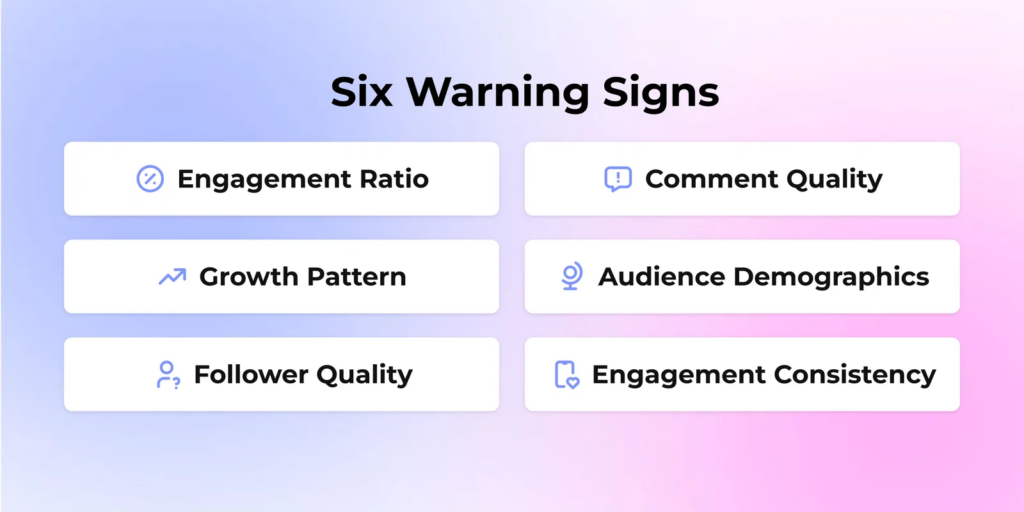
Engagement Rate
Engagement ratio or engagement rate is a measure of audience engagement of an influencer. It shows how actively the audience interacts with the content posted by the influencer (in the form of comments, likes, and shares).
It is calculated using the following formula:
Engagement rate = (Total engagements / Total number of followers) x 100
The resulting number shows the percentage of followers who interact with the influencer on average.
It is a common metric that’s readily available across all social platforms and influencer marketing tools. What’s important is how you interpret it.
Too high or too low engagement rates are clear warning signs. You need to look at industry benchmarks for engagement rates for comparison. Without knowing industry averages, engagement rate doesn’t make much sense.
Here’s an overview of the average monthly engagement rates across leading social platforms for 2025 as per Buffer:
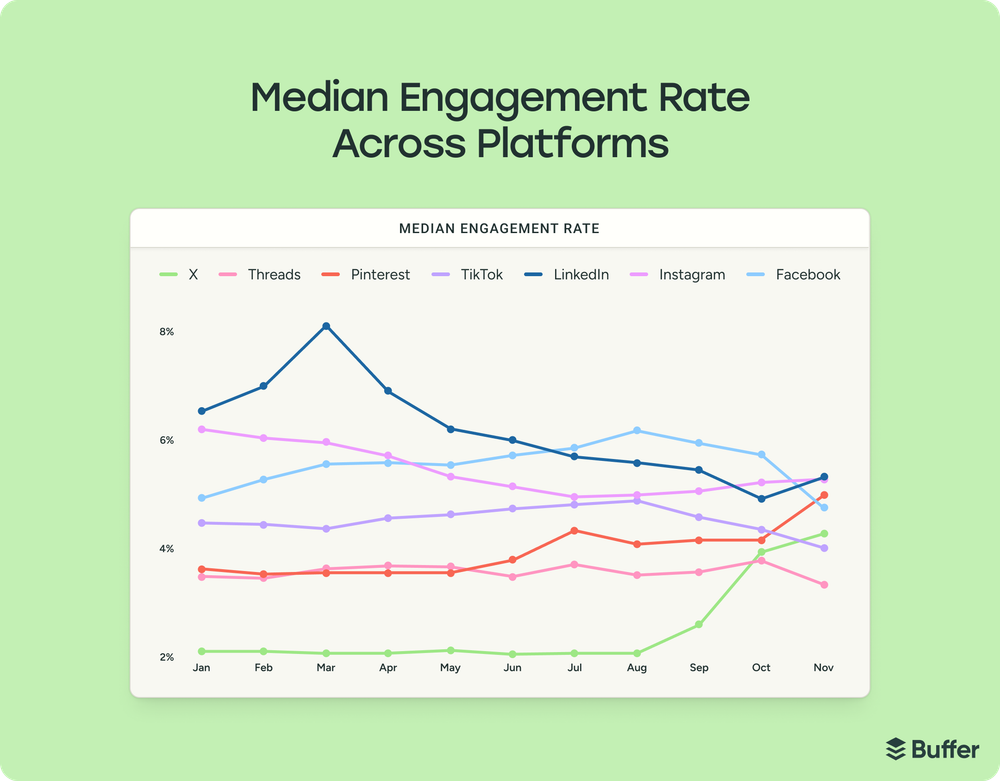
It shows an average of under 6% for all platforms.
Now, if you see an engagement rate that’s 0.5%, it’s too low. It indicates the followers aren’t active and possibly fake (needs further investigation).
On the flip side, if you come across an engagement rate of 14.5%, it doesn’t make sense. It is also a red flag.
It’s best to look at a few different benchmarks for a clear understanding.
Comment Quality
Engagement rate doesn’t tell the complete story.
You always have to dive deep into the comment quality to look for warning signs.
Influencers use bots for engagement to improve their engagement ratio. You need to check the types of comments on a few recent posts. Up to 38% of influencers are found to use suspicious methods to grow their engagement.
Bots post these types of comments:
- Generic comments that aren’t specifically related to the post
- Single word or a couple of words
- Multiple emojis with no text
- A lot of similar comments that are exact copy-paste.
Here’s an example of how bot comments look like:
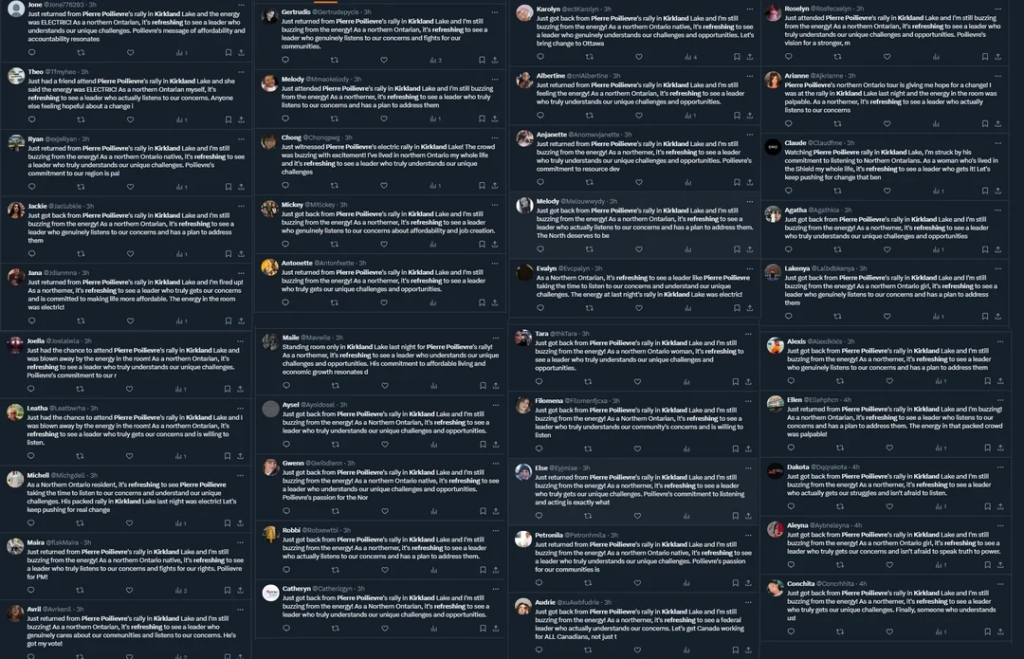
Research shows that social media bots significantly differ from humans in communication patterns. And this difference is evident.
They are easy to find. You don’t need any tools. Checking comments manually will reveal any patterns.
If you find suspicious comments that aren’t related to the post, stay away from the influencer.
Follower Quality
Bot followers are more common than engagement bots. A follower count isn’t inherently good or bad. It needs to be inspected.
It comes down to follower quality which is a metric used to measure the authenticity of followers of an influencer. And it covers three aspects:
- Authenticity which tracks real vs. fake followers
- Relevance in terms of interests and demographics
- Status of the followers (active vs. passive).
An analysis of 100K accounts revealed that as much as 37.2% of influencer followers are fake, purchased, or inauthentic.
This is a lot.
This is a reason why merely looking at the follower count is a bad idea. A better metric is follower quality.
Here’s how to inspect follower quality and what red flags to look for.
Check profiles of a few followers of the target influencer at random. Check if their profiles look real or fake. Fake accounts usually have no activity, a fake profile photo, lack a bio and description, and follow a lot of accounts.
Most of these fake accounts have been created recently because they are tracked and blocked.
If the influencer has a few of such followers, it’s a big red flag.
Also, look at the posts and the type of content they share. It should be related to the niche of the influencer.
For instance, the followers of a local food influencer should ideally be located in the same city. If they aren’t located in the same area, it’s a warning sign.
You can use a tool like HypeAuditor or any other to track follower quality easily. But don’t go without a manual check.
Growth Pattern
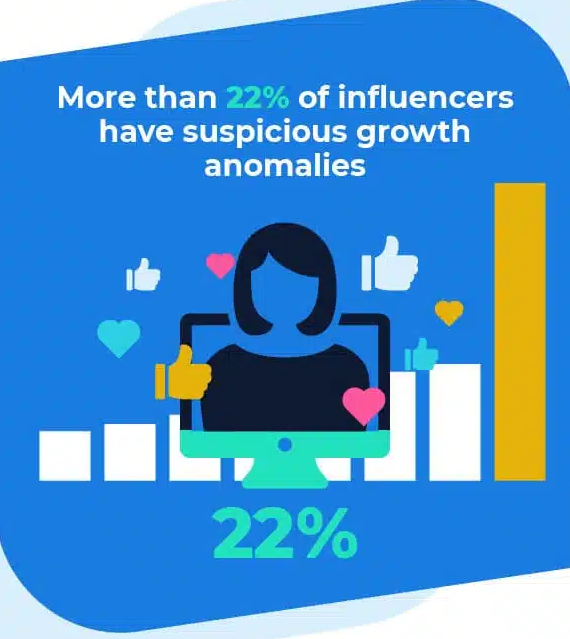
Up to 22% of influencers have suspicious growth anomalies. This is mostly related to the number of followers and, in some cases, engagement too.
You need to look at the sudden spikes and anomalies in followers and engagement.
Organic growth is consistent and gradual. If the influencer has a couple of viral posts, it makes sense. But if there’s no viral content and you see a massive increase in the number of followers and engagement per post fairly quickly. It’s not a decent sign.
Here’s how to look for suspicious growth patterns:
- Look at the follower growth for the last 6-12 months. Are there any sudden spikes that can’t be justified?
- Has the engagement rate on posts grown instantly without any viral posts?
- Is an increase in followers accompanied by a high engagement rate?
Growth is normally linear and gradual. If it has some other pattern, it needs to be investigated.
And it’s a lot easier. You just have to look at the follower quality and engagement rate (for pre-growth and post-growth). These two metrics should improve in the case of organic growth. If it’s mere growth, it’s a warning sign.
Engagement Consistency
Engagement on posts isn’t always consistent. It fluctuates.
Only a few posts get heaps of engagement. This is the natural process.
It’s something you should look at when evaluating influencers.
Social media engagement growth follows an S-curve which shows natural growth. It starts slowly and then it gains momentum gradually. There are rarely instant spikes.
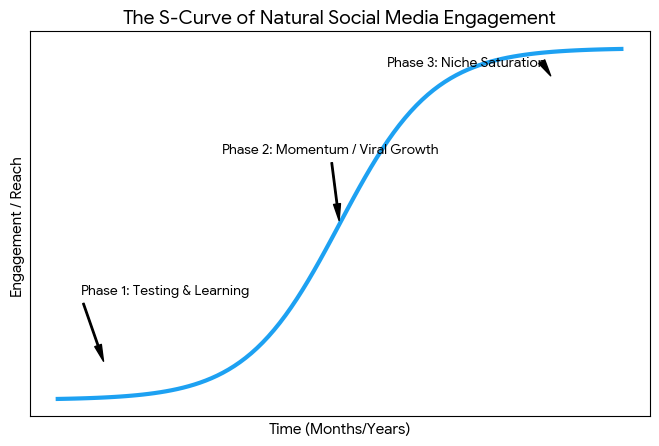
There’s always a plateau stage where engagement stalls. This is due to saturation, interest changes, and other factors. At this stage, the influencer has to switch to different content formats or topics to revive engagement.
It takes at least a year to move from the initial start to the momentum phase. Any influencer who gets engagement in batches or too quickly, you need to stay away.
Engagement, at any stage, is not consistent. It is never linear.
How do you assess engagement consistency?
The best way is to run a manual check. You might not be able to plot an S-curve, but you’ll get to know engagement consistency.
Look for instant spikes. See if all posts get engagement. The posts that have high engagement should be worth sharing.
Inspect random posts and engagement for the past few months to monitor consistency.
Audience Demographics
This is one of the most reliable red flags. Inspect audience demographics and look for potential mismatches.
The target audience (aka followers) of an influencer should share the same demographics, especially interests and location.
For instance, a US travel influencer should have followers from the US and from English speaking countries. The followers must have an interest in travelling.
Check profiles of a few followers to find any mismatches.
You can use tools like Modash or HypeAuditor to get detailed audience insights. If a high percentage of followers don’t have the same interests and hobbies, the influencer isn’t a good fit.
It doesn’t necessarily mean the followers are fake. The followers can still be genuine, but it won’t help you achieve your influencer marketing goals (due to audience mismatch).
You don’t want to pitch your US-based products to people living in Asia, even if they are real.
How to Spot Fake Influencers [Checklist]
Warning signs and red flags aren’t enough to spot fake influencers. They help you in basic screening. You need to follow a checklist to find fake influencers.
Below is a complete checklist to spot fake influencers and spend your marketing budget smartly:
Check Core Metrics
The first step is analyzing essential metrics.
You can request an influencer to share metrics. If you are using an influencer marketing platform, you’ll get these metrics from them.
Here’s a list of the metrics to analyze along with their thresholds and interpretations:
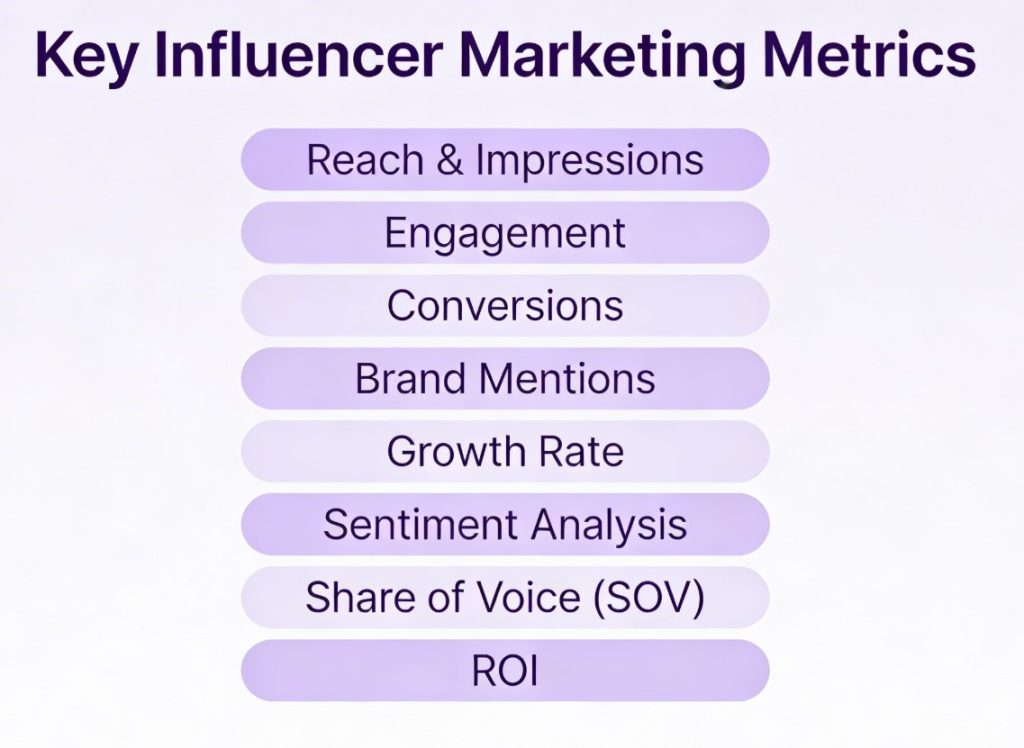
- Follower count: Check the number of followers of the influencer. Generally, the higher the number, the better. If you are working with micro or nano influencers, you should be ready to see a low follower count.
- Reach and impressions: Total views and unique views of the content are important metrics that must be analyzed. Reach and impressions are critical for brand awareness and the engagement level of the influencer.
- Engagement rate: It is used to track the activity level of the followers. Look for engagement rates above 1%. On the higher side, anything above 10% is suspicious.
- Growth rate: This includes both follower growth and engagement growth. Organic growth is between 4-8% per month. If it goes above 10%, it needs to be inspected. Influencer accounts with steady growth are ideal. Stagnant growth isn’t ideal as it indicates a lack of audience interest or market saturation.
- Audience demographics: The audience of the influencer (aka followers) must be your target audience. Look at their location, interests, and other demographics and make sure they match with your buyer persona.
- Audience authenticity: This is where you identify fake followers. This has to be done manually by looking at audience profiles and reading comments randomly. A single comment by AI or a fake profile is enough as these bots don’t usually follow people at random.
- Content quality and quantity: Look for content publishing frequency, quality, and formats. Look for AI generated content. If it’s mostly AI content, avoid the influencer. Ideally, at least one post per day is the bare minimum for any social platform.
Verify Analytics
Analytics are also faked.
You need to ensure that the analytics you have are verified.
There are a few different ways to ensure verification:
- Access to social platforms’ analytics: The best way to get verified analytics is via social networking sites. You can ask for access or you can ask an influencer to share screenshots. A lot of social platforms like Meta let users give read-only access to analytics to anyone. So, it’s not really a big deal.
- API: This is a more advanced way to verify analytics. You can ask an influencer to provide access to analytics via API either directly or via a third party.
- Apps: You can use third-party apps like HyperAuditor that connect with the influencer’s account to pull real-time data which is also analyzed by AI to detect fraud. This is ideal as it’s pretty straightforward.
So, the rule is simple: Always look for verified analytics.
Don’t rely on what the influencer says or claims. Make sure the analytics you are viewing are actually from the social site and not fake.
Growth Analysis
Massive followers and high engagement seem ideal for an influencer marketing campaign. You need to inspect how the influencer reached the current stage.
Was this growth steady, or is it based on a few sudden spikes?
This is an area that most marketers miss. They just look at the current numbers, verify them, and proceed with the contract.
You need to check the growth rate.
This includes a few key areas:
- Growth velocity
- Identification of spikes
- Growth drivers.
The growth velocity needs to be steady as that’s how accounts grow organically. Natural growth follows an S shape (see above). It is never a straight line.
All the spikes in the growth curve must be investigated. Here’s an example of what a spike looks like:
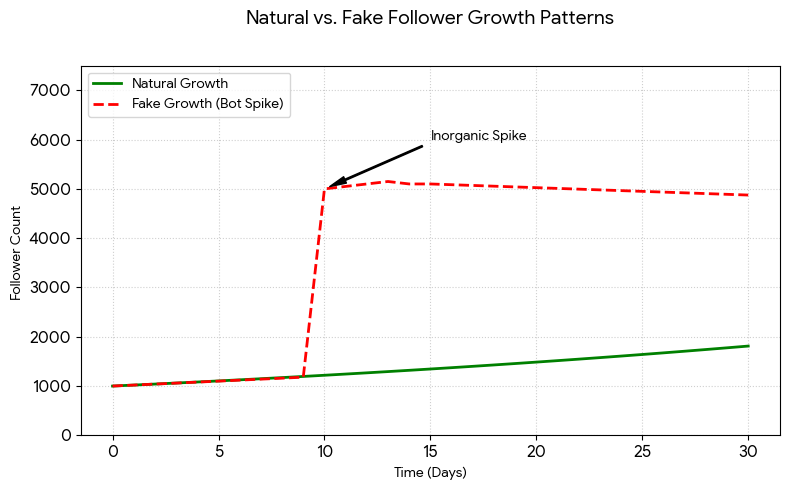
For instance, an instant increase in the number of followers or a high engagement rate on a few posts in a short span of time.
These indicate the use of bots or other manipulative techniques.
Of course, it needs to be investigated. Not all spikes are fake.
For instance, if a post goes viral, it can transform an influencer’s growth overnight. You need to look at the post and figure out if it really went viral or its engagement was driven by bots.
Finally, you need to look at the major growth drivers. For example, viral posts, collaborations and JVs by the influencer, consistent posting, etc.
The current state of an influencer is important. But how an influencer reached there is equally important. Don’t miss the journey.
Influencer Reviews
Look for influencer reviews.
Yes, it might sound too much, but it’s a must.
The first step is looking for natural reviews of the influencer. You can find them on the influencer’s own accounts. For micro and nano influencers, you can look for them on social media and forums as brands usually post there.
It is really hard to find public reviews about influencers, in general.
The second option is to ask the influencer directly for either reviews, references, or recent client history. Ideally, you should reach out to a few brands they have worked with recently and ask for an honest review.
You can hunt brands by looking at the content the influencer has posted recently. It’s pretty easy.
Most brands won’t reply to you. And references and reviews shared by the influencers are usually biased (because they share the best ones).
There are, however, a few ways to figure out if previous clients were happy or not:
- Check social accounts and websites of the brands the influencer has worked with. If they shared videos and content of the influencer, it means they are satisfied and happy. If there’s no mention of the influencer’s content, it’s likely that it didn’t work out well.
- If the influencer has worked on multiple campaigns with all or most brands, it’s a positive sign. However, if brands just run single campaigns, it’s not a good sign.
- Look at the type of content produced for brands and engagement on sponsored content. Ask yourself, do you want this type of content for your brand?
If you are using a tool or an app, you’ll be able to see reviews of the influencer for campaigns for that specific marketplace. This gives you a nice idea of an influencer and helps you spot fake influencers.
Use a Tool
This is a must.
Influencer marketing apps and platforms are very helpful in identifying fake influencers. Imagine you have to collaborate with multiple influencers. It gets really tough to audit several of them manually.
At some point, you have to switch to a reliable platform.
The earlier you do it, the better.
Here’s a list of the popular influencer marketing apps that’ll help you spot fake influencers:
- HypeAuditor: It is a dedicated tool to find authentic and reliable influencers. It maintains its own list of influencers who are pre-vetted, so it saves you a lot of time.
- Modash: It simplifies finding and vetting influencers as it provides a detailed performance analysis of target influencers.
- Upfluence: You can pick and choose influencers from its database which is frequently updated. You get access to detailed metrics making it easier to spot fake influencers.
- Lessie AI: It finds social accounts based on your needs and scans more than 100 different data points to find authentic influencers.
- Social Auditor: It analyzes influencer accounts for bot followers and fake engagement.
- GRIN: It offers a free tool that gives a credibility score to an influencer helping you check authenticity instantly.
- Inflencity: You can use it to generate a follower quality score which is based on multiple factors that their tool scans.
These tools are helpful in spotting fake influencers. For better results, use 2-3 different apps to screen influencers.
Influencer Marketing Works Well When Done Right
Influencer marketing is a highly profitable marketing strategy. You can reach a wide audience instantly and drive heaps of traffic.
But it has to be done right.
Choosing the right influencer is the most important step. It has a direct impact on campaign performance.
If you end up with a fake influencer, you won’t see a decent ROI. You can’t translate followers and engagement into clicks and brand awareness when dealing with a fake influencer.
This ruins ROI.
Spotting fake influencers and avoiding them is the first step in setting up an influencer marketing campaign.
Learn the process. And start implementing it.
Featured Image: Unsplash


