Google is the most used search engine in the world. But relying on Google as the sole traffic source for your website isn’t a healthy sign.
In 2025, Google reduced its index by roughly 20% which equates to millions of websites and webpages being wiped off Google search.
This is a recurring activity that Google performs every year at regular intervals.
It’s not about doing something wrong. It’s about relying too much on a traffic source that you have zero control over.
This guide covers reasons why relying on Google for traffic generation isn’t a smart idea and what other methods you should explore.
Why Relying on Google is a Bad Idea?
Putting all your eggs in one basket is a bad idea.
But that’s not the only reason, as a business owner, why you shouldn’t rely on Google for (organic) traffic.
There’s a lot more to this story…
- It is crucial to be on the first page of Google to get any organic clicks and traffic. If you don’t make it to the first page, you don’t exist. Up to 93% of the organic traffic is attributed to Google’s first page. You have to be on the first page (ideally at the top) to get decent organic traffic. This is a challenging task because rankings fluctuate a lot.
- It takes a lot of time to rank on Google. If your domain is new or has low authority, it takes 2 years to reach the first page. And there’s no guarantee that you’ll ever reach the first page.
- Google changes its algorithms a lot. It updates algorithms several times in a single year and this makes it hard to sustain ranking and traffic. You can lose your rankings overnight and might not get them back ever.
- The competition is fierce. Google is the most used search engine globally with almost 90% market share. This makes it very hard to reach the top and maintain your rankings.
- There’s no support. If you think your website was hit or penalized mistakenly, there’s no way you can contact Google. There’s no notification, no explanation, and no details. You have to figure out the reason yourself and try to fix it. This is all guesswork.
- Up to 60% of Google searches have zero clicks in 2026. This means that for 60% of search queries, no website ever receives a visitor. Generating traffic from Google search is becoming harder and this will worsen in the future with AI sophistication.
HubSpot, for instance, lost 77% of organic traffic after Google updated its core algorithm.
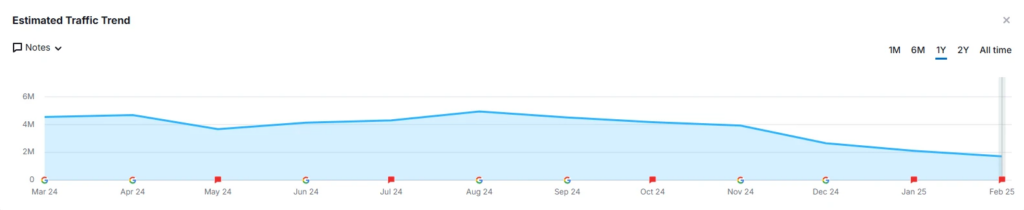
Forbes lost up to 80% of its organic traffic during the same time period due to the same algorithm update.
This is indeed a risky, challenging route.
Ways to Drive Traffic Without Relying on Google
Google is indeed one of the biggest sources of organic traffic. It is the most used search engine. But there’s still a world outside Google’s ecosystem.
Below is a list of the major traffic sources that you must add to your strategy for diversification:
Other Search Engines
Google isn’t the only search engine out there.
While Google is clearly the market leader in search with a whopping 90% search engine market share, it isn’t the only search engine around.
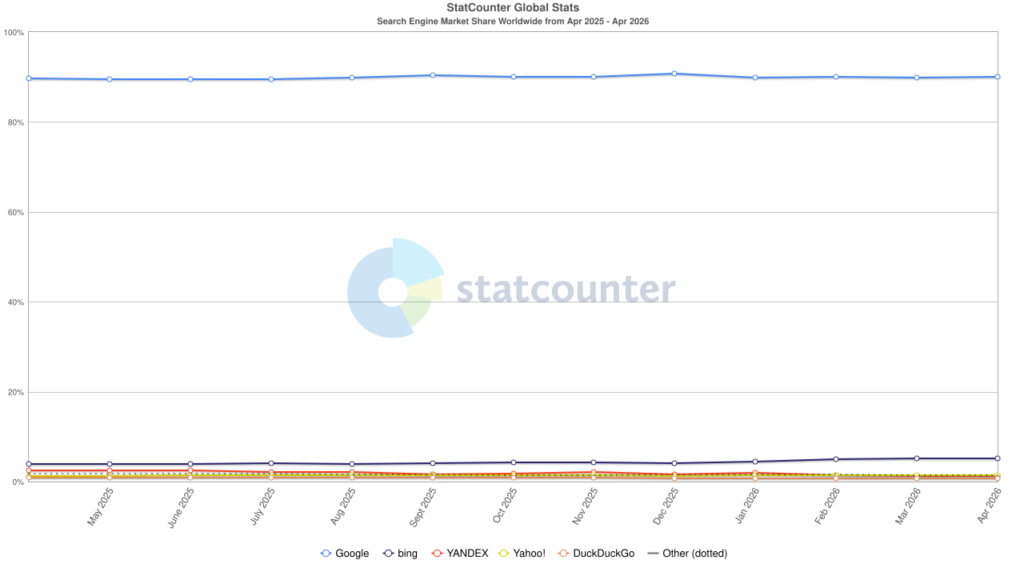
Bing is the second largest search engine with 5.14% market share followed by Yandex, Yahoo, and DuckDuckGo. Yahoo and DuckDuckGo use Bing as their source which increases its market share up to 7.35%.
Yandex has 1.19% search market share while Baidu has 0.46%.
For context, if you only focus on Bing as your primary traffic source, you’ll still get millions of searches per day. Bing processes more than 1.1 billion searches per day worldwide.
That’s a lot.
Of course, it has no comparison with Google, but if you want to ditch Google, Bing is your best bet for organic search traffic.
The good thing about Bing is that it powers a lot of other search engines. When you rank on Bing, you ultimately rank on search engines that use Bing as a source. These include:
- Yahoo
- DuckDuckGo
- Ecosia.
Yandex and Baidu are localized search engines for Russia and China, respectively. You can use them to generate organic traffic too.
Do these alternate search engines work well to drive traffic?
Yes, they do.
They work well for diversification. And you can rely on these search engines for organic traffic.
Think in terms of dollar value per visitor and not just traffic.
A website with a decent conversion rate can kill it with Bing search alone. There’s no big or small traffic source. Every traffic source is equally important.
Social Media
Social media is one of the biggest sources of traffic. It includes both organic and paid traffic.
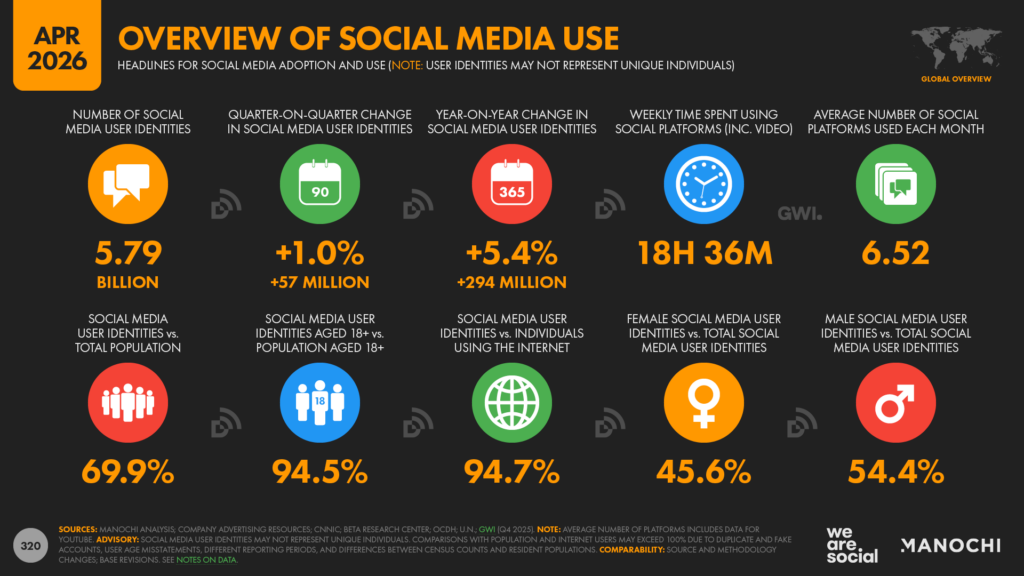
There are 5.79 billion social media users worldwide as of April 2026 which equates to 70% of the world’s population. This is much higher than the roughly 5 billion people who use Google worldwide.
Additionally, there are certain people who use social media as their primary search engine. For instance, 74% of Gen Z reported that they use TikTok as their primary search engine and don’t use Google to find new information.
An online survey of 2000 people reported that younger generations (like Gen Z and millennials) use social media for search purposes and don’t rely on Google as often:

An increasing number of people use YouTube (up to 57%) to find new information and use it as their primary search engine. Around 56% of people use Facebook instead of Google.
It’s not just about video search. Social media is used as a primary search engine by at least half of the world’s population which includes all generations.
There are two ways to generate traffic from social media platforms:
Organic Social Traffic
People who visit your website from any social platform naturally, without any paid traffic sources. It is derived from your community and followers.
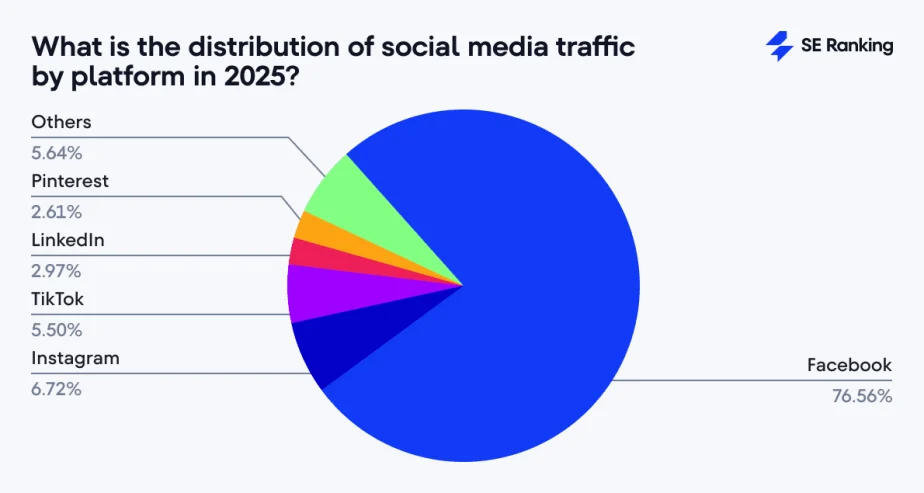
Statistics show that Facebook is the biggest contributor to traffic generation among social platforms. It’s because Facebook is the most used social media network in the world:
The content you publish on social media drives traffic to your website and/or landing pages. You get free traffic as long as your content and profile are out there. It doesn’t require active promotion, rather, it’s natural traffic. You might not get it instantly as it requires time.
The good thing about social organic traffic is that it’s free and you get it fairly quickly. There’s no pain in fighting constant algorithmic updates. Relevant content makes it to the people’s feed automatically.
There are a few downsides to this type of free traffic from social media:
- It needs time to develop an audience, following, and community before you start getting organic visitors from any social platform. The good news is that it doesn’t take up to 2 years, as in the case of Google. You can grow fairly quickly on social media.
- Social content has a short life. This makes organic traffic from social media less sustainable and somewhat unpredictable. Content gets obsolete fairly quickly. This isn’t the case with Google search, where you develop authority as your site and content age.
- You have to publish new content consistently to stay relevant and to keep your audience engaged.
Paid Social Traffic
The drawbacks of social organic traffic can be handled via paid social.
You can run social media ads to send instant traffic to your website. It provides you with immediate targeted visitors from a social network of your choice.
Meta ads is set to overtake Google Ads in 2026 and will become the leading online ad network in the world:
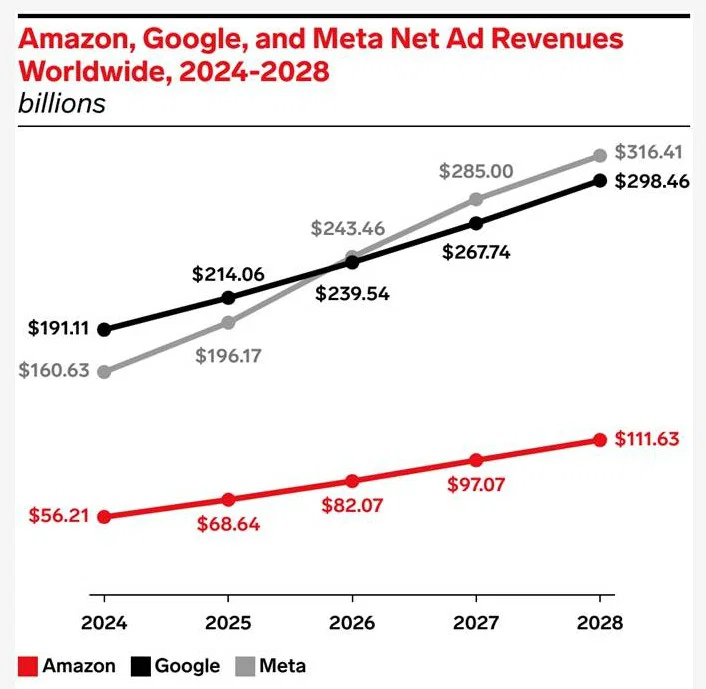
It clearly shows a shift away from Google Ads. Social ads are also becoming the new norm.
There’s technically not much difference between running and managing an ad campaign in Google Ads or Meta Ads or any other social platform. It’s pretty simple.
There isn’t much difference in costs and ROI.
The major difference is that Google Ads targets an in-market audience who is actively searching for a product or solution (e.g., search ads). Social ads lack this capability. They are somewhat intrusive as people aren’t in buying mode on social platforms.
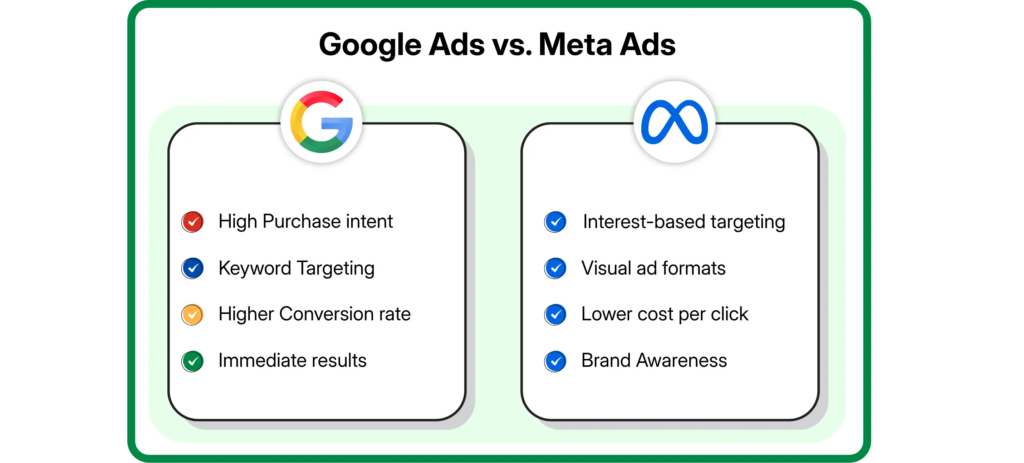
On the flip side, you get a lot of asset types to choose from on social platforms. For instance, you can run video ads of all types without any limitations. Video ads are more engaging and text and/or image ads. Google search ads don’t offer this flexibility.
These differences are applicable across all social ad networks which means all these ad networks provide you with instant access to tons of traffic.
Email List
I’m a big fan of email lists.
For two major reasons:
- You own your list and can use it in any way you like. It’s your audience. There’s no third party involved whatsoever.
- You don’t have to rely on other traffic and sales sources. Email provides you with the highest ROI, up to 3600% and 4x higher than Google Ads.
If you have an email list, you don’t have to rely on Google for traffic generation. In fact, you don’t have to rely on any other traffic source.
But…
Your list has to be fairly decent-sized and highly engaged.
On top of that, you need lots of time to build a decent-sized email list.
If you haven’t been building an email list and you want to ditch Google, there’s no way you can do it now or even in a few months.
This is a reason you should build an email list from day one.
Once you have an email list, here’s how it works as a traffic source:
- Create an autoresponder
- Send links to new content and offers to your list regularly
- Create a referral program for your list and bring in more subscribers (as customers) to grow your list.
Does this work as a full Google replacement?
Not really.
Because you don’t get access to new ideal customers as you do on Google. You have access to the same number of subscribers unless you manage to grow your list.
Considering the fact that the average list size of a B2B business is 4.81K with an upper limit of 16.91K, your chances of getting decent traffic are minimal:
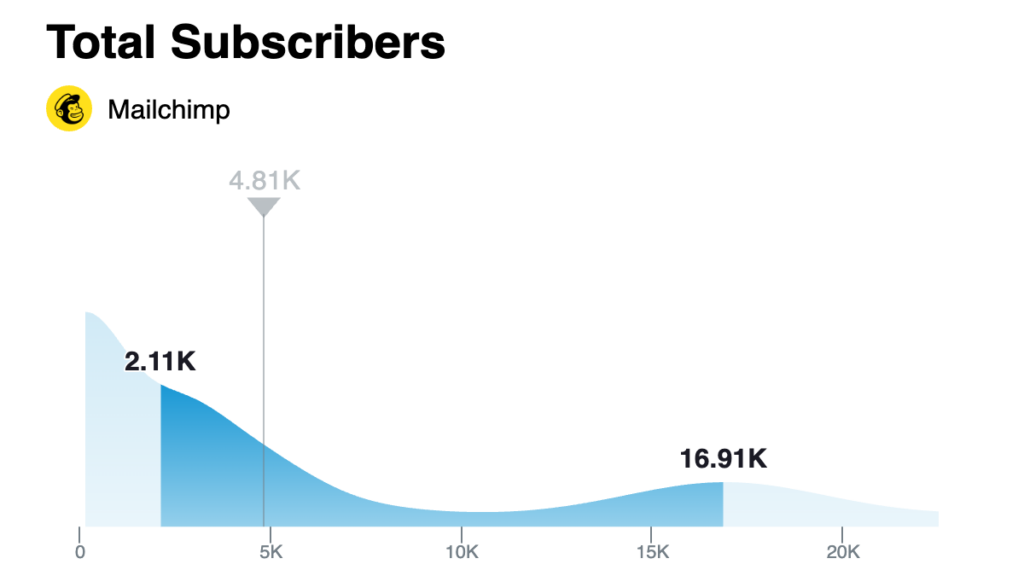
No traffic source is big or small.
Every visitor counts.
In challenging times, when Google deindexes a site, even a small email list seems too much.
Start building it.
AI Search
AI search engines are among the top traffic sources.
A study found that 63% of websites receive traffic from AI sources and up to 98% of all AI traffic is generated by 3 chatbots:
- ChatGPT
- Perplexity
- Gemini.
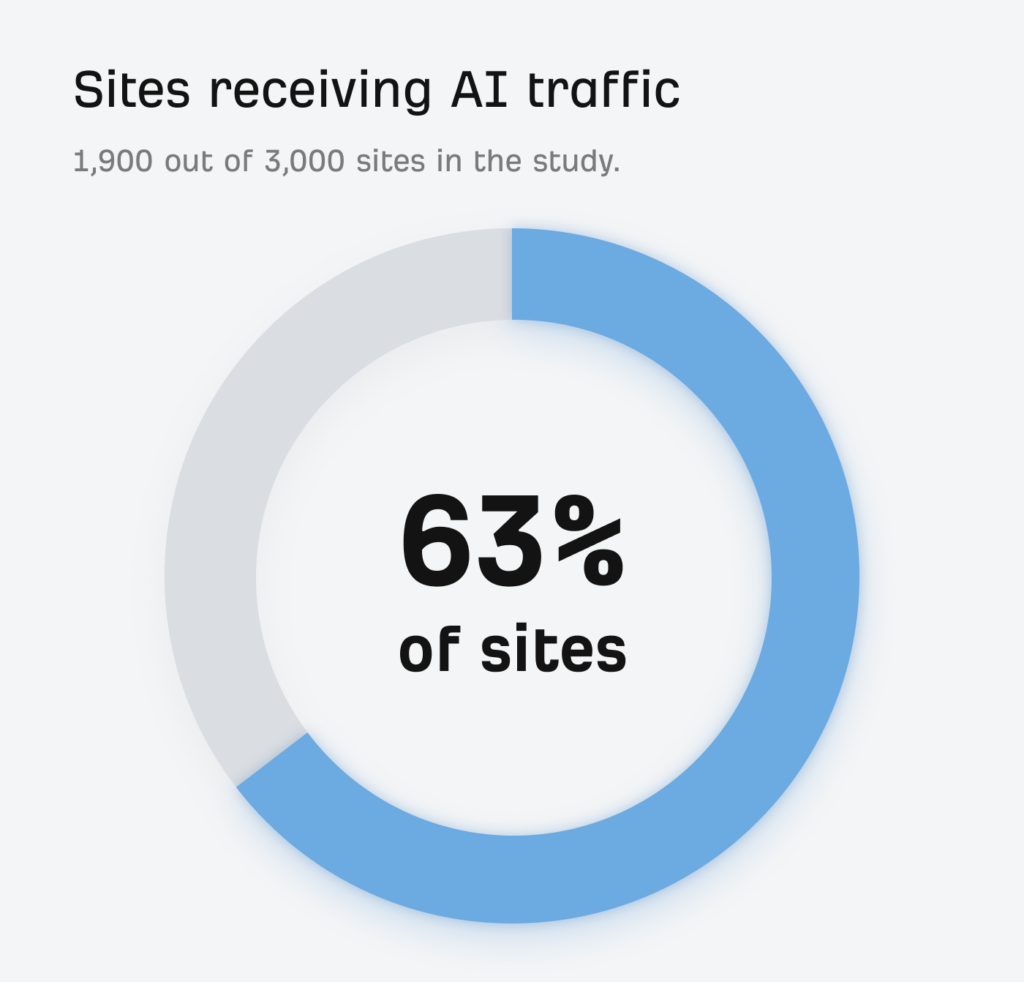
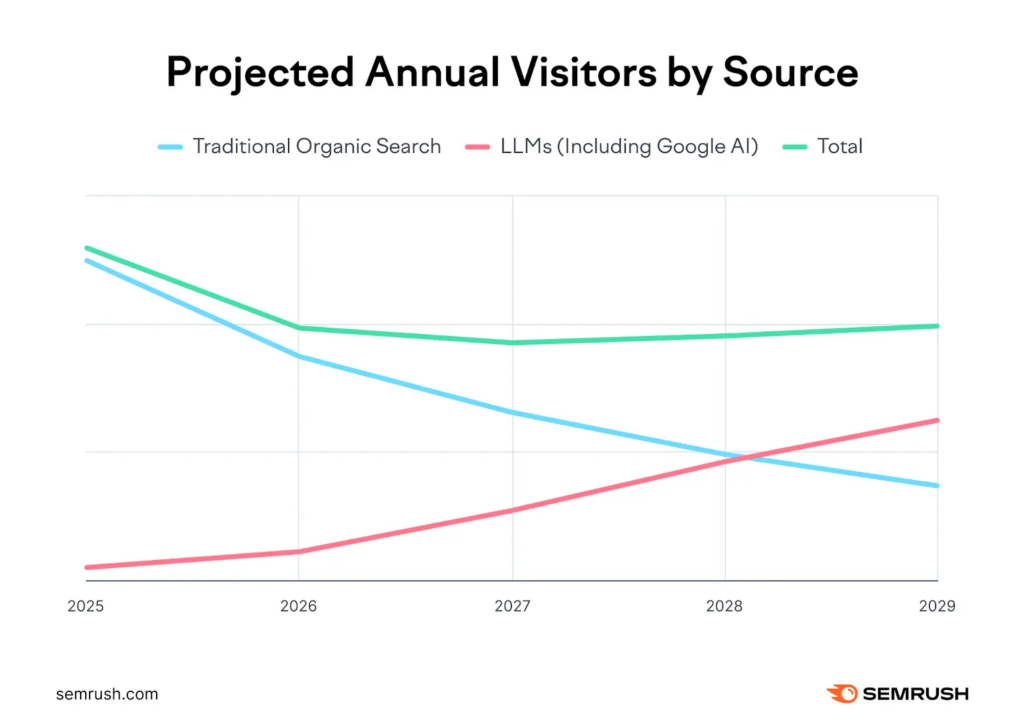
According to Semrush, LLMs are expected to cross traditional search by 2028 as people are switching to AI search:
ChatGPT has more than 700 million weekly active users and is now the fourth most visited website in the world.
If you plan to receive traffic from AI search, you need to optimize your site accordingly. You need to make your website AI-friendly and write content in a form that chatbots can understand easily.
It’s called generative engine optimization (GEO) where you actively take steps to improve your site’s visibility for generative engines like ChatGPT and Perplexity.
Here’s how to do it:
- Follow all the on-page SEO best practices as discussed here and here.
- Structure content properly with clear headings, bullets, and paragraphs.
- Provide direct answers and write summaries of every new section because that’s what LLMs prefer.
- Use schema markup as it makes it easy for AI to understand content and its purpose.
- Establish topical authority by covering the topic in detail. Avoid writing short pieces.
Your site doesn’t necessarily have to rank in Google to get citations from AI search engines. This is the best thing about them as they don’t rely on Google.
This turns out to be the best alternative to Google traffic.
Content Syndication
It is a perfect technique to drive tons of quality traffic without relying on Google or any other search engine. Content syndication refers to republishing the same piece of content across sites and blogs.
This lets you instantly reach a new audience and get referral traffic.
It’s a common practice that leading blogs follow. Here’s an example:

The good thing about content syndication is that you get proper attribution with a link. This helps you get traffic and build brand awareness.
You can syndicate content by sending a published article to another website that allows content syndication. There are syndication tools you can use such as NetLine or Outbrain.
Other methods include:
- Reach out to blogs that allow content syndication. To find such sites in your niche, run the following search query in Google: “the post originally appeared”. Modify this query accordingly by adding relevant keywords to it.
- Publish a guest post on another website and then republish it on your blog.
- Self-syndicate content by republishing across different channels and platforms you own.
- Use a paid or free content syndication network to scale your content syndication efforts.
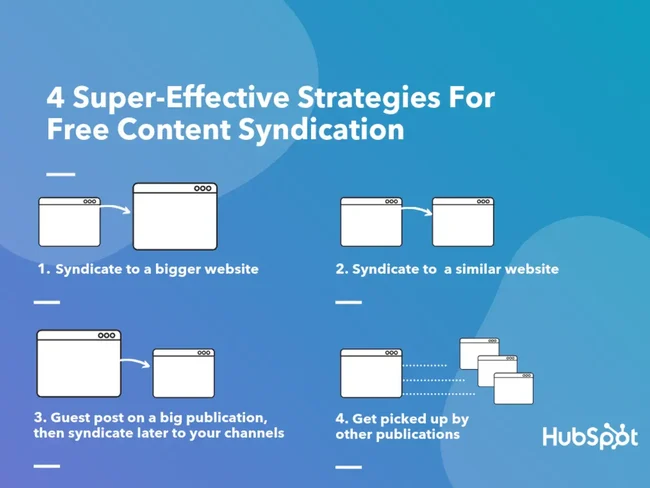
Content syndication is a legit marketing technique. It’s not considered duplicate content when proper sourcing and canonical tags are used.
You might not see a lift in referral traffic instantly. It requires time. It needs time to scale.
What’s important is that you syndicate content consistently for months and years. This helps you develop a network of traffic sources that you control.
Content Syndication Best Practices
It’s important to do it correctly right from day one. Follow these content syndication best practices to ensure you get maximum traffic:
- Always ensure that the content is fully indexed on your site before sending it elsewhere. This means there should be a wait time after you publish new content. Don’t send it out instantly.
- Use a canonical tag to get SEO benefits. This is normally done by other sites, but you need to do the due diligence. It is also important to make sure you get a link to the original source (either dofollow or nofollow) as it doesn’t just help you with referral traffic but it’s important for search engines and AI engines.
- Always syndicate your best content. Most businesses prefer having their best content on their site while they syndicate mediocre content. This is a bad technique. You need to show your best content to more people to build authority and trust. It also gets easier to get syndicated with high quality content such as research studies, whitepapers, and in-depth reports.
- Build your email list. You don’t own the incoming traffic, so it’s best to get them to your list. Create lead magnets and sign-up forms for your website and make sure your focus is on capturing email addresses – not just one-off traffic.
Referral Marketing
This traffic generation method is for brands that have an existing customer base. If you have a new business with limited customers or brand awareness, this won’t work for you, unfortunately.
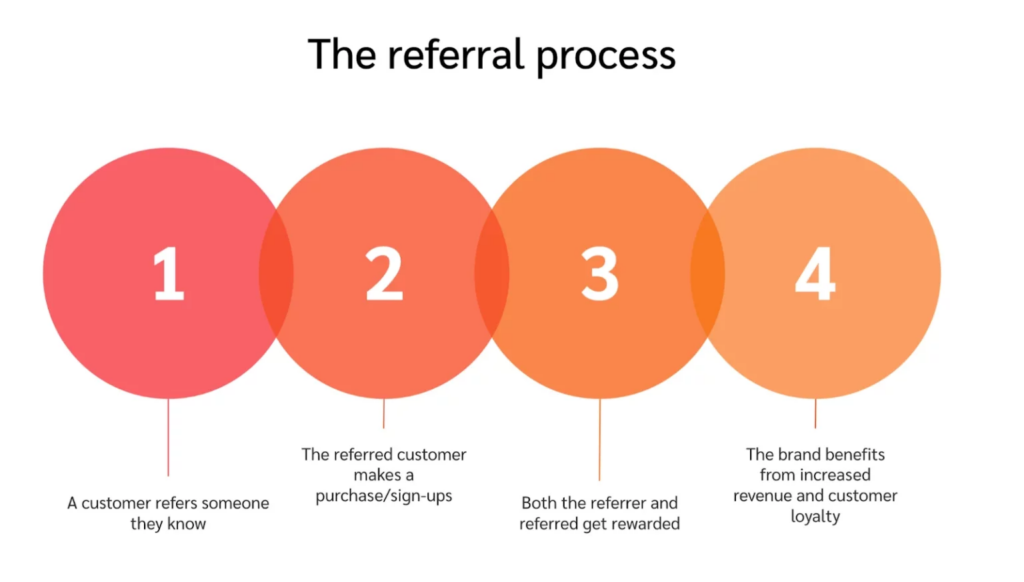
Referral marketing is an approach to reach new audiences via your existing satisfied customers. You offer an incentive to your customers every time they recommend your brand or product to their family and friends.
Since they are already happy with your product, they are more likely to recommend your brand to a friend if offered a valuable incentive.
Here’s how it works:
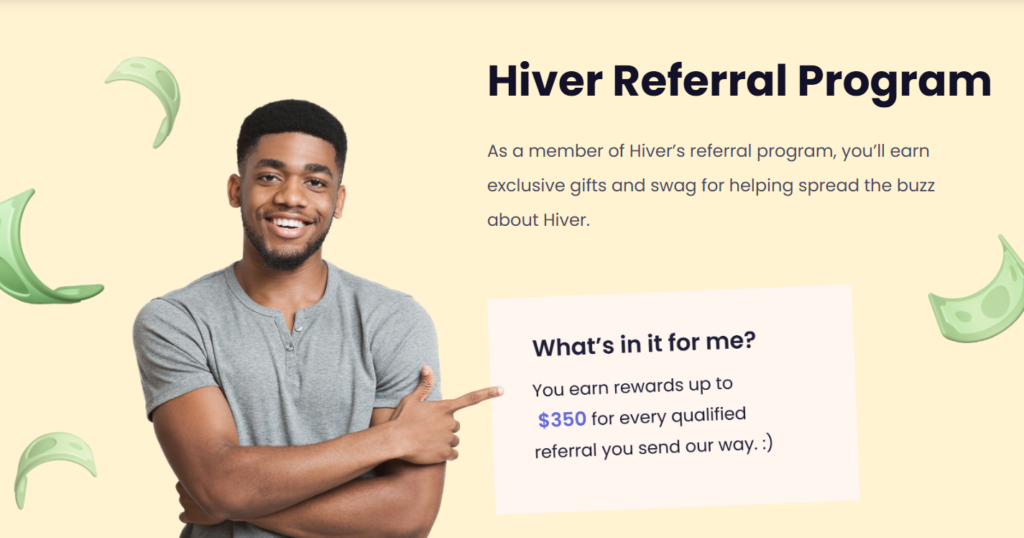
Below is an example of a referral campaign:
Referred customers spend up to 200% more than average customers. This is because they are recommended by someone they trust.
This marketing technique doesn’t just focus on traffic, rather, it brings in new customers (which matters more). So, you directly get customers which lowers your customer acquisition cost leading to high margins and customer lifetime value.
And it works as a continuous loop.
Here’s how:
- Existing customers bring in new customers
- New customers then bring more customers
- All the customers are offered a new product
- Update your pricing model and convert to subscription-based pricing for recurring revenue.
There are a few assumptions, though:
- You must have existing happy customers.
- The product catalogue should have multiple products. Or, there must be subscription-based pricing.
If your business doesn’t meet these conditions, it’s best to go with other traffic generation sources.
You can start your referral program by signing up with a referral marketing platform. It’s more of a full-fledged marketing strategy and growth approach. When done right, referral marketing can help you a lot in meeting your marketing goals.
Paid Traffic
This is an obvious alternative to Google search traffic.
Paid traffic sources include both online and offline sources.
Online advertising involves any type of paid digital ad on an ad network. Since we already covered social ads above, we won’t be going into those.
You can run ads on a wide range of networks including Google Ads. If you don’t want to use Google Ads, you still have a lot of options to choose from:
- Microsoft Ads (It covers Bing, Yahoo, DuckDuckGo, and other supported ad networks)
- Amazon Ads for ecommerce businesses
- Brave Ads
- Taboola
- Ad exchange platforms like OpenX
- Niche ad platforms like Quora and Reddit Ads.
Ideally, any paid traffic source falls into this category. For instance, influencer marketing and collaborations are ways to generate traffic.
Similarly, you can reach out to a target website directly and ask them to place your banner ad. In this case, you deal directly with the publisher. These types of online ads are quite common. You just have to find a relevant site that targets your audience. Ask for a banner ad cost per day, week, or month and get started.
There’s no limit to online ads if you bypass conventional ad networks and platforms.
And you should try all types of paid traffic sources. Do not limit yourself to online ads. Here’s a list of touchpoints a potential customer has access to:

TV, radio, direct mail, billboards, flyers, etc., are all effective in traffic generation. Most small businesses don’t use them anymore assuming them to be outdated.
They are not.
Yes, they aren’t the biggest source of web traffic generation, but they do play a role. Especially in brand awareness. And when you are not relying on Google, every alternative has a value.
Final Words
Putting all eggs in one basket is a bad business approach.
The same applies to relying on a single traffic source for your business.
Google search is great. But it has its drawbacks. You can lose your rankings overnight. Even if you don’t lose your rankings, it is still an incorrect (rather bad) business approach.
You have access to several other free and paid traffic sources. It’s best to explore and master them when things are in your favor. Don’t wait for the moment when your rankings dip.
Be proactive. Have a contingency plan.
Featured Image: Unsplash