

Only 10-20% of people who are looking to buy a business actually end up buying a small business.
Others just window shop.
What type of buyer are you?
Buying a small business seems too good. You get a business that generates money right from day one.
It works great.
Only if you know how to find and buy the right type of small business.
This guide covers the exact steps that will help you find and buy a small business.
Benefits of Buying a Small Business
Existing businesses offer a wide range of benefits that make them lucrative for other businesses and individuals.
Here’s an overview of key benefits of buying a small business:
- Instant profit: Buying an existing small business gives you access to instant cash flow. This is a huge plus because most businesses take, on average, 3-5 years for breakeven. When you buy a small business, you skip the line and get decent cash flow from day one.
- Low risk: Around 23% of small businesses fail within the first year. You avoid this risk when you buy a small business. Because its business model, product, and market are validated. You are sure that it hasn’t made any of those early-stage critical mistakes.
- Proven track record: Existing businesses have analytics and history that can be verified. When you have access to data instantly, you are in a better position to make the right decision from day one.
- Existing system and tech stack: You get everything in place. Apps, workforce, documents, customers, and the entire system. This alone takes a lot of time to build.
- Easier financing: If you plan to get financing, an existing business with proven numbers is more likely to land you a good deal. Lenders usually don’t go with new businesses that don’t have any sales.
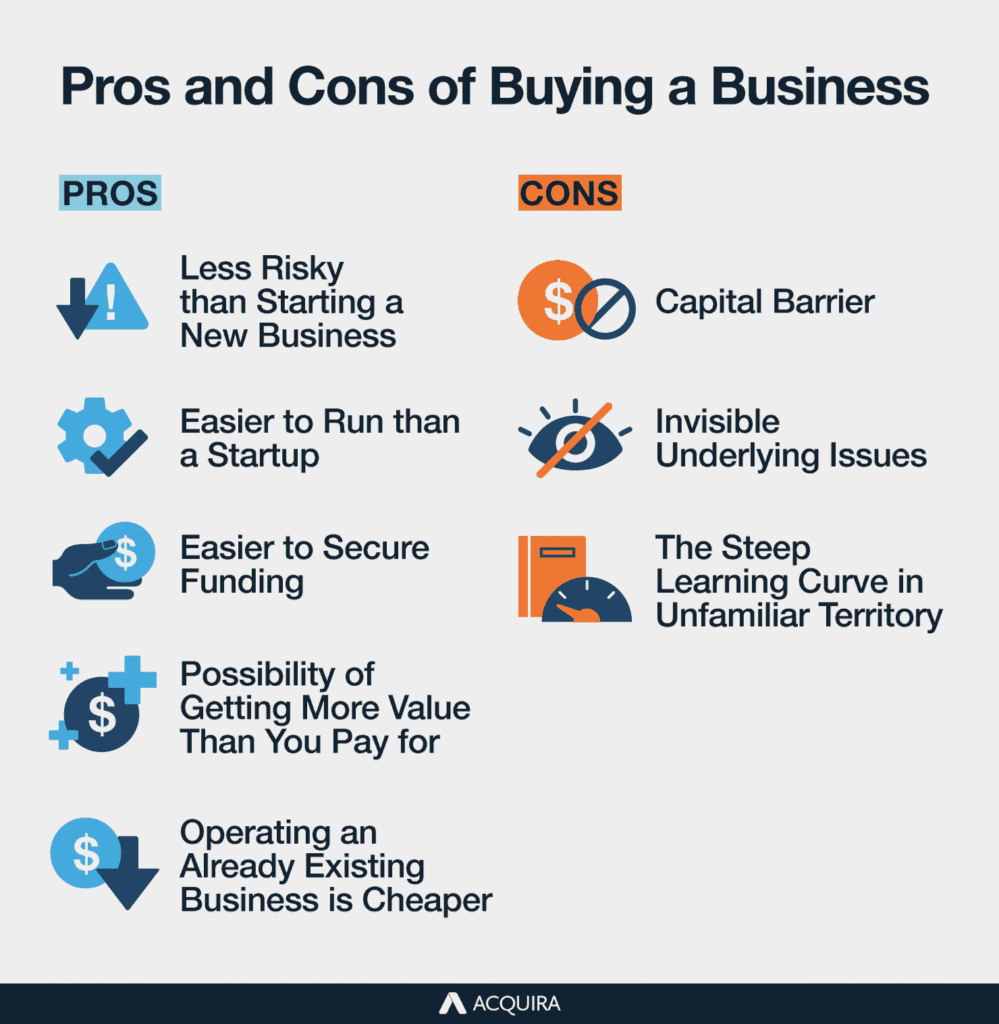
Of course, there are a few downsides too, but they can be tackled if you do a decent job at finding the right business (more on this below).
When Buying an Existing Business is the Right Choice for You?
There are times when buying an existing business makes more sense than starting your own venture from scratch. The following quick checklist will help you figure out if buying a small business is the right option for you:
- You have an existing business and want to expand it. This is the most common scenario where you have funds that you want to spend on a new business that could be related or highly unrelated to your current business.
- You have capital but limited resources. A lot of people have savings, but they don’t have the time, knowledge, or other resources to start a new business from scratch. Buying a small business that’s doing well is the best option for them.
- Acquire a competitor to minimize competition and grow stronger. This is what a lot of businesses do. Small acquisitions are very common. Even large businesses acquire their small competitors to kill the competition. In this case, you don’t necessarily look at the business’s profitability. Rather, your task is to acquire and divest a business into yours.
- Barriers to entry force a lot of people and businesses to buy a small business. A lot of industries require regulatory approvals and licensing. For instance, pharmacies, waste management, CNC machining, government contracting firms, etc. all require a lot of paperwork to get started. If you want to plan to enter such a market, it is always a good idea to buy an existing company as it will give you a head start.
- Move into a new market. A lot of businesses prefer jumping into a new market instead of acquiring their customers. It’s a growth strategy they pursue. The idea is to expand your business in a new vertical for diversification.
Steps to Buying a Small Business
Buying a new business gets easier if you know the exact steps. Below I have covered the step-by-step guide to buying a small business:
Define Search Criteria
The first step is defining the type of business you want to buy.
And develop corresponding search criteria to find relevant businesses in your chosen category.
The search criteria will be used in the second step (see below), but it needs to be set up first.
Let’s start by identifying the type of business you want to buy.
There aren’t any restrictions or limitations as to what type of business you can choose. Your selection should be based on your primary skillset or interest.
The business should align with your skills, goals, and industry trends.
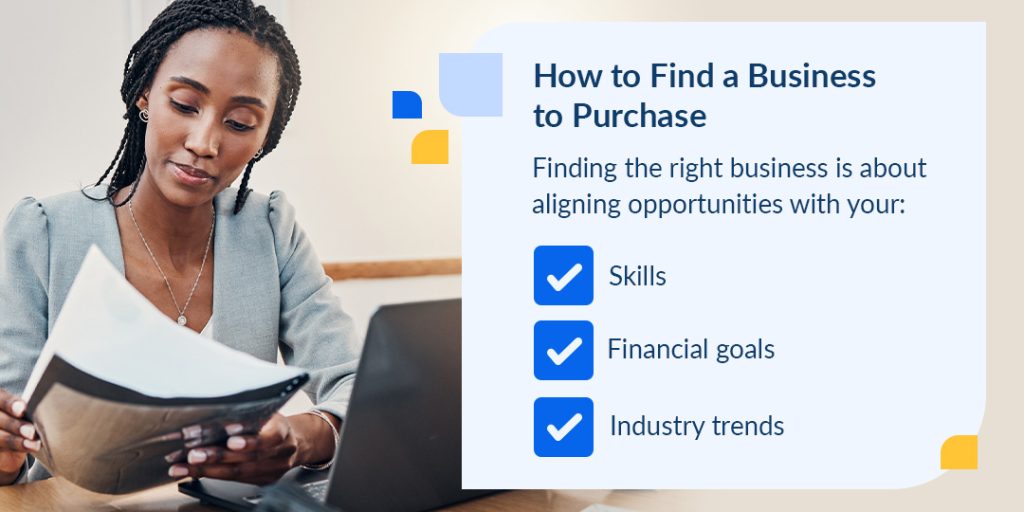
For instance, if you have experience in customer support services and have great communication skills, you should look for a business in a niche where you can use your skills and expertise.
Your decision should also align with your financial goals. You aren’t buying a business to showcase your skills. Your business should generate profit to meet your financial goals.
Importantly, ask yourself this one question: What is the current and future scope of the business you are buying?
For instance, if you decide to buy a SaaS company that offers automated customer support chatbots to businesses. It sounds great as it matches your skillset and expertise.
Most businesses need automated customer support solutions today.
But they might not need it in the coming years due to AI (which is exceptionally good at automation). AI agents can easily handle this task at a much lower cost.
What’s trending today might not be needed at all a few years down the lane.
You need to carefully decide business type considering both current and future prospects.
Search Criteria
This is the real task. You need to identify variables based on business type that will help you find and filter businesses.
The best thing about setting criteria is that it helps you stay focused.
You’ll find lots of businesses that are up for sale. Most of them look highly lucrative. It gets challenging to stay focused as every other business seems a nice fit (when you look at its revenue and profit).
Your criteria will save you time, help you maintain your focus, and ensure you buy the right business.
The search criteria should include the following major variables (you can add more based on the type of business you choose and your preferences):
- Business size: You are interested in a small business, but how small? Should it be a single-owner business or should it have a team? The size of the business defines management effort, cost, and return.
- Niche: For a small business, it is best to look for a niche. Identify a few niches in your industry that relate to your expertise.
- Geography: What should be the target market and geographical radius of the business? Again, it is linked to so many different factors like commuting, variable cost, growth opportunities, etc.
- Finances: Identify minimum revenue, profit, margin, and other key financial metrics and ratios. Set your bare minimum based on industry benchmarks relevant to geographic location, niche, and business size.
- Price: The maximum price you can pay for a business. If you are interested in getting a loan, set the price accordingly.
More Options
Other optional variables include:
- Tech stack: What is the existing tech stack used by the business, how much does it cost, and how easy is it for you to take over (learning curve). Set your rule on whether you need a highly automated business that uses a wide range of apps and tools or a more manual one that doesn’t rely on apps.
- Growth potential: This is where you set an estimated growth timeline for businesses for evaluation. For instance, you can go with businesses that have the potential to grow at a faster pace (under a year).
- Competitors: Define how many competitors the business should have including large and small ones. This impacts growth, pricing strategy, and market share.
- Time commitment: Set the maximum time you can allocate to the business. Should it be full-time vs. part-time?
As you can see, these variables (that define your search criteria) heavily depend on market research and analysis.
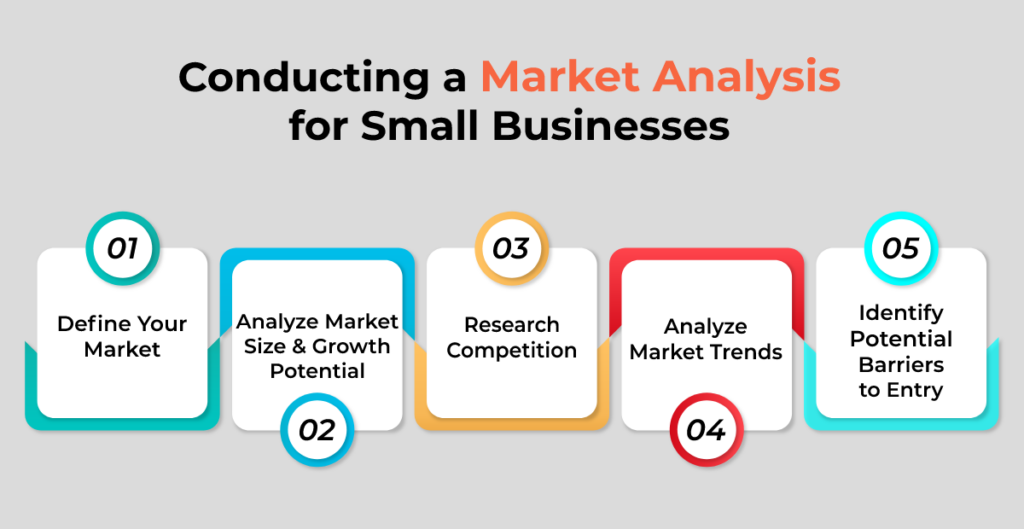
It is mandatory.
Instead of using your judgment, it’s best to spend time understanding and analyzing the market to get the best deal.
Find Businesses
Once you have set the search criteria, it’s time to find relevant businesses that meet your criteria.
The big question: Where to find small businesses for buying?
Let’s find out…
There are 3 major ways to find small businesses to buy:
- Use marketplaces like Flippa. People list their businesses on marketplaces with necessary details. You can sign up for a marketplace and hunt businesses at no cost.
- You can use local or international business brokers. A broker charges a higher fee than a marketplace and this is a reason most people don’t prefer brokers. But they do a very good job. If you can afford a broker, it should be your first choice.
- Outreach is another option where you reach out to small businesses directly and see if they are interested in selling.
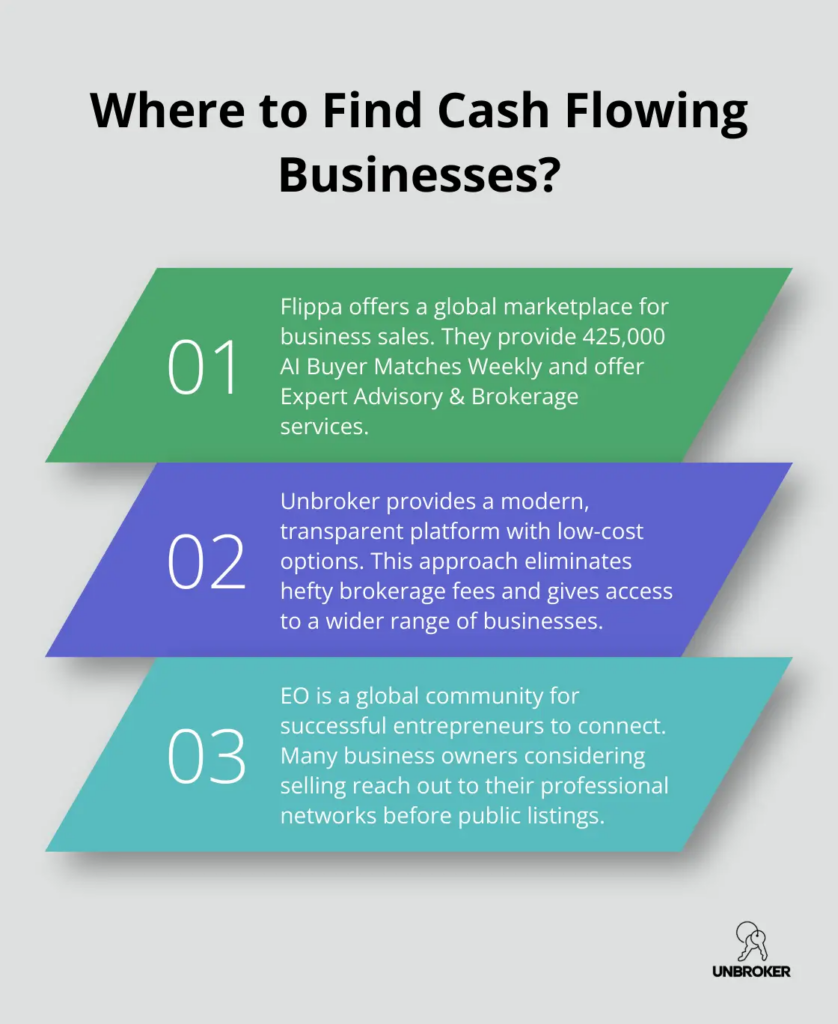
Ideally, you should use a mix of all of these methods to find authentic small businesses that are up for sale.
In the meantime, you need to maintain an Excel sheet where you add details of all the businesses that you like. The sheet should have your search criteria with variables listed. Give a quantitative number to each business you add in the sheet.
For instance, you can rate businesses out of 10 for the key variables (size, niche, geography, finances, and price). If you are using a marketplace, it gets easier to get all this data.
If you are using a broker or cold outreach, it will get really tough to rate businesses as you won’t be able to find this data easily.
This is a reason why most people who are interested in buying a small business prefer marketplaces for lower fees, transparency, and ease of use.
Top Marketplaces to Buy Businesses
Here’s a list of the major online marketplaces you must consider when buying a small business:
- Flippa
- Acquire
- Empire Flippers
- BizBuySell
- BizQuest
- Motion Invest
- Business Exits
- FE International
- Niche Investor
- BuySellEmpire.
Check out these sites and prepare a list of businesses that fit your criteria.
Screen Available Businesses
Once you have prepared a handful of businesses, it’s time to evaluate and compare them.
A simple rule is to add scores and calculate percentages. Then sort businesses and pick the top ones.
But you don’t have to rely on quantitative numbers alone.
Why?
Because you might end up leaving decent business opportunities that fall short on any one of the variables.
For instance, a new business that is in a profitable niche with zero competitors is a great deal. But being new, it might perform poorly on finances.
Similarly, you might rate a hyped business with fake numbers much higher.
There are tons of people out there who fake their stats, analytics, finances, and pretty much everything. The purpose of screening is to:
- Avoid overlooking good businesses with high potential that underperform on one or more variables.
- Identify businesses with fake data.
You need to analyze the top 5-10 businesses from all aspects.
If you can spend a little time on scrutiny, it will be great.
For instance, you can ask sellers to give access to Google Analytics and share financial reports. You can also run some manual scans like:
- Website analysis
- Social media account analysis
- Join email lists and see what type of content they share
- Check business registration, trademarks, and licensing details and verify them all
- Analyze online reputation.
You will notice that a lot of businesses with decent scores won’t be able to pass these manual scans. And that’s the whole point of the screening process.
Initial Contact
The final, screened list of businesses is now ready for contact.
The first message is critical.
If you are using a marketplace, you have to follow their rules which normally requires signing an NDA before you even see any details of the business.
In other cases, you have to make sure the initial contact pitches you as an interested potential buyer.
From the perspective of the sellers, they are interested in people who are serious and won’t waste their time.
This is why it gets really important when you are approaching a business that’s not up for sale.
So, what should the initial contact be like?
It must have the following elements:
- Introduction
- Why are you interested in buying the business
- What are your requirements (and what are you looking for in a business)
- An open-ended call to action.
The conversation on marketplaces is quite informal. You can send direct messages to sellers. You should use the below template (after tweaks) on the marketplace to build your rapport.
Initial Contact Template
Here’s a template you should use:
Inquiry regarding potential acquisition of [Business Name]
Dear [Seller/Owner Name],
My name is [Your Name], and I am an experienced [your background, e.g., operations executive / local business owner] based in [Your City/Region].
I have been following [Business Name] for some time and am very impressed with the strong reputation and service you have built in the market. As I am actively looking to acquire and grow a solid business in this space, I wanted to reach out and see if you might be open to a confidential conversation regarding the future of your company.
I’m looking for a small business in [niche] with a solid track record and potential to grow and expand. The business should have [list your top variable here].
If you are open to exploring a potential transition or sale, I would love to schedule a brief, 15-minute introductory call this week to introduce myself further and learn more about your business.
Thank you for your time and consideration.
Best regards,
[Your Name]
[Your Title/Company if applicable]
[Your Phone Number]
[Your Email Address]
[Link to your LinkedIn profile or professional website]
You can tweak it as per need, but make sure the structure remains the same.
Conduct Due Diligence
Due diligence refers to a detailed investigation and review of a business and verification of the data before proceeding with the acquisition. The purpose of due diligence is to verify data and check provided information for accuracy.
It is a systematic process that’s more detailed than the previous screening process.
You need to perform due diligence for businesses that respond positively and share details (which shows they are interested in selling).
Here’s an overview of the key steps of a due diligence process:
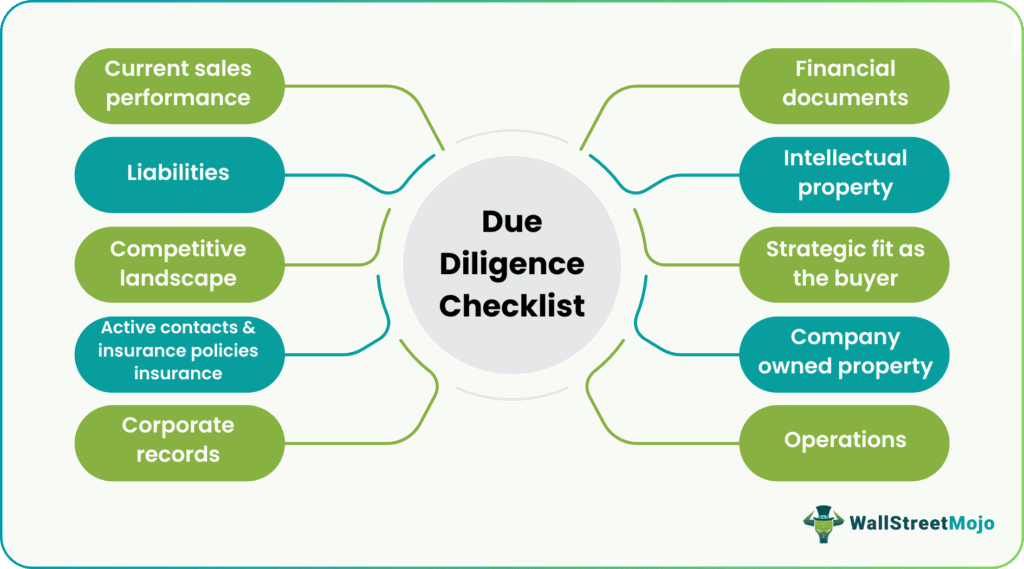
At its core, it needs to review the following:
- Financial and tax record
- Legal review
- Compliance check
- Operational review
- Asset evaluation.
Any document, number, or resource that you get from the business needs to be verified. Don’t trust what they show you or tell you. Do your own investigation.
In some cases, you might have to spend a few bucks for official document verification, or you might have to hire an expert (e.g., a tax expert).
Check out this checklist that has a full list of everything you need to review.
Since it is a time-consuming process, make sure you proceed with due diligence for a business you are ready to purchase.
Business Valuation
This is an important step that should follow due diligence.
Why?
Because a business’s true valuation can only be calculated once you have verified the data. Anything you do before it is just an assumption.
Business valuation is the process of finding out the economic value of the business. It is aimed at calculating a fair value of the business so that you don’t end up overpaying for it.
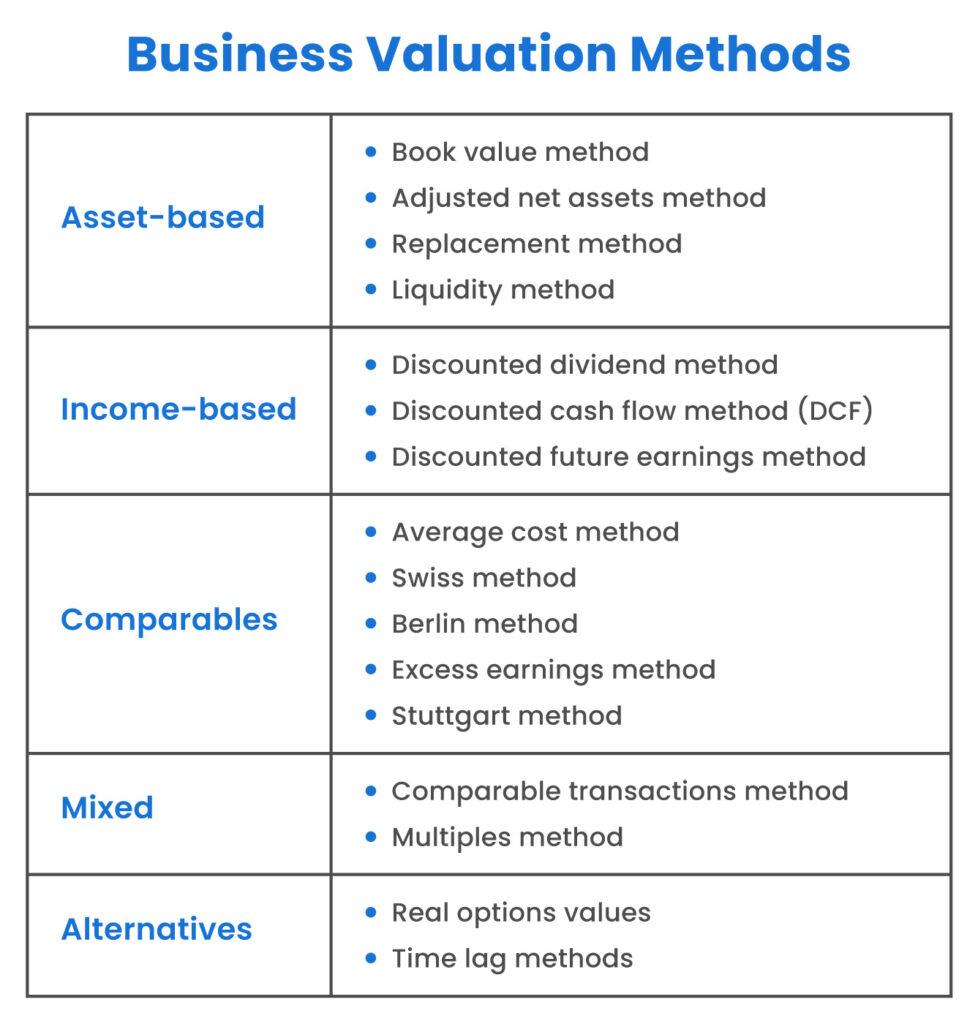
The popular business valuation methods include:
- Asset-based valuation is the simplest one where you add all the assets and subtract debts and liabilities. This is the best approach for private businesses.
- Earnings multiplier is often the approach used by marketplaces like Flippa. In this case, you multiply the business’s profit by a number based on industry trends.
- Discounted cash flow is a method where you estimate future cash flow of the business and use it to calculate today’s value. It is more suitable for businesses where future cash flow can be estimated easily such as SaaS businesses that use subscription-based pricing models.
You can find the accurate value of the business yourself based on data you have.
Negotiate
Once you know the true value of a business, you can go ahead and pitch your offer.
Negotiation is necessary and isn’t always related to monetary values.
You have to negotiate on terms, support, technicalities, and legal aspects. But obviously, price tops the list.
When you are using a marketplace, a formal letter of intent isn’t required. When dealing directly, you need to submit a letter of intent which is a document that outlines the terms of future agreement.
It includes deal structure, price, exclusivity, confidentiality, and other binding and non-binding terms as per your requirements.
Marketplaces have their own ready-to-use templates and formats that save you from all this.
What’s important is that you negotiate the deal terms and pricing which should cover the following:
- The price that’s well below business valuation
- Payment terms that should favor you and must not be 100% upfront. Better to go with escrow
- It’s best to pay in milestones instead of a single payment. Milestone payments favor both parties.
Finalize and Close Deal
The final step is finalizing and closing the deal.
This doesn’t sound as simple as it is.
It involves a lot of details and processes as listed below:
- Adjust final price based on inventory and accounts receivable and payable. These differences must be settled in the final price. These adjustments are beyond the final agreed price. The price you pay should account for these appropriately.
- Get the agreement ready with clear clauses. Make sure the former owner doesn’t take major clients and customers with them.
- Have an attorney verify the final contract before signing it. You get the contract and other legal documents from the marketplace which shouldn’t be signed as they are.
- Carefully read all the documents and check every clause.
- Have up to 90 days of free consulting from the previous owner for a smooth transition.
- If you are getting a loan, make sure all the documents are clear and available.
The deal should be finalized and closed as soon as possible after the letter of intent. The more it gets delayed, the more problematic it gets for you.
The business keeps running in the background and a lot of things can change. This is why you must have all the documents ready when you go into the negotiation process.
Final Words
Buying a small business is a hectic process. If you know what you are doing and have all the things ready in your hand, it gets much smoother.
What’s important is what happens after the deal is closed.
How do you manage the business and does it perform as expected?
These are the biggest questions that you should focus on after getting the business.
Anyone can buy a small business.
But not everyone can grow a business. You need to make sure that the business you have bought meets your financial objectives.
The real game begins when you get the business.
Featured Image: Unsplash


