All businesses need leads.
Some generate average leads via cold emails and calls. Others generate high-quality leads that improve ROI, boost CLV, and increase revenue.
Everyone knows the difference between low and high quality leads.
Since quality leads require more effort (and sometimes more upfront cost), it is often not the first choice of most businesses.
And that’s the problem (and a myth too).
A high quality lead always outperforms a low-quality lead at all levels and metrics.
Let’s unlock the best techniques to generate high-quality leads with a clear understanding of why they matter more than anything else for your brand.
What is a High-Quality Lead?
A high quality lead is a prospect that’s highly likely to become a customer. The lead has a strong buying intent and is a true representation of your ideal customer.
The core characteristics of a quality lead include:
- True representation of your ideal customer profile
- Motivation to become a customer
- Engaged
- Has resources to proceed (e.g., budget).
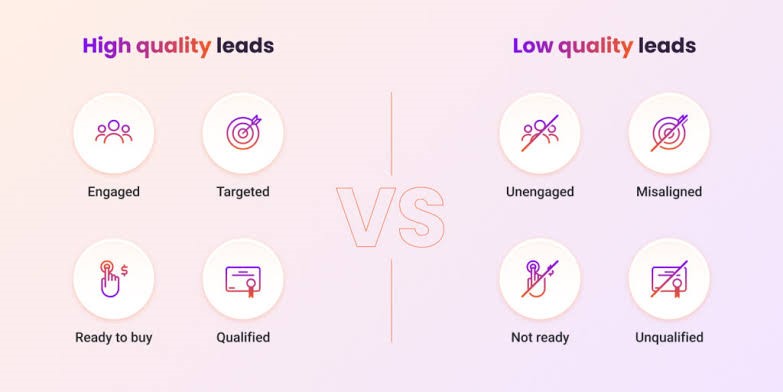
A quality lead has a much higher conversion rate. This has a positive impact on a lot of business metrics.
For instance, high quality leads have a short sales cycle. This saves you tons of resources. It, in return, significantly lowers cost per acquisition and increases ROI per lead. A reduced cost to acquire a lead improves customer lifetime value, which is the core metric you should be looking at.
So where do you get such high quality, ready-to-convert leads?
There are two ways:
- You nurture leads with regular engagement and it takes time and resources. Your sales team will contact the lead multiple times during the sales cycle, which typically lasts 1-3 months.
- You improve targeting and reach out to people who are more likely to become customers. Be where your ideal customers are.
The Cost to Generate High Quality Leads
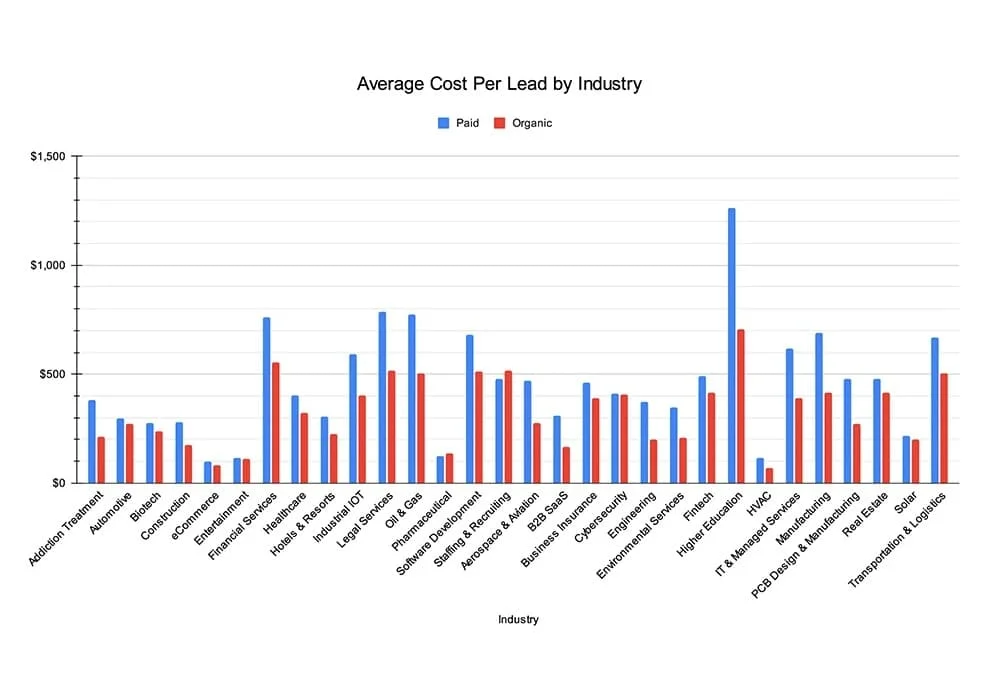
An average lead costs between $50 and $200+. It comes down to how you acquire a lead.
Here’s an overview of the cost of generating a lead across 30 industries:
According to another estimate, the starting cost to generate a lead is $146 for small businesses:
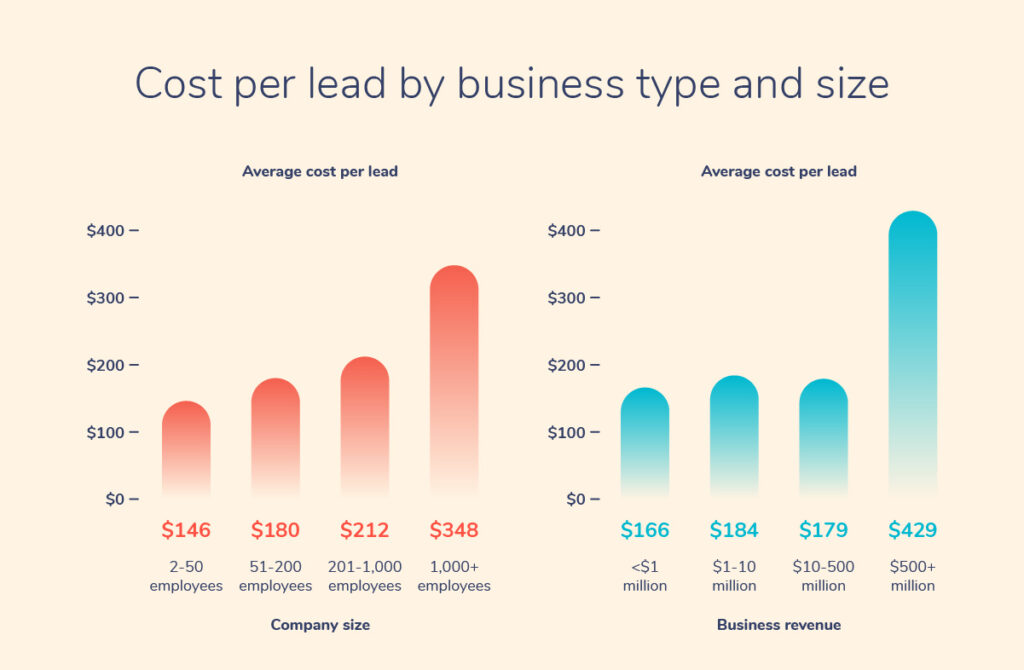
Up to 28.6% of companies say they spend $100 to $1,000 a month on lead generation. Collectively, around 50% of businesses spend between $100 and $2500 per month on lead generation:

This’ll give you a rough idea of the costs associated with lead generation.
Let’s break this cost down and see where this spending goes:
- Lead generation tools and resources (tech stack)
- Marketing and advertising costs
- Salaries and administration expenses
- Miscellaneous costs.
These are the major contributors to lead generation.
The lead nurturing process by your sales team is the second part, which also requires additional expenses.
If you are generating high-quality leads, you can significantly reduce lead nurturing costs. This is where it all changes. Imagine you acquire an average lead for $100. And then you spend an additional $50 in the lead nurturing process. The lead costs you $150 in total.
Now imagine this:
You acquired a high quality lead for the same price ($100). It will convert instantly without much effort from your sales team. This lowers the total lead generation cost to $100 immediately (because you don’t spend any money on the nurturing process).
So, whatever your current lead acquisition cost is, it can be optimized if you just switch to high quality leads.
How?
Let’s find out…
Proven Ways to Generate High-Quality Leads Without Paid Ads
High quality leads are everywhere. You just need to be at the right place at the right time.
Here are some tried and tested techniques to generate high-quality leads:
SEO
The best and highest quality leads can be generated via content and SEO.
People who run a search query in their favorite search engine are interested in your product or solution. They are more likely to enter your sales funnel.
Compare this lead with a cold email.
When you outreach, the people who receive your email aren’t inherently interested in buying. Most of them aren’t even a little bit interested in your product. Even if you end up generating leads, these will be low-quality.
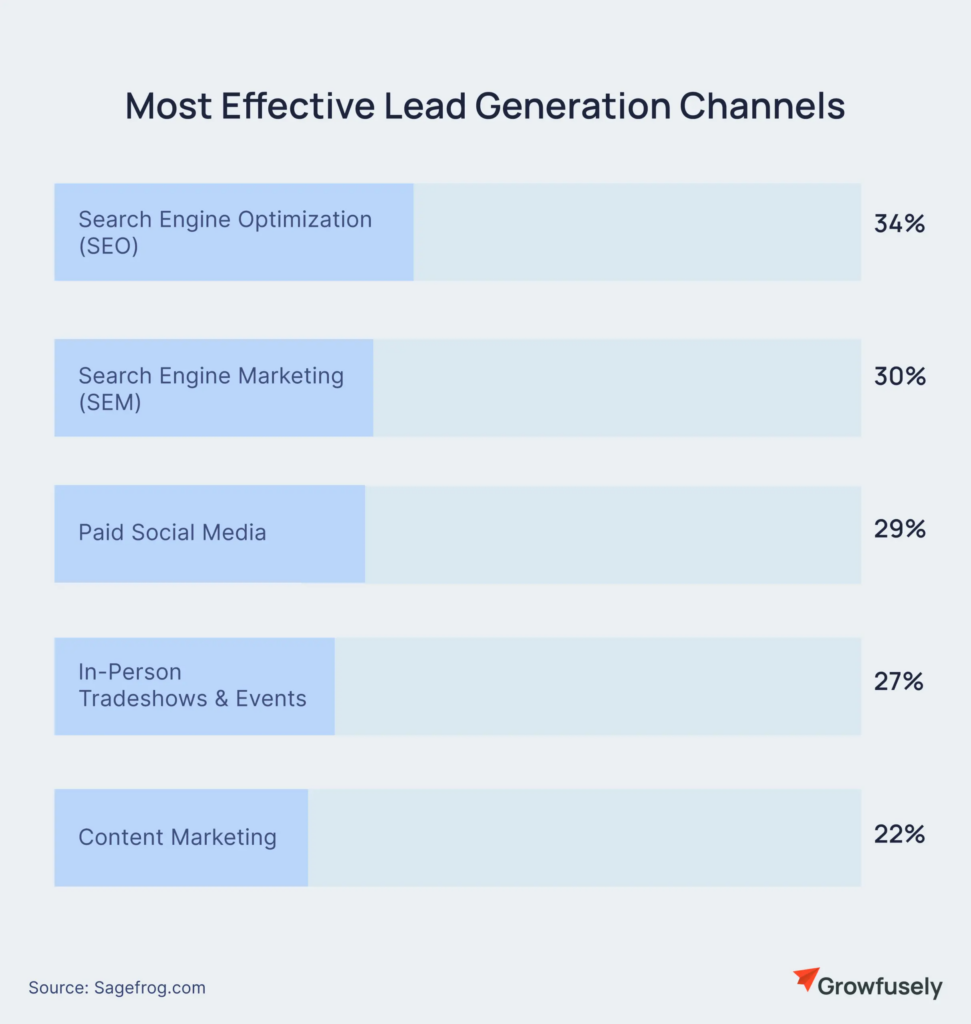
This is the reason SEO is the most effective lead generation channel, according to 34% of B2B brands:
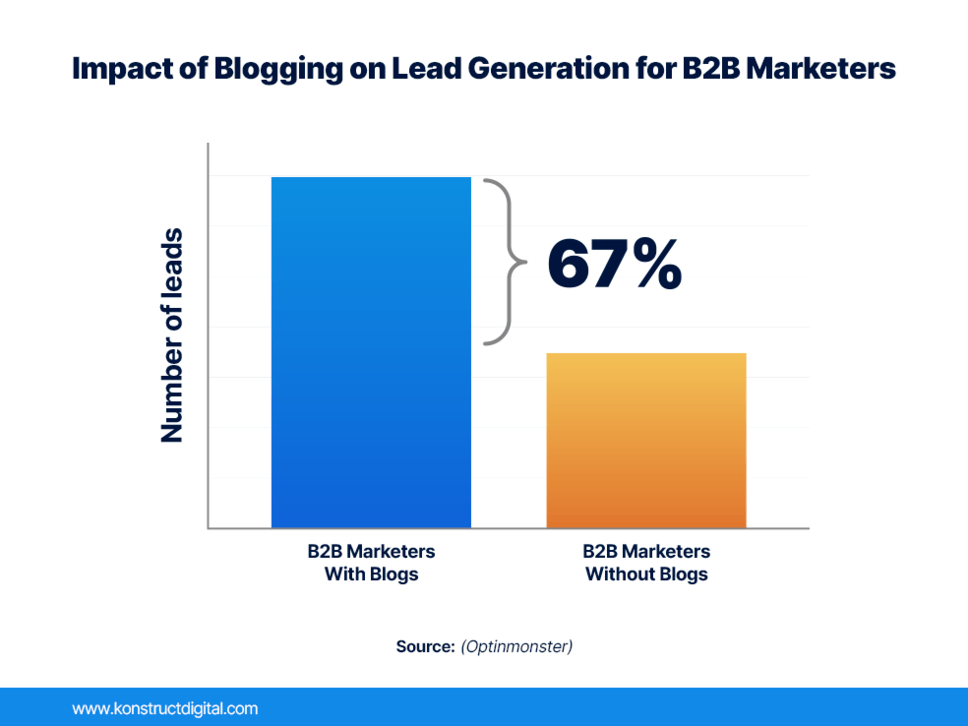
B2B businesses that have blogs get as much as 67% more leads than businesses without blogs:
The reason is simple:
Potential leads find you via search engines instead of you hunting them.
That’s the whole point of doing inbound marketing.
Here’s the hard part…
It’s not easy to rank and drive traffic consistently. And it’s not just about publishing content focused around primary keywords on your blog.
Lead generation through search engine optimization needs a plan and strategy.
Here’s how to use SEO to generate high-quality leads:
- Create an SEO strategy for your business with a focus on blogging
- Identify relevant keywords for all stages of the funnel (emphasize the top of the funnel)
- Write and publish people-first content following Google’s E-E-A-T guidelines
- Optimize content for search engines following best practices
- Publish frequently and update old content
- Track performance and optimize your strategy.
Lead Magnets
Lead magnets help you generate high-quality leads at potentially very low cost. They also play a critical role in optimizing your SEO efforts. Lead magnets work best with SEO.
I’ll explain that in a moment, but first…
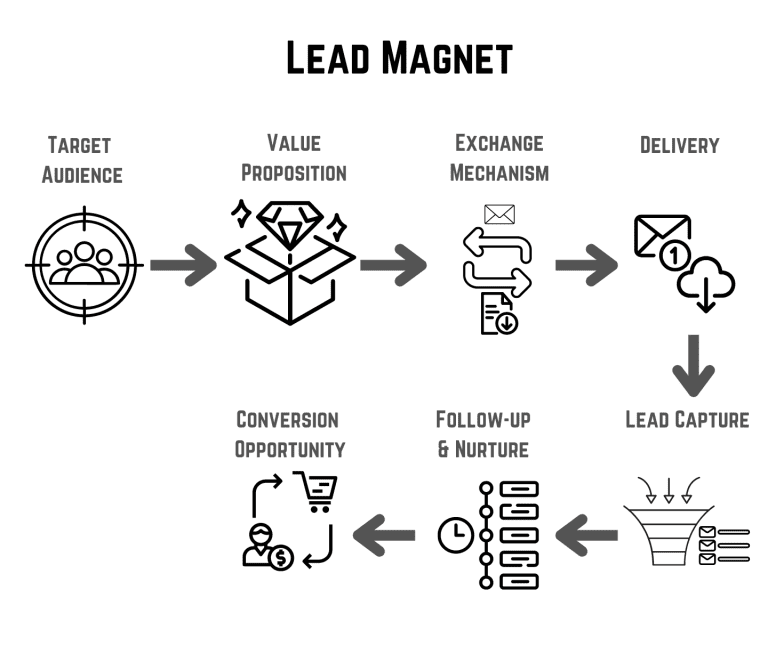
A lead magnet is a highly valuable asset that you offer to potential customers in exchange for their contact details (primarily email addresses). Here’s an example of a lead magnet:

And here’s how it works:
There are two ways you can (and should) use lead magnets:
- On your website and blog to capture leads and push visitors to your sales funnel
- Across marketing collateral. Instead of sharing your site’s home address, share your primary lead magnet’s URL for a higher conversion rate. Also, send paid traffic to targeted lead magnets.
When you are focusing on driving organic traffic to your site for lead generation, you have two ways to deal with the incoming traffic:
- Let them decide on their own if they want to fill out the form to enter your sales funnel. Or, you can send them a generic, all-purpose form to push them to a sales funnel.
- Create targeted lead magnets across all categories and offer the most relevant, quality lead magnet to the readers based on what they are reading.
The second option is where you’ll have the best conversion rate and you’ll generate high-quality leads fairly quickly.
How to Use Lead Magnets Smartly
HubSpot uses this second technique very smartly. They have created lead magnets for all types of content they publish. When you are reading a social media post, you’ll see a lead magnet related to social media. If you are on an email marketing post, you’ll see an email marketing lead magnet.
Here’s an example of how to pitch your lead magnet that’s relevant to the content:
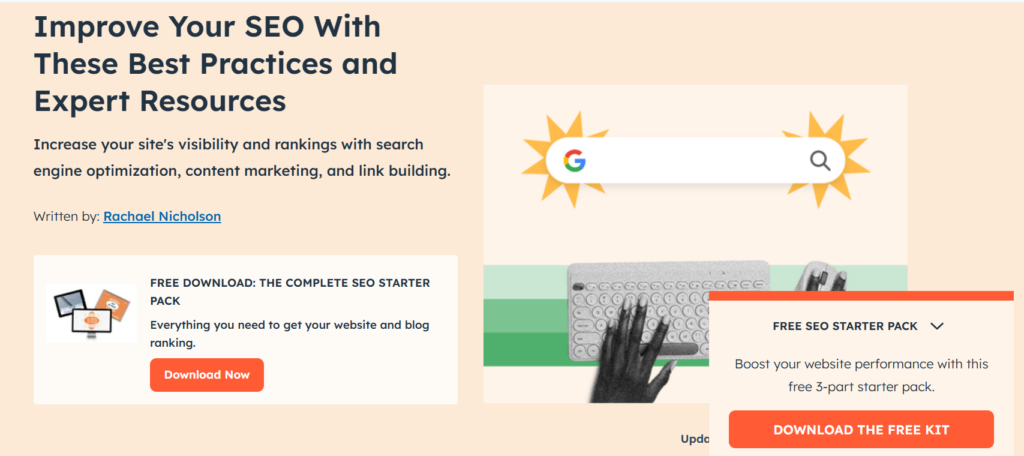
Once a user enters the email address to get the lead magnet, he/she is pushed to the relevant email sequence and the lead nurturing process begins.
The same rule applies for paid traffic. Create targeted lead magnets consistent with the ads and offers. Send traffic to dedicated squeeze pages for a high conversion rate and higher quality leads.
That’s how you should implement lead magnets across all touchpoints. And SEO is no different.
What’s more important is what type of lead magnet you are using. Is it something users can easily find elsewhere? Does it answer their query superficially, or does it share content they can find via ChatGPT?
If that’s what you are doing, it won’t work.
The lead magnet has to be exceptionally high-quality and irresistible. It must offer them value for free that they can’t find elsewhere.
You can use checklists, reports, whitepapers, interactive tools, learning resources, and other types based on your audience, industry, product, and brand strategy.
But it must be free, targeted, and valuable.
Content Marketing
When you are working on SEO and creating lead magnets to generate high-quality leads, content marketing fits in perfectly.
Here’s how:
Instead of sticking with blog posts, you go a step further and create a wide range of content types (e.g., videos, audio, images, etc.) to reach your target clients across different touchpoints.
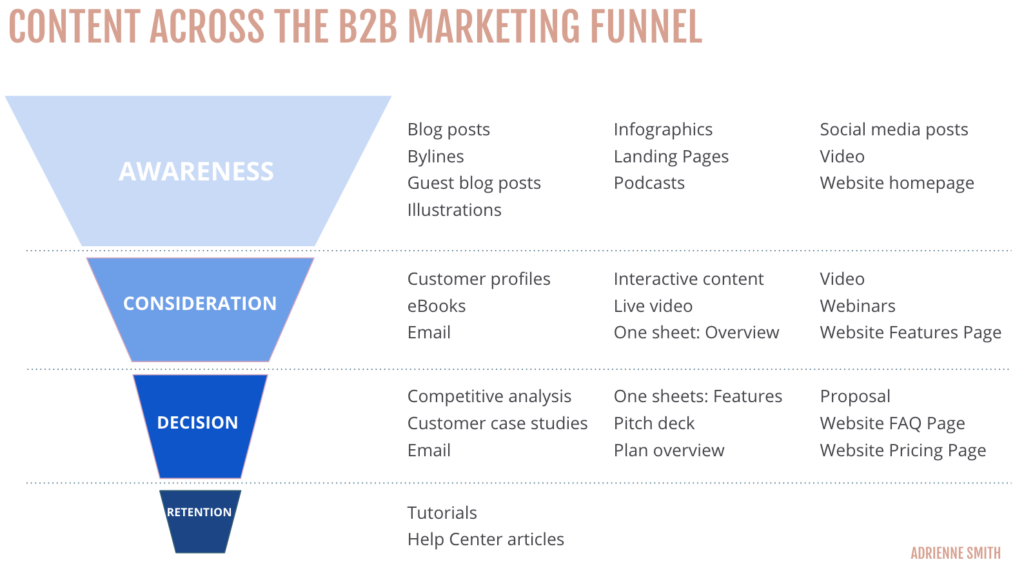
Content marketing covers your entire sales funnel and full buyer journey.
You need to map content with different stages of the sales funnel to reach and connect with potential clients throughout their lifecycle.
There are a few major benefits of having a content marketing strategy for B2B lead generation:
- You can use lead magnets to improve conversion rate significantly
- Leverage content repurposing. This means you have to create a piece of content once and then reformat it for publication on other platforms. This saves a lot of resources
- It is a fully scalable marketing strategy that improves brand awareness, brand recall, and other metrics (as a byproduct)
- It gives you access to a wide range of platforms including social sites.
Content marketing, however, works when you have a plan and a corresponding strategy. It doesn’t mean creating, publishing, distributing, and repurposing just any content (at random).
No.
You need to identify content types, topics, formats, channels, and map them to your sales funnel and buyer personas. It should be a data-driven approach to generating quality leads. This means you need to start with primary data collection.
Ask your ideal clients what type of content they like, what websites and platforms they use, what their biggest challenges are, etc. Use this data to update buyer personas.
Then create relevant, targeted content.
Best Practices for Lead Generation with Content Marketing
Follow these techniques and tips to generate high-quality leads with content marketing for your B2B brand:
- Have a strategy and action plan.
- Use data to update buyer personas. Don’t hesitate to create new personas as you tap into new channels and touchpoints.
- Create targeted and optimized lead magnets. Content itself won’t generate leads unless it is supported by relevant lead magnets.
- Use landing pages, squeeze pages, and optimized CTAs to boost conversion rate that helps you generate high-quality leads.
- Create content for all the stages of the funnel. Avoid sticking with one funnel stage.
- Buyer personas and data should support your decisions. Don’t use your judgment or gut feeling. If you have to choose a social platform, ask your target audience if they use it or not. That’s the right approach.
- Repurpose content. Convert a blog post into an email series and social posts. Get the most from every piece of content you create.
- Test, tweak, and optimize everything including your strategy and campaigns. Run A/B tests to figure out what works and what doesn’t.
- Understand your target audience. This is the key to a successful content marketing strategy for lead generation.
Don’t forget: Your focus is on lead generation, so make sure you publish the right content type. Here’s what content formats work best for lead generation:
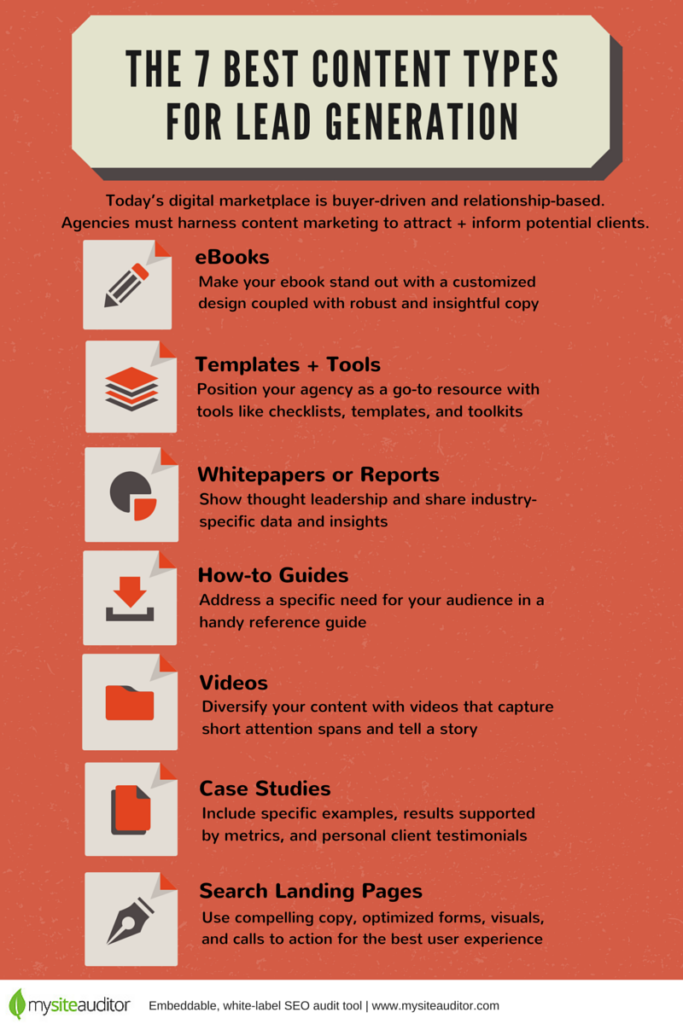
Notice, it doesn’t include conventional calculators, exclusive tips, or listicles. Because this type of content is pretty mainstream and won’t help you much in generating top leads.
You have to be the best in the market with the best content.
Referral Program
One of the best ways to generate high-quality leads is to leverage referral marketing.
Ask your existing clients (happy ones) to bring in more customers in exchange for a reward. Since they are happy with your brand or services, they are more likely to recommend you to their family and friends.
You need to create a formal referral program to track progress.
Here’s an example of how a referral program works:

A referral program delivers exceptional results as customers who are acquired via a referral program spend up to 200% more than average clients. On top of that, a referral program has a very high ROI:
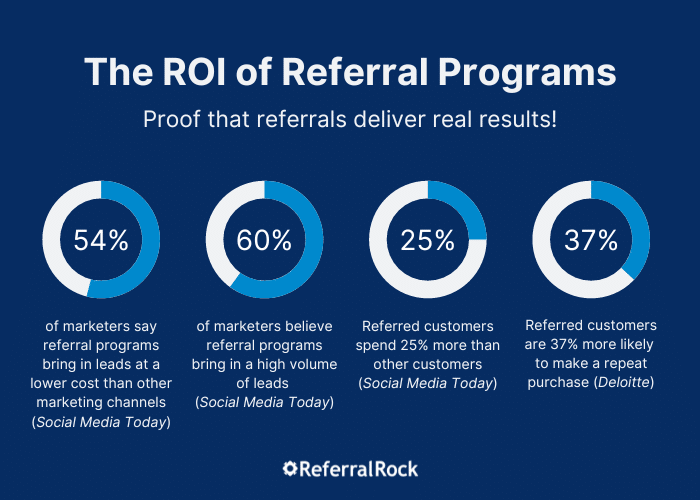
Leads generated through referrals have a fairly low acquisition cost. This is an added benefit that improves customer lifetime value and business profitability.
So how to start a successful referral program and use it to generate high-quality leads?
Let’s dive in.
How to Set Up a Referral Program for Lead Generation
You need to use a referral marketing platform like Referral Factory or ReferralCandy. A dedicated app makes it easy to set up, manage, and scale your referral program.
Here’s what you need to do to ensure your referral program doesn’t end up in vain:
- You need to have a decent number of existing happy clients. If you are new or have a limited number of clients, a referral program can still work, but it won’t be able to do a lot for you in terms of lead generation.
- Set attractive incentives for both existing and new clients. This is very important. Cash or a discount is the most lucrative incentive form. For instance, you can offer 1-month of services free to both the referee and referral. Or, you can give them a gift card for a fixed amount that they can spend anywhere (not specifically with your brand).
- Set up well-defined triggers and an onboarding process. You don’t generate a lead with a referral program, you get a customer. Make sure you offer your best to the incoming potential clients. This requires setting up a dedicated onboarding process.
- Keep it dead simple. Make it easy for customers to invite their friends and family. Remove hurdles and friction.
Webinars
Webinars are a great way to generate high quality leads at potentially very low cost.
Up to 73% of B2B companies say webinars are the best lead generation source. Up to 89% of marketers say webinars outperform other lead generation channels by a large margin. And 52% of brands say lead quality is above average or excellent when generated via webinars.
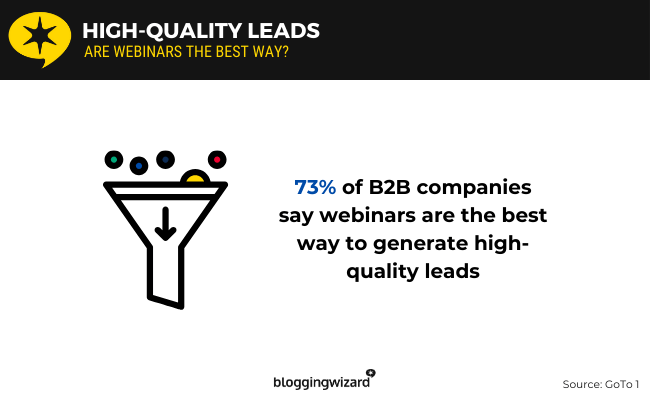
There are a few reasons why webinars are extremely useful in generating high quality leads:
- Anyone signing up for a webinar is interested in your product or brand. Participants have a problem and they are looking for a solution. This makes them an in-market audience.
- You get a chance to interact and engage with potential clients. This helps you set the stage and boost conversions.
- Attendees have the chance to ask questions at the end of the webinar. This works best. No other lead generation method allows the audience to ask direct questions.
- Since you already have the email address of the potential client (once someone signs up for a webinar), you have a lead. Webinars help you warm up and filter leads. People who continue with your brand after the webinar are most likely to convert (that’s an indication of a quality lead).
If you haven’t tried webinars yet for lead generation, it’s time you should focus on them. They really work well.
Build a Community
Social platforms aren’t about memes and socializing. They work exceptionally well for generating quality leads.
The idea is to develop a community.
Think of Reddit, Quora, LinkedIn, Pinterest, and tons of other social platforms. They have a highly targeted audience (unlike Facebook and Instagram, where everyone hangs out). Instead of publishing content using your editorial calendar, you should create a community.
Followers don’t convert to leads.
But when you have a community where people interact and communicate openly, that’s where you generate leads.
You have two-way communication in a community of like-minded people.
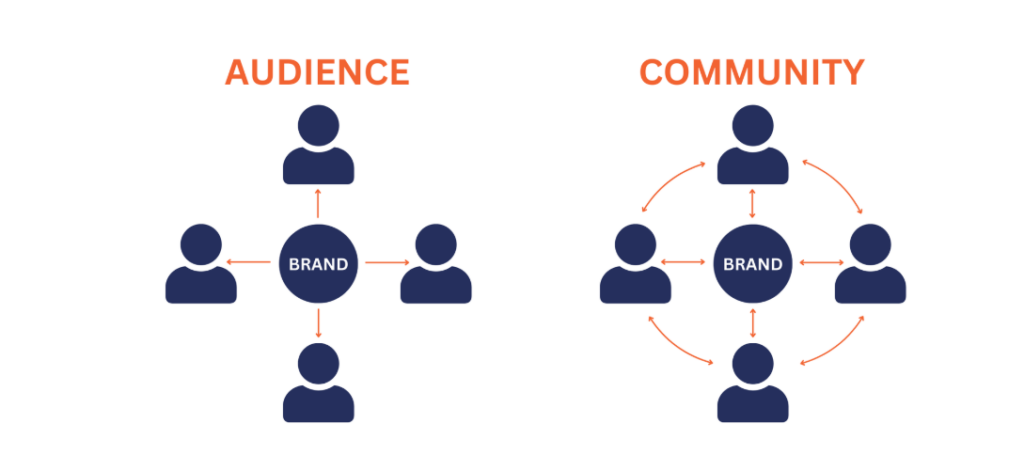
Think of a private group on Facebook or a Reddit community. Your brand manages and controls it. People join in to share ideas and get exclusive content, recommendations, or anything of high value for free.
Research shows that community members convert 58% faster into a lead than cold traffic. This reduces acquisition cost by a whopping 32%.
The big question is how to build a strong, powerful community to generate high-quality, affordable leads.
Here’s how to get started:
- Identify your primary platform. This is where you have to figure out where your target audience hangs out and where they like spending time. Look into buyer personas to find the most suitable platform.
- Build a community around a broad area that’s relevant to your brand and audience.
- Encourage two-way communication. Let the audience speak, ask questions, answer queries, and contribute freely.
- Add moderators and manage the community actively. Answer queries without pitching your products or services. The idea is to make it useful and value-driven.
- Once it grows to a certain level, you can consider offering upgraded solutions to members and push them to your funnel. This is for those who don’t opt in themselves.
Networking
This one is my favorite.
Networking is the best source of lead generation. It helps you generate leads of the highest quality. This is because it is focused on personalization. You build relationships and deliver value (with minimal or no focus on sales or lead generation).
For instance, all the executives of your brand and employees use LinkedIn to share valuable content. This helps create an audience and the executive builds thought leadership. It brings in new leads regularly.
Other forms of networking include:
- Industry events where you engage with people in-person.
- Use of contacts like business partners, suppliers, friends, vendors, etc. These are your best sources of bringing in new leads.
- Sponsor community events to get in front of your target audience.
Networking is more focused on your communication skills and how you engage with people. You don’t have to sit at the table at an event and wait for people to come to you.
No, that doesn’t work.
The idea is to reach out to people, talk to them, deliver value, and keep doing it without any expectations. Everyone in your company should do it and for all channels (be it online and offline).
This should be embedded in your company’s culture.
It builds a positive image of your brand and you’d get leads for years to come at zero cost.
Final Words
Not all leads are equal.
High quality leads have a short sales cycle and convert very well.
Generic leads might be cheaper, but they consume a lot of resources during the nurturing process. This negatively impacts lifetime value and business profitability.
If you want to generate high-quality leads, stick with the methods and techniques described above.
Master SEO, content marketing, lead magnets, referral program, webinars, community development, and networking to build a robust system of lead generation.
These techniques do work individually.
But they work best when employed collectively. That’s how you develop a lead generation system that continuously generates leads of the highest quality at a fairly low cost.
Featured Image: Unsplash