Answer engine optimization (AEO) is much more than a buzzword. It is becoming an important part of SEO strategy. Every small business needs to understand its value and follow answer engine optimization best practices to get relevant citations from AI tools.
Sounds complicated?
It isn’t.
This step-by-step guide will show you how to implement answer engine optimization across your website for better AI engine visibility.
What is Answer Engine Optimization?
Answer engine optimization (AEO) is a content structuring and format practice that focuses on getting more citations (as a source) from AI tools and AI-powered search overviews.
You optimize your content for answer engines (which are AI tools that give direct answers to users’ queries such as Google AI Overview and ChatGPT).
Here’s an example of an answer engine (Google AI Overview) giving a direct answer to a query:
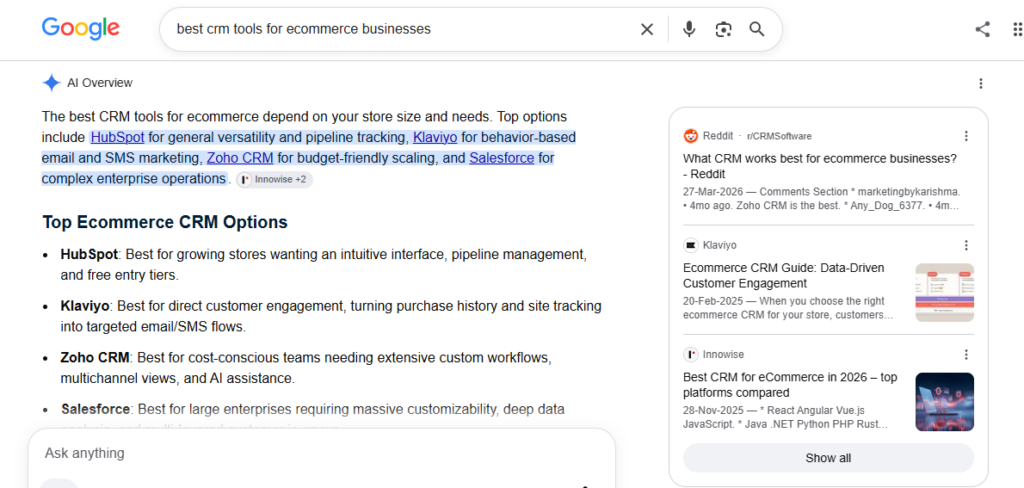
I’m sure you must have seen these types of AI Overviews in Google and other search engines. There are a few things to notice here:
- It provides a direct answer to the query. The user does not have to visit any additional website to check a list of top CRM tools.
- It cites sources that are clickable.
AEO focuses on making your site get these citations from all types of AI tools that provide direct answers.
These citations give your brand visibility, referral traffic, and authority.
Statistics show that up to 80% of people use AI summaries at least 40% of the time to get answers to their search queries.
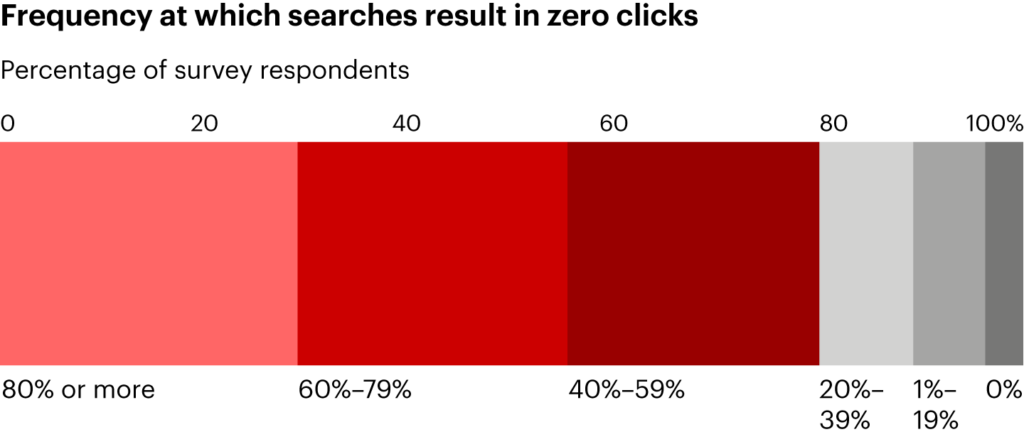
Since more people rely on answer engines to get direct answers to most queries, it is crucial for businesses to get cited by these AI tools.
How Does an Answer Engine Work?
Before you jump to optimization, it’s important to understand how an answer engine works.
Here’s how they work: It decodes and understands the search query, retrieves relevant data from its database (or might crawl in real-time), generates an answer, and represents a direct version of the generated answer to the user.
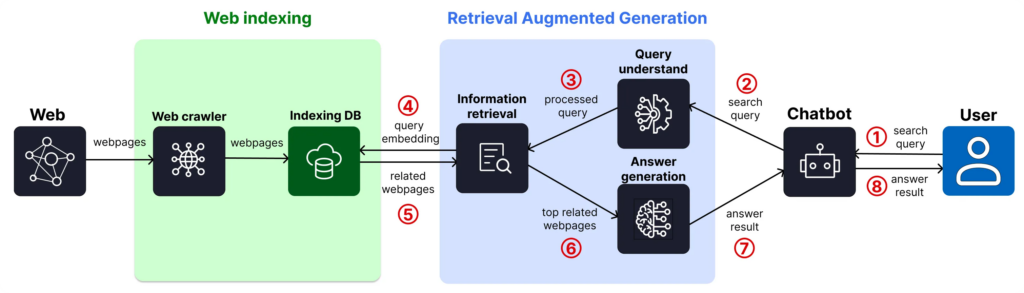
1. It Discovers and Stores Information
Answer engines work similarly to traditional search engines.
An answer engine crawls the web and maintains its database. This is similar to what search engines like Google do.
Most of these answer engines continuously update their index in real-time. They keep on looking at everything they find and store it in their database for use.
2. It Interprets the Question
An answer engine’s core function is to interpret and fully understand the query. This is the key.
It includes the user’s intent, location, requested format, and whether current information is needed. It is more than mere keyword interpretation.
Most answer engines use their memory and your past interactions with them to understand a query. The information a user has shared with the answer engine drives the interpretation.
3. It Retrieves Relevant Pages and Passages
According to Google, its passage ranking system has the potential to assess specific sections on a web page for use in search based on its relevance.
This is exactly what most AI tools do. They don’t use an entire page as is, rather, they use a passage ranking system to index different parts of a web page differently.
Answer engines use query fan-out where they run several related searches across different subtopics and data sources.
4. It Evaluates the Available Evidence
Once the engine has access to the data, it then decides what information to include in the answer.
It considers relevancy, clarity, originality, freshness, source reputation, supporting evidence, consistency with other sources, and whether the page appears to have been written from genuine experience.
It’s hard to figure out the exact weightage of these factors as the data is proprietary and changes between platforms. But all answer engines have a list of variables they use to evaluate available data before it is used in an answer.
5. It Constructs and Presents the Answer
This is the final step where the answer is crafted.
The answer is sourced from different web pages. Most AI engines provide links in their answers for readers. This is where it gets interesting because as a business, you want your site to be cited by these engines.
AEO Vs. SEO
AEO is quite similar to SEO. But there are differences, of course.
Here’s a breakdown of how AEO is different from SEO:
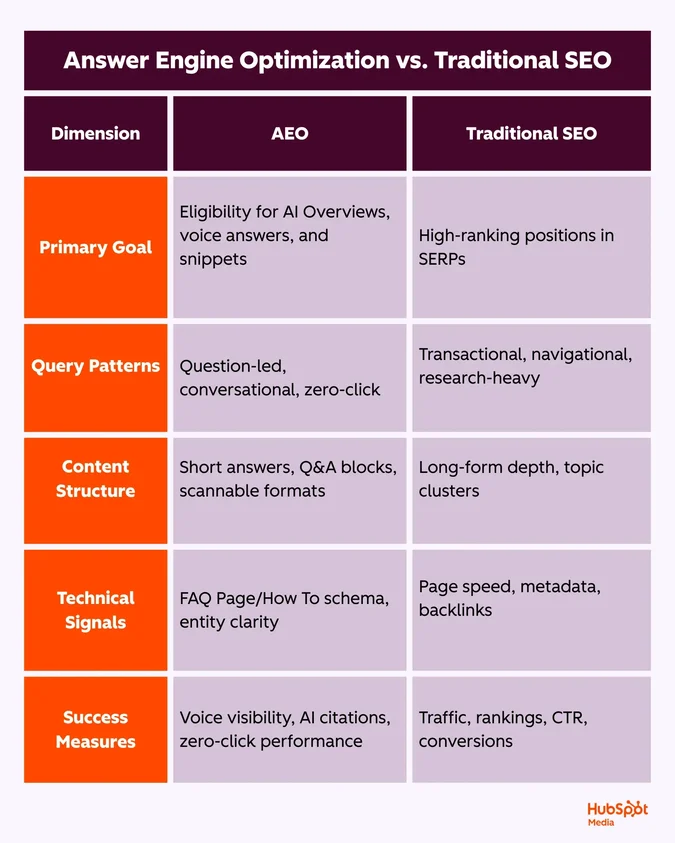
- Goal: The primary goal of AEO is to get citations by AI engines to boost brand awareness and referral traffic. SEO focuses on improving organic traffic by ranking higher in SERPs.
- Content structure: AEO relies on using specific content formats and types that include short summaries, schema markup, and other formats that are easier for AI engines to crawl and understand. SEO is geared towards creating long-form helpful content showcasing expertise and experience.
- Types of queries: With AEO, you target long-tail conversational queries that usually don’t get any clicks. While SEO targets all types of search queries and keywords across all search intent types.
- Metrics: AEO performance is tracked by the number of citations and brand mentions across AI engines. SEO is tracked via a range of metrics including SERP rankings, organic traffic, conversions, impressions, average position, etc.
AEO is essentially a subset of SEO.
If you are following SEO best practices, you’ll need a few extra tweaks to optimize your site and content for answer engines (more on this discussed below).
This is because the main purpose of SEO and AEO is to ensure crawlers can find, understand, and index your content.
Answer Engine Optimization Best Practices
Let’s get down to the details as to what actions you need to take to optimize your site and content for AI engines:
Follow E-E-A-T Guidelines
This shouldn’t be surprising.
E-E-A-T framework by Google is primarily for SEO, but it works for AEO as well.
There are two factors that AEO gives a lot of importance to: Authoritativeness and trustworthiness. You need to demonstrate authority and trustworthiness if you want to get cited by generative engines.
A study found three main techniques for AEO:
- Citing sources in the content
- Adding statistics
- Establishing authority.
Here’s an example for each, quoted from the paper along with relative improvement after making these changes:
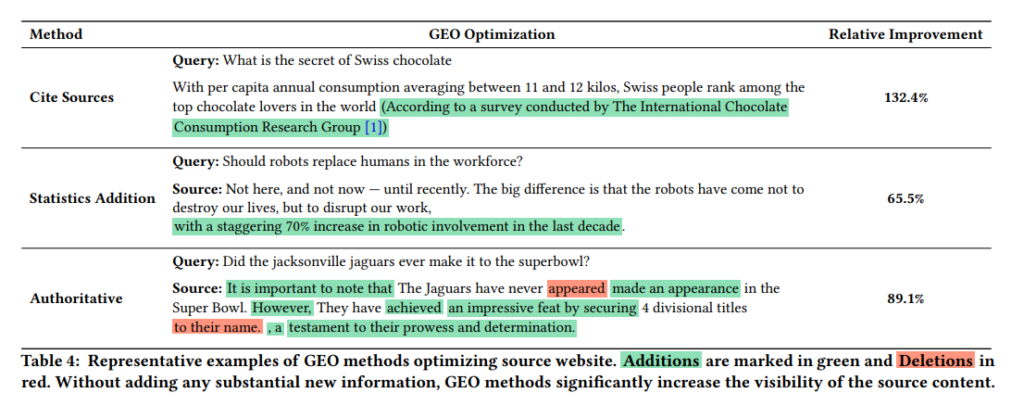
This strictly adheres to Google’s E-E-A-T framework where you have to establish authority and trust.
The idea is simple: If you are writing great content that search engines and people love, AI tools will love it too. If you are, however, creating substandard content, some generative engines might cite you for a short period, but they would switch to better sources soon.
The quickest way to optimize your site for answer engines is to do the following:
- Always cite your sources. These sources must not be generic pages rather, they need to be authority sites.
- Support your claims and arguments with data and citations.
- Add statistics, numbers, data, and facts with citations in your content.
- Continuously update and refresh your content. Remove old, outdated sources and data. This is crucial because generative engines prefer new, fresh data.
- Add quotes from industry experts and thought leaders to build authority. This is something that answers engines like a lot.
Format Content for Answer Engines
This is the crux.
Generative engines require a specific content type represented in a specific format. This means you have to tweak your writing style.
Content Types
First, let’s find out what types of content formats answer engines prefer.
The main content formats include:
- Product content such as product pages, product comparisons, best products, etc.
- Ranked lists such as listicles
- Comparison content includes all types of comparison articles and tables, especially commercial intent
- Original research covers primary data-based content such as white papers, studies, surveys, etc.
- FAQs section includes a dedicated FAQs block
- UGC covers all types of user-generated content across social platforms and forums
- Explainer guides include in-depth guides and detailed articles.
There’s no single best content format for AI citations. It depends on a wide range of factors that vary across AI apps.
Studies, therefore, have mixed results.
A study spanning over 12 weeks found what type of content formats ChatGPT, Google AI, and Perplexity cite the most for both B2B and B2C. The findings were interesting.
Product-specific content received the most citations for both B2B and B2C. It includes product specifications, comparisons, and a list of best products.
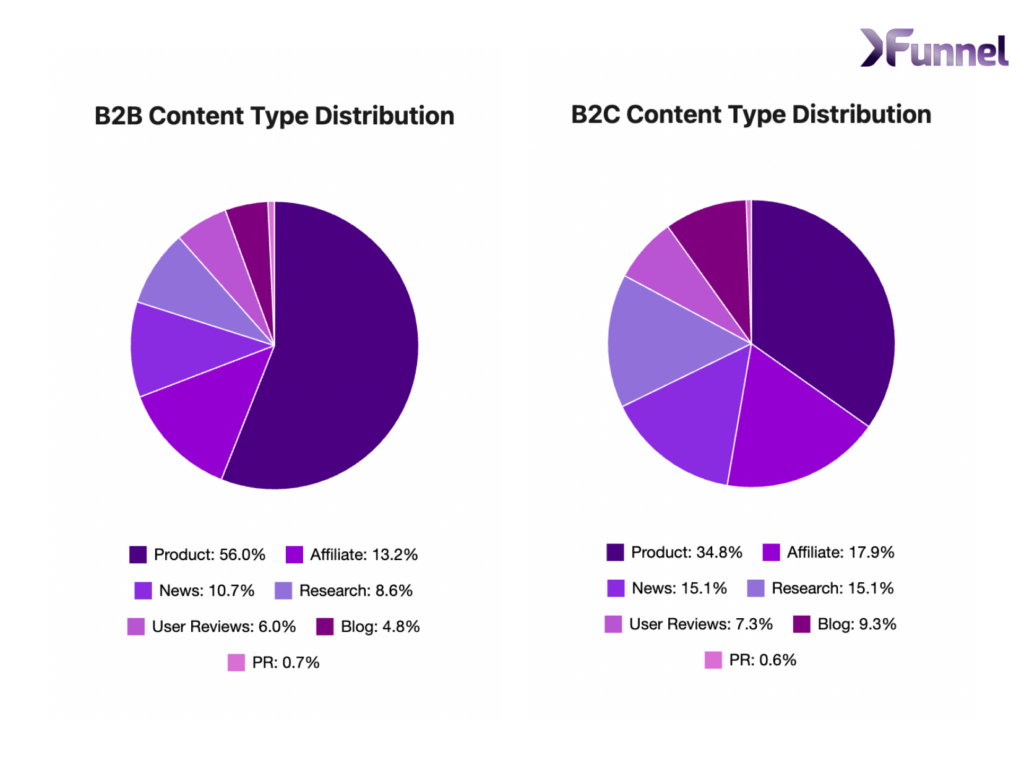
Another study found listicles to be the most cited, followed by articles and product pages. This was confirmed by another study that found 63% of AI citations going to listicles and numbered lists.
It’s hard to generalize a single best content format. Generally, listicles and product pages work best because they offer valuable insights and represent content in a format that AI engines can understand easily.
Content Format and Structure
You need to write, present, format, and structure content in specific ways to ensure AI engines can find, understand, and cite it easily.
Only publishing a certain content type won’t help you much unless it is formatted properly for AI citations.
A study, for instance, reported that 44% of all AI citations originate from the top 30% of text on any web page. Similarly, tables and structured data are the best formats for AI engines as they can easily get the right piece of information quickly.
Since the first 30% of the text is more likely to be cited by AI apps, it’s important to put the most important content at the start. Ideally, you should use the key takeaway section at the top of the article (as used by a lot of popular sites).
This is a must-have for AI citations.
But there’s more.
Here are answer engine optimization best practices you must follow for content formatting:
- Add a short summary of the major findings at the top of the article.
- Write short paragraphs where each paragraph represents one idea.
- Write short, meaningful sentences.
- Add bullets and lists to make content readable for AI engines.
- Start new sections or headings with a summary of the section.
- Add tables as much as you can.
- Use numbers, percentages, statistics, and other data forms.
- Follow on-page SEO best practices such as heading tags, meta tags, internal links, etc.
- Have proper introductions, body, and conclusion for every content piece.
- Add graphics, charts, and images.
- Cite your sources.
Your content needs to follow SEO core guidelines as well. You can’t get AI citations if your content lacks authority and technical SEO.
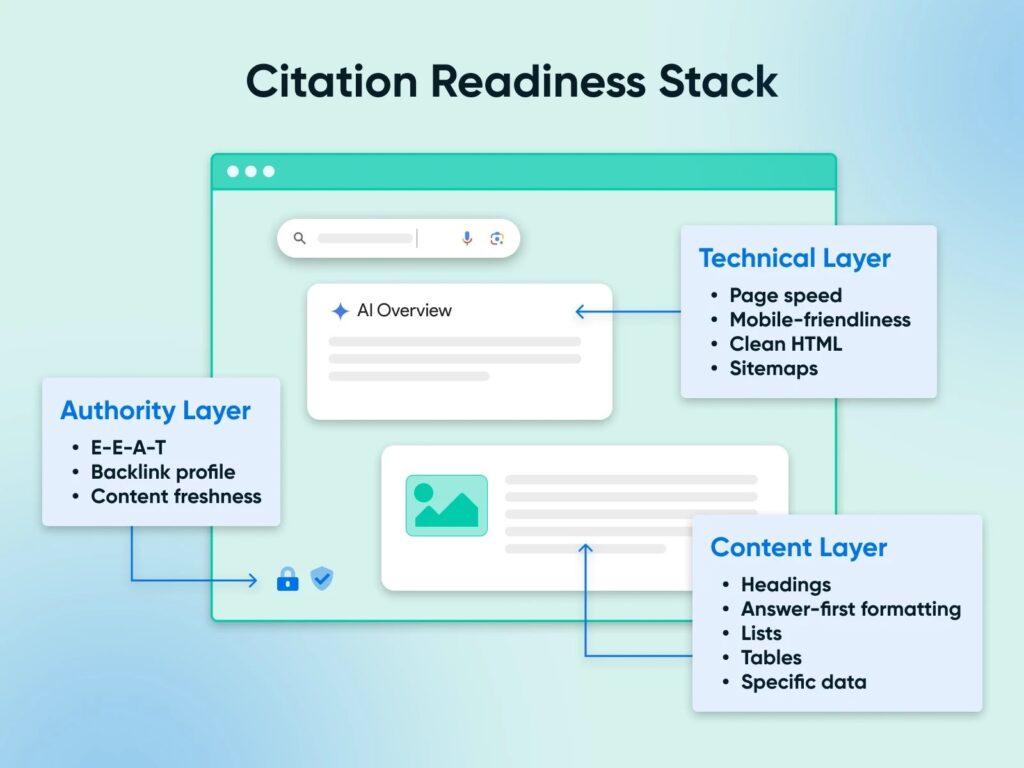
It all comes in a single package.
Implement Schema Markup
This is one of the most important answer engine optimization best practices.
Schema markup refers to the additional HTML data added to an existing page that provides more information to crawlers and AI tools. It helps AI tools better understand your page and its content.
It is primarily used to display visual data such as star ratings, price, and product availability.
Here’s an example of how schema markup enhances the visual appearance of the content in SERPs:
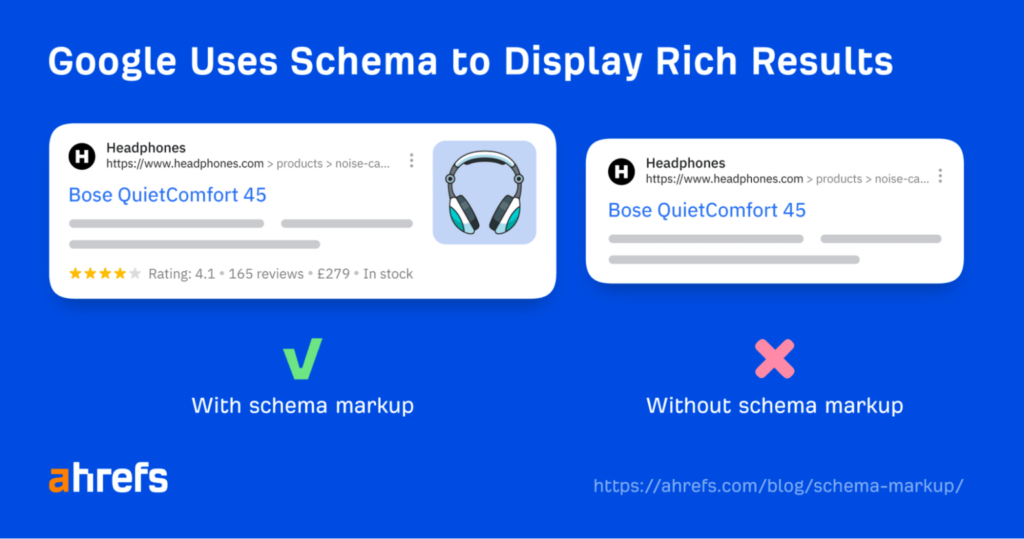
I’m sure you must have seen such visual search results in Google and other search engines.
The schema markup works the same way for answer engine crawlers. It helps them get to know the page’s purpose quickly. It provides them with key details upfront (hence, a high probability of getting citations).
A study of 1,885 pages by Ahrefs found that pages that have schema markup are 3x more likely to get AI citations than pages without schema markup. Up to 53% of pages cited by AI had schema markup:
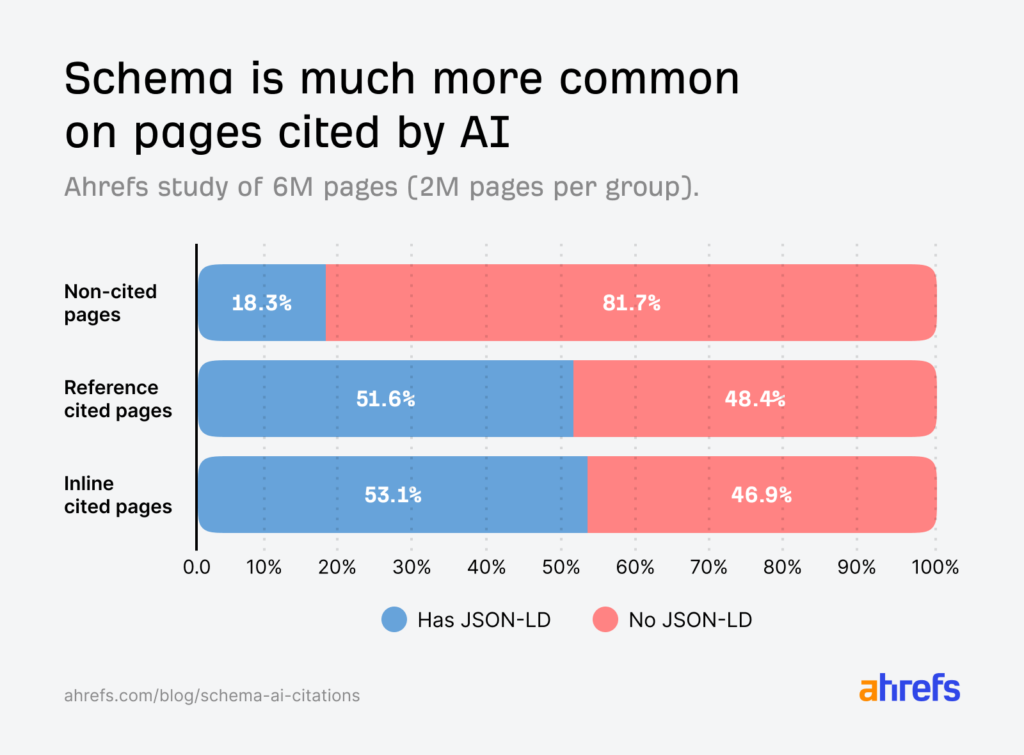
Another study reported that pages having FAQPage schema are 3.2x more likely to get cited by AI Overview in Google.
The reason why answer engines like schema markup is that it makes their job easy. They don’t have to guess. They don’t have to go through the entire page. The key data is available right upfront. This minimizes burden and optimizes their crawl rate.
Best Schema Markups for AI Citations
The good news is that you don’t have to go with all types of schema markups for answer engine optimization. You need to stick with a few major ones that include:
- FAQPage: It works best because it provides quick answers to questions that AI engines can find and cite instantly. This is one of the most common types of schema markups for AI citations.
- HowTo: This is used to tell answer engines that your content is a detailed, step-by-step how-to guide. It is ideal for long-form how-to articles.
- Article: Generally, all types of blog posts have this schema markup unless you change it to something else (like HowTo). It tells AI tools that the content is an article so they can find its author, publication data, and cite it accordingly.
- Person: It is used as a digital ID for authors and persons. AI engines use it to cite individuals based on their relevance. Use it for authors, staff, and other key individuals.
- Product: It tells AI tools details about a product such as its price, rating, inventory, reviews, etc. Products having schema markup are more likely to be cited by AI engines.
- Organization: It guides answer engines about your business with logos, social profiles, overview, etc. This should be used across your site for your business.
- Speakable: It tells AI apps the parts on a web page that are suitable for reading. It is used extensively by AI assistants and speech tools. You should add this schema to major parts and sections on a web page that you want to be read aloud.
- LocalBusiness: Use it if you have a local business. It tells AI engines the name, location, phone number, and other key details of a local business.
Should you use other schemas?
Yes, if you want to.
Should you use other schemas?
Yes, if you want to.
But research shows that these are the ones most commonly used by answer engines for citations. If your primary goal is answer engine optimization, you must stick with these. Add more if you want to but don’t fit all of them unnecessarily.
Don’t overdo it.
Understand Search Intent
Answer engine optimization requires an in-depth understanding of search intent and matching those with the content you are creating.
Each content piece must be aligned with the correct search intent and user goal.
The first step is mapping content structure with the right search intent and then optimizing for answer engines.
Here’s how to do it:
- Informational intent: These content pieces target the top of the funnel where users are interested in getting more information. Give a quick short answer to the query at the start of the content piece.
- Commercial intent: It targets the middle of the funnel and must be supported by side-by-side comparison tables. Use product markup schema to provide AI engines with correct, updated product details.
- Transactional intent: It targets bottom of the funnel users and AI needs detailed, actionable guides with pricing, setup, and usage details.
- Navigational intent: This targets repeat or retained users and it covers detailed how-to articles and support-related queries.
Your content should answer the search query precisely.
However, a single piece of content rarely addresses a single query. It, in most cases, addresses several related search queries across different intents.
For instance, a detailed product guide might have a comparison table (addressing commercial intent), an explanation of how the product is helpful for users (information intent), and it might also cover pricing and product details (targeting transactional intent).
It means you need to optimize content for AI engines accordingly by addressing the right intent at the right section.
This is what makes AI engines cite you as a source, as they can then easily map the text to different search queries.
Branding Consistency
Consistency is a key metric for answer engine optimization. AI tools prefer citing businesses that meet two branding criteria:
- Consistency
- Cross-platform presence.
Your branding has to be consistent and you must have a presence across different platforms.
This is what builds trust, credibility, and authority.
A study of 75K brands revealed that branded web mentions have the highest positive correlation with brand appearance in AI Overview. Branded anchors and branded search volume are in the second and third spot:
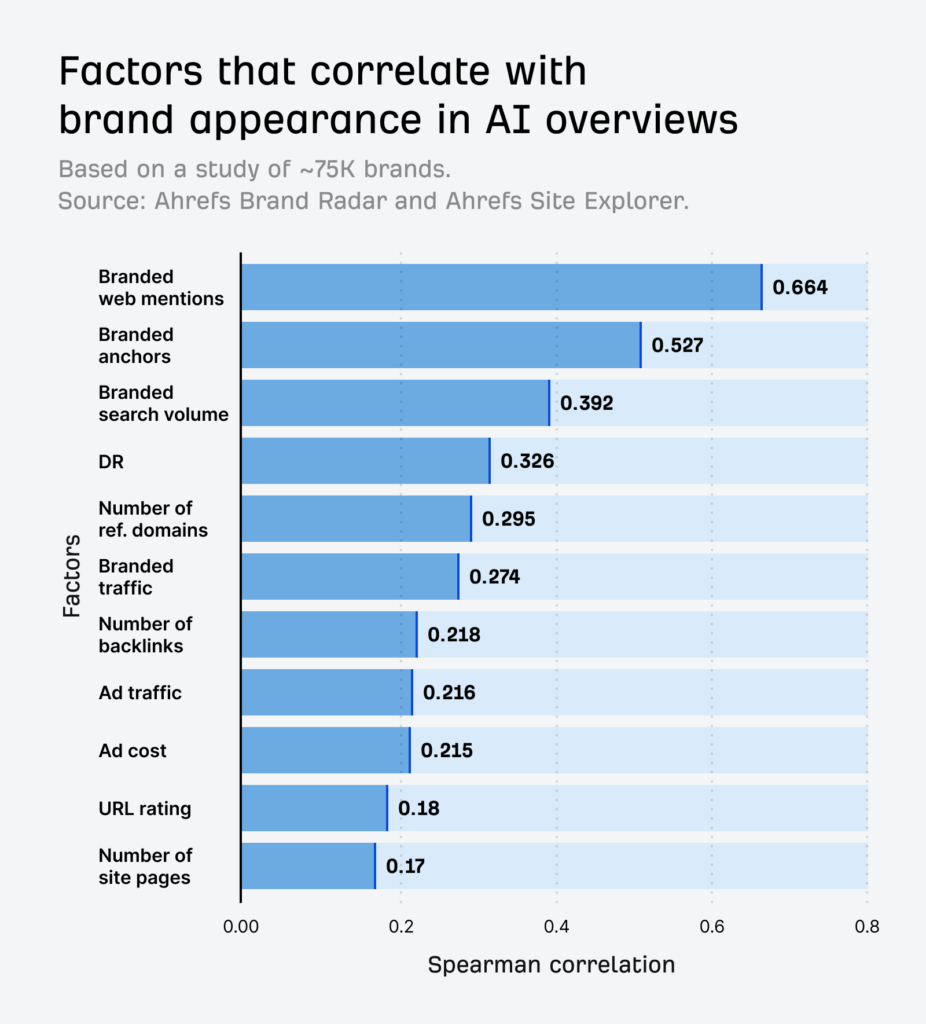
Other off-site factors like domain rating, backlinks, referring domains, etc. have much lower correlation.
Another study reported that Reddit, Wikipedia, G2, and other platforms account for up to 25% of AI citations. Businesses that actively use third-party non-conventional platforms (other than social media) are more likely to get AI citations.
This shows that AI apps prefer brand mentions across platforms. The more you have it, the better.
And it has to be consistent, of course.
Using different brand names or logos will confuse AI crawlers. All branding must be consistent from day one.
Answer Engine Optimization Best Practices for Branding
Follow these guidelines and techniques to ensure your branding is consistent across platforms:
- Create a style guide for your brand from day one and stick with.
- Business name, website, logo, color scheme, address, phone numbers, and other key details must all be consistent.
- Be active on relevant platforms. Go beyond conventional social platforms.
- Find niche forums, review sites, community pages, and other platforms that are consistent with your business and show your presence.
- Enable Google Alerts for your brand name to get notifications whenever your brand is mentioned anywhere. This helps you manage reputation and convert unbranded mentions into links.
- Create a content repurposing strategy. This helps you reformat a single piece of content for different channels and platforms. It helps you maintain your brand presence across platforms and sites.
- Assign team members to engage with the community on Reddit and Quora actively. One day per week is all you need to respond to queries on these platforms.
- Add links to social platforms and relevant sites everywhere. Cross-linking is essential as it helps AI engines find and cite your social platforms.
Final Words
Answer engine optimization isn’t a one-off task. It must be a part of your marketing and SEO strategy.
The techniques covered above will give you a jumpstart right away.
Start monitoring AI citations and references via a tool like Semrush or Ahrefs. These tools track AI citations, pages that are being cited, and queries for which they are cited. This data helps you improve your optimization strategy by figuring out what’s working.
Ideally, you should create automated workflows for AEO. For instance, creating relevant schema markups automatically for every single article. Similarly, repurposing content once it goes live.
These workflows should be integrated into your SEO strategy so that AEO becomes an essential part, not an option.
SEO without AEO is incomplete. It’s time you understand it and take the necessary actions.
Featured Image: Unsplash